Background: Intensifying Global AI Supremacy Race
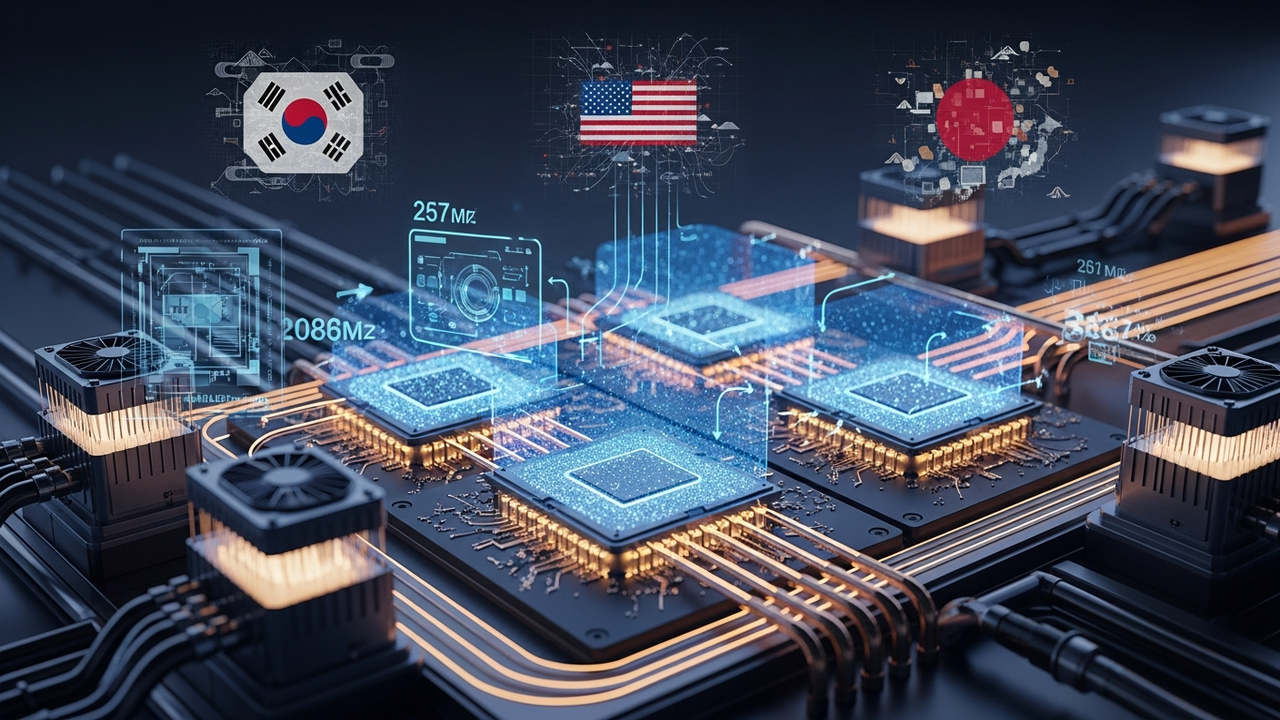
The global race for AI supremacy is escalating, driving nations to seek strategic partnerships that can accelerate technological advancement and secure competitive advantages. In this context, a significant proposal emerged at the “6th Korea-U.S. Industrial Cooperation Conference” held in Seoul: the formation of a “technology alliance” between South Korea, the United States, and Japan. This alliance would focus on advanced industries, particularly semiconductors and energy, recognizing their critical role in the future of AI infrastructure.
Key Findings: Collaborative Development for Energy-Efficient AI Computing
The core of the proposed alliance centers on the joint development of energy-efficient AI computing infrastructure. As AI models grow in complexity and scale, their energy consumption becomes a major environmental and operational cost concern. To address this, the proposal highlights the necessity of establishing a joint research and development platform specifically for computing, energy management, and advanced cooling technologies. Furthermore, it advocates for the creation of a standard consultative body to harmonize technical specifications and best practices across the three nations.
- Proposal for a Korea-U.S.-Japan “technology alliance” in semiconductors and energy.
- Emphasis on joint development of energy-efficient AI computing infrastructure.
- Call for a joint R&D platform and standard consultative body for computing, energy, and cooling technologies.
- Recommendation for an “Asian version of Imec” to develop cost-effective AI data center systems and memory.
Technical Significance & Outlook: The ‘Asian Imec’ Concept
Experts at the conference further elaborated on this vision by recommending the establishment of an “Asian version of Imec.” Imec, headquartered in Belgium, is a world-leading research and innovation hub in nanoelectronics and digital technologies. An “Asian Imec” would aim to replicate this collaborative research model, fostering joint development of cost-effective AI data center-specific systems and high-performance memory semiconductors. This initiative is technically significant as it pools resources and expertise from three leading technology nations, potentially accelerating breakthroughs in areas like power-efficient chip architectures, advanced packaging, and novel cooling solutions essential for sustainable AI growth. The outlook suggests that such a trilateral alliance could create a powerful innovation ecosystem, enabling the partner countries to collectively set new benchmarks for AI hardware efficiency and address the increasing energy demands of future AI deployments, thereby strengthening their leadership in the global AI landscape.