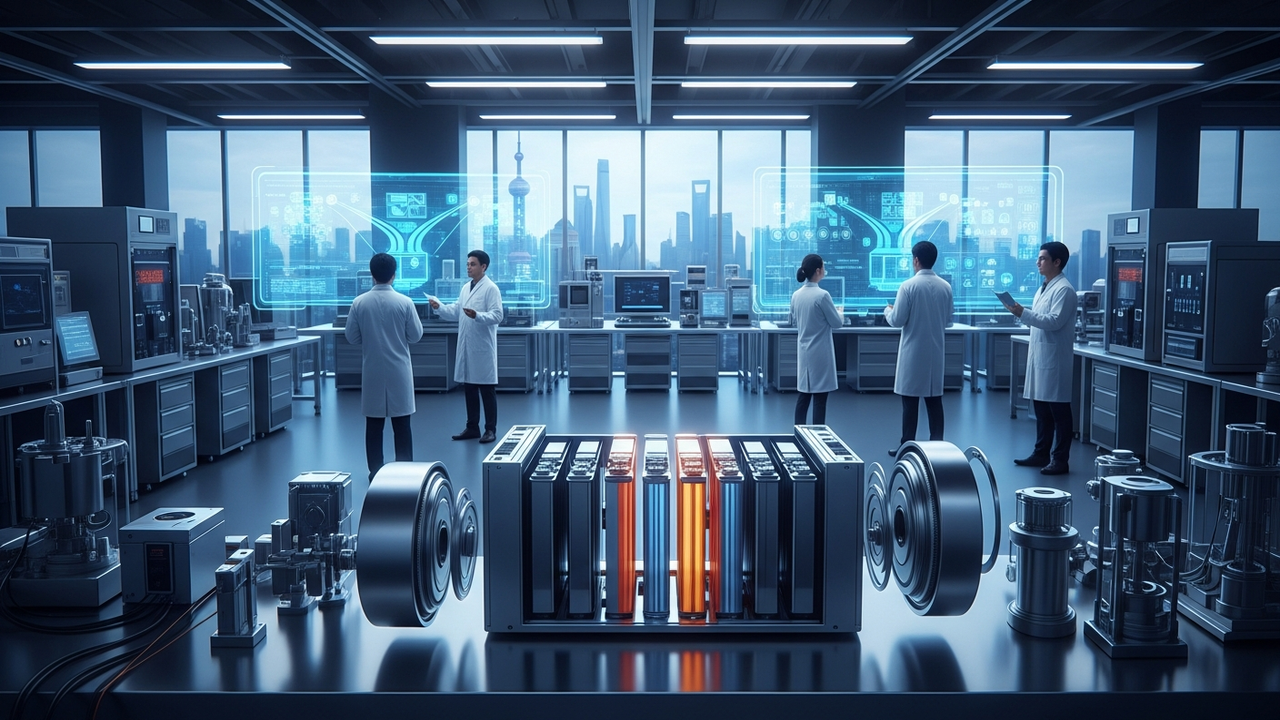
Current State of the Solid-State Battery Market at CIBF2026
The China International Battery Fair (CIBF) 2026 served as a crucial platform for showcasing the latest trends in solid-state battery (SSB) technology. The exhibition clearly indicated that the industry views the transition to solid-state as a “mandatory” strategic objective. However, it also revealed a fragmented landscape, with major technological pathways—including sulfide, oxide, polymer, and semi-solid batteries—still diverging without a unified direction. The prevalent presence of products in the sample verification stage suggests that full-scale commercial mass production is yet to be widely achieved, reflecting the ongoing developmental challenges.
Key Company Announcements and Moves Towards Mass Production
Several companies made notable technological announcements at CIBF2026. Particularly, Sinoma Science & Technology showcased a 20μm thick composite skeleton-supported sulfide all-solid-state electrolyte membrane. The company positioned this membrane as the “world’s first scalable for mass production” and highlighted its direct compatibility with existing liquid electrolyte battery manufacturing lines. Such compatibility holds immense potential for reducing manufacturing costs and lowering adoption barriers, which are critical for accelerating the market introduction of SSBs. Beyond battery material developers, numerous equipment manufacturers also presented new technologies and specialized equipment for SSB mass production, including dry electrode equipment, solid electrolyte coating lines, and precision calendering machines, demonstrating innovation across the entire supply chain.
Technical Challenges and Future Outlook
Despite the rapid advancements, significant technical challenges persist for the full commercialization of solid-state batteries. These include reducing interfacial resistance, suppressing dendrite growth, extending cycle life, and further lowering manufacturing costs. Sulfide electrolytes are attractive for their high ionic conductivity but are sensitive to atmospheric moisture. Oxide systems offer superior stability but tend to have lower ionic conductivity. Semi-solid batteries are also being explored as an intermediate solution. CIBF2026 underscored China’s leadership in SSB development while also reflecting the intensifying competition among different technological pathways to establish dominance. The coming years will be crucial in determining how these technologies evolve and which pathways will emerge as mainstream in the market.


Comments