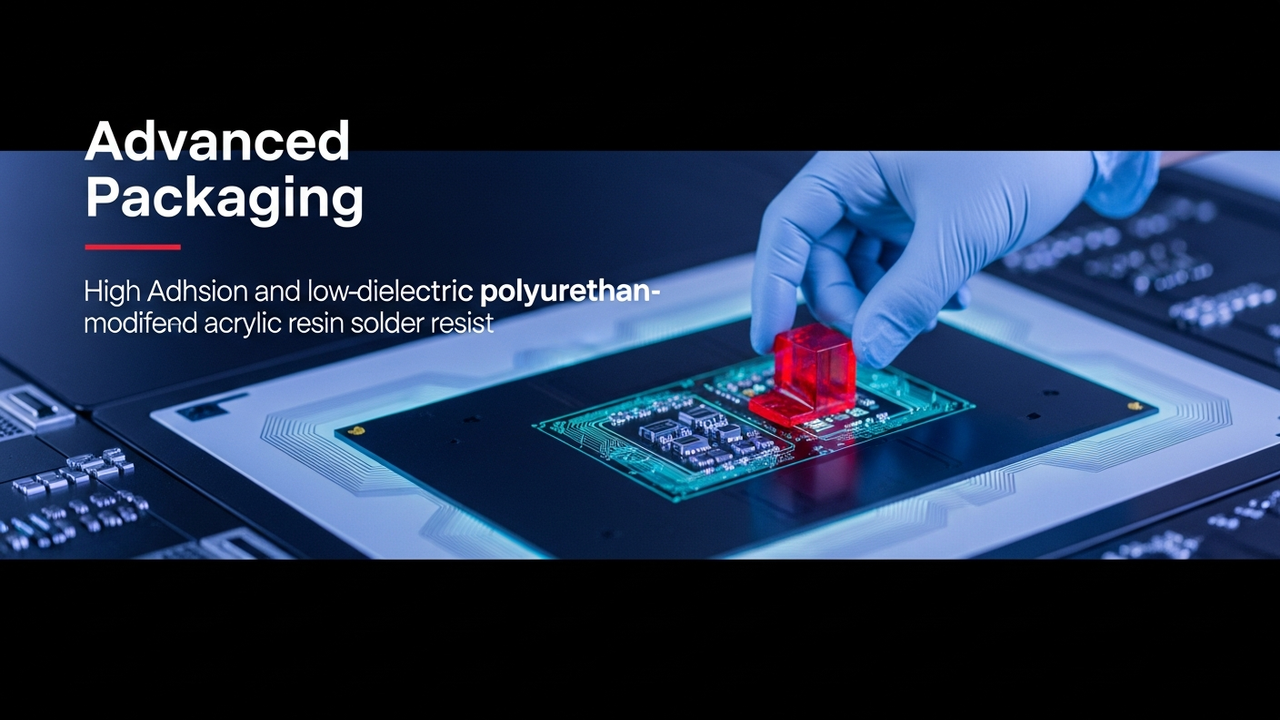
Background: High-Density Electronics and the Role of Solder Resists
Recent advancements in electronic devices, driven by the evolution of smartphones, high-performance servers, and IoT devices, demand ever-increasing miniaturization, higher density, and higher operating frequencies. Consequently, semiconductor packaging technology, particularly solder resists (solder mask protective films) on printed circuit boards (PCBs), requires increasingly sophisticated performance. Beyond basic functions like preventing circuit shorts, flux adhesion, and physical/chemical protection, solder resists now critically need high adhesion for fine line patterning and low dielectric loss for high-speed signal transmission. Traditional materials have struggled to meet these combined demands, making novel material design an urgent necessity.
Key Findings: Innovation in Polyurethane-Modified Acrylic Resins
This research proposes a new type of solder resist based on polyurethane-modified acrylic resin, designed to meet the stringent requirements of advanced packaging. The innovation of this material design lies in the following points:
- High Adhesion: Introducing the flexibility and excellent adhesion properties of polyurethane into the acrylic resin backbone achieves strong adhesion to copper traces and various substrate materials. This reduces the risk of delamination on fine circuit patterns, improving process stability and reliability.
- Low Dielectric Properties: Optimizing the molecular structures of both acrylic resin and polyurethane components reduces the dielectric constant and dielectric tangent (dielectric loss). This minimizes signal attenuation and delay in high-frequency signal transmission, ensuring stability for high-speed data communication, particularly in millimeter-wave applications.
- Mechanical and Chemical Stability: Enhanced resistance to high-temperature exposure during the soldering process and to chemical agents in manufacturing and operational environments, maintaining its protective function as a solder resist over the long term.
- Photolithographic Suitability: Retains photosensitive resin characteristics, allowing for fine pattern formation using conventional photolithography processes. This facilitates compatibility with high-density wiring designs.
These properties are achieved by precisely controlling the balance between the soft segments of polyurethane and the hard segments of acrylic resin, maximizing the synergistic effects of combining their respective advantages.
Technical Significance & Outlook: Enhancing Next-Generation Electronic Device Performance
The development of this polyurethane-modified acrylic resin solder resist is expected to play a crucial role in next-generation high-performance electronic devices, especially in advanced packaging for 5G/6G communication modules, AI processors, and high-frequency millimeter-wave radars. High adhesion improves package reliability, while low dielectric properties dramatically enhance data transmission speed and efficiency.
This advancement in material technology will enable further miniaturization and functional integration of electronic components, contributing to the realization of higher-performance and more energy-efficient devices. The research findings represent a concrete example of innovation through the fusion of materials science and electronics engineering, forming a foundational technology that will support the future development of the electronics industry. Future directions include applications in even harsher environments and emerging fields like flexible electronics.







Comments