Background
With the escalating global warming crisis, technologies for converting emitted CO2 into valuable fuels or chemical feedstocks (CO2 electroreduction) have become a critical research area for building sustainable energy systems. High selectivity and efficiency in methane (CH4) production are particularly sought after, given its potential for use as natural gas and its broad applications as a chemical feedstock. Historically, challenges have included the reliance on expensive noble metal catalysts, low selectivity, or excessive energy input. The F1-CQDs developed in this study, based on inexpensive carbon materials, demonstrate performance comparable to or exceeding noble metal catalysts, representing a significant step towards addressing these challenges.
Key Findings
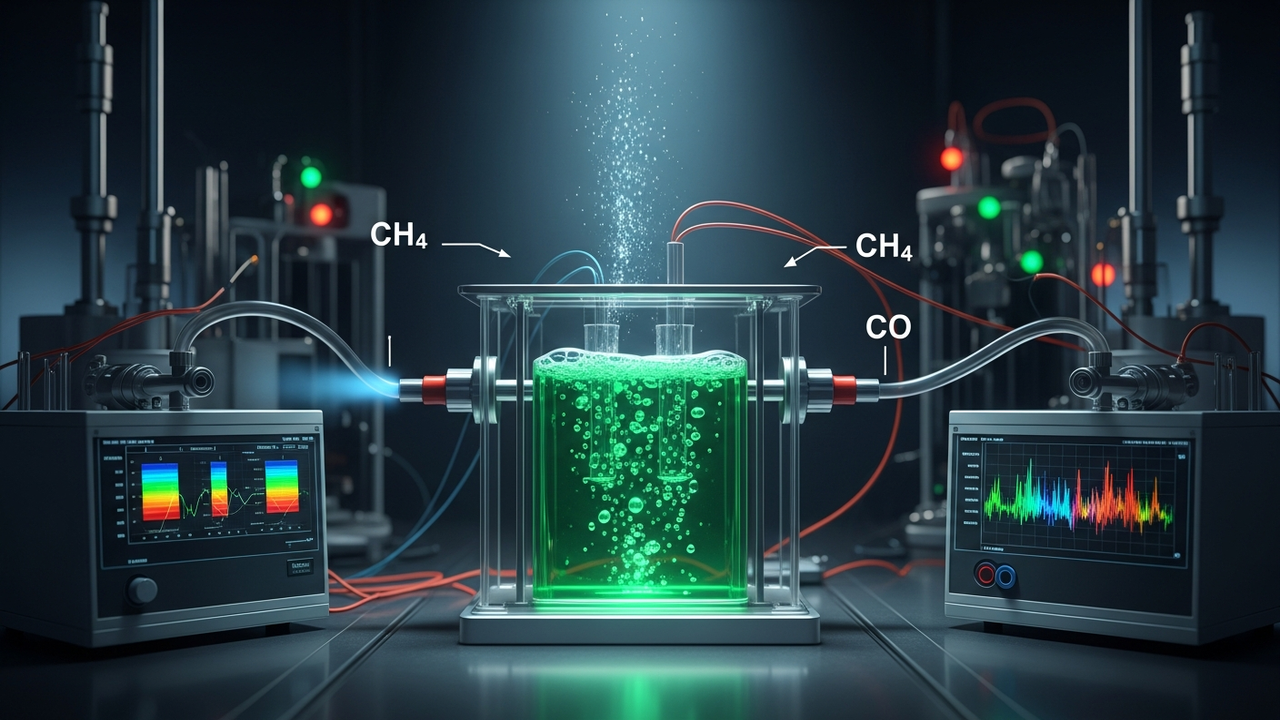
In the selective electroreduction of CO2 to CH4, researchers have developed fluorine-rich carbon quantum dots (F1-CQDs) containing up to 28.8 at.% fluorine, demonstrating exceptional catalytic performance. Under flow cell conditions, this catalyst achieved a high CH4 Faraday efficiency of 63.2% and a CH4 partial current density of 210.8 mA cm⁻², significantly enhancing the efficiency of converting CO2 into a valuable chemical.
Technical Details
The superior performance of these F1-CQDs is attributed to their unique electronic structure. Detailed analysis combining in situ spectroscopy and density functional theory (DFT) calculations revealed that the semi-ionic C-F bonds within F1-CQDs act as Lewis base sites, stabilizing CO2 reduction intermediates. These sites not only promote the adsorption and activation of CO2 molecules but also facilitate water activation and the transient formation of active hydrogen (*H) at adjacent carbon sites. This precise modulation of hydrogen dynamics favors the selective conversion pathway from CO2 to CH4, effectively suppressing competing hydrogen evolution reactions (HER). While conventional catalysts often suffer from low CH4 selectivity due to competitive CO2 and H2O reactions, F1-CQDs overcome this challenge by optimizing the hydrogen activation pathway via C-F bonds.
Strategic Significance & Outlook
The F1-CQDs technology holds great potential for accelerating CO2 emission reduction and renewable energy integration. Future efforts will focus on evaluating the long-term stability of this catalyst, developing scalable production processes, and demonstrating its performance under actual industrial conditions. Further precise control over fluorine incorporation methods and the local electronic state of fluorine atoms could also lead to research aimed at enhancing selectivity for specific hydrocarbons other than CH4. This breakthrough is expected to contribute to the advancement of carbon recycling technologies and pave the way for sustainable chemical processes, ultimately aiding in the transition away from fossil fuel dependence.