Key Findings
Engineers from Intel Foundry presented groundbreaking research at ECTC 2026 on advanced packaging technologies set to redefine the future scalability limits of Artificial Intelligence (AI) and High-Performance Computing (HPC). They demonstrated the scaling of EMIB-T packaging technology, enabling larger package sizes and the integration of more compute and memory resources. Notably, innovative advancements in Co-Packaged Optics (CPO) were unveiled, featuring high-performance detachable edge optical connectors and a novel V-groove-based edge-coupled glass capillary interface for robust, energy-efficient, high-bandwidth AI scale-up networks. These technologies represent critical steps in the evolution of optical interconnects to meet the exponential growth of AI workloads.
Technical / Clinical Details
The key technological innovations presented include:
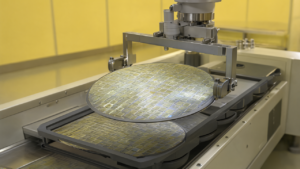
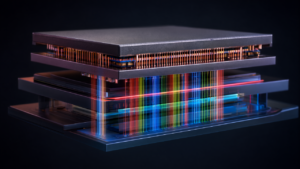
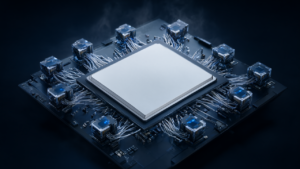
- Scaling of EMIB-T Packaging: EMIB (Embedded Multi-die Interconnect Bridge) is Intel’s proprietary technology for integrating multiple dies within a single package. EMIB-T advances this technology further, allowing for larger package sizes and the integration of more compute and memory dies. This will enhance the performance and density of AI accelerators and HPC processors.
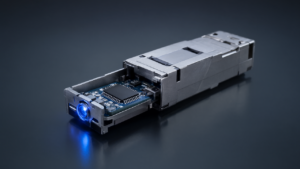
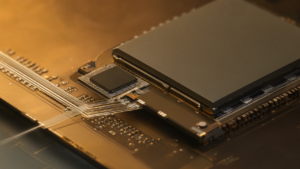
- High-Performance Detachable Edge Optical Connectors: As CPO adoption accelerates, the connection between optical engines and external fibers becomes paramount. The new detachable connectors provide high-precision and robust connections, facilitating maintenance and upgrades in data centers while preserving optical performance.
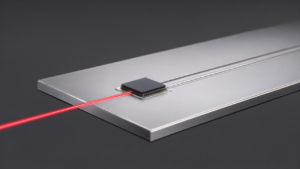
- V-Groove-Based Edge-Coupled Glass Capillary Interface: This novel interface represents an innovative approach to efficiently couple optical signals from the chip to the fiber. By utilizing glass capillaries and V-groove structures, it achieves low insertion loss and high reliability, improving the power efficiency and signal integrity of CPO modules. This is essential for resolving data transfer bottlenecks and reducing power-per-bit in AI scale-up networks.
These advancements offer comprehensive solutions to overcome the bandwidth, power, and thermal constraints faced by AI and HPC systems.
Background & Context
The demands of AI and HPC applications continue to push the limits of data movement and computational power. Traditional electrical interconnects are encountering bottlenecks in terms of power consumption, latency, and physical scalability, making the transition to optical communication technologies imperative. CPO, which positions optical engines in close proximity to compute chips, is widely recognized as a promising solution to address these challenges. Industry leaders like NVIDIA are also heavily investing in and adopting optical interconnects for AI clusters, making advanced packaging technologies a key determinant of next-generation data center performance.
Strategic Significance & Outlook
These advanced packaging technologies presented by Intel Foundry at ECTC 2026 are crucial for elevating AI and HPC scalability to the next level. Specifically, the detachable optical connectors and new optical coupling interfaces in CPO will accelerate the deployment of optical interconnects, contributing to the realization of more flexible and maintainable data center infrastructures. This will enable AI workloads to be processed faster and more efficiently, accelerating innovation in a wide range of fields, including autonomous systems, scientific simulations, and large language models. These innovations from Intel are laying critical foundations for driving computing in the AI era.