Key Findings
At ISC High Performance 2026, Q.ANT announced the development of innovative photonic analog processors that utilize light instead of electrons. Specifically, the company’s photonic AI chip pilot line, based on thin-film lithium niobate (TFLN), offers significantly more energy-efficient computing and higher computational density compared to conventional electronic processors, across fields such as AI inference and training, advanced image processing, and scientific simulations. This technology aims to provide a blueprint for increasing data center capacity and cost-effectively modernizing chip production processes worldwide.
Technical / Clinical Details
The core of Q.ANT’s photonic analog processor is its thin-film lithium niobate (TFLN) platform. TFLN’s excellent electro-optical properties enable high-speed and efficient optical signal processing.
- Photonic Analog Computing: This chip performs computations using analog properties of light, such as amplitude and phase, rather than digital 0s and 1s. This bypasses the thermal generation and power consumption bottlenecks faced by traditional electronic chips, enabling high-speed and low-energy operations.
- High Energy Efficiency: Optical signals have lower transmission losses than electrical signals, allowing vast computational processing, essential for AI workloads, to be performed with less power. This significantly contributes to reducing data center operational costs and environmental impact.
- High Computational Density: By leveraging the high integration density of TFLN and the parallel processing capabilities of light, more computational resources can be accommodated within the same footprint, thereby enhancing data center processing power.
- Application Areas: It contributes to accelerating AI inference and training, especially for large language models (LLMs) and generative AI. Furthermore, it is expected to find applications in advanced image processing for medical diagnostics and defense, as well as scientific simulations of complex physical phenomena, among other fields.
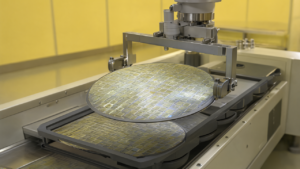
This pilot line represents a crucial step towards the mass production of future photonic AI chips.
Background & Context
The explosive growth of AI continues to push the limits of computational power and energy efficiency in data centers. Traditional electronic chips are approaching the limits of Moore’s Law, and issues of power consumption and heat generation are becoming severe. In this context, photonic computing is rapidly gaining attention as a promising alternative for next-generation AI accelerators. In Europe, initiatives like PhotonDelta aim to strengthen the photonics industry supply chain and enhance regional manufacturing capabilities. Q.ANT’s technology, particularly in the realm of analog computing, is paving a new path in this global competition, addressing both energy efficiency and performance.
Strategic Significance & Outlook
Q.ANT’s thin-film lithium niobate photonic AI chip pilot line has the potential to significantly impact the future of AI computing. If this technology is commercialized, data centers will be able to perform more computations with less power, reducing AI training costs and improving accessibility. Furthermore, this pilot line provides a concrete model for cost-effectively modernizing chip production worldwide, accelerating the industrialization of photonic technology. Q.ANT’s efforts represent a crucial step towards achieving both sustainability and high performance in AI-era computing, contributing to the further development of AI and the exploration of new application areas.