Key Findings
HyperLight Corp. has successfully developed state-of-the-art optical modulators utilizing thin-film lithium niobate (LNOI) technology, achieving ultra-low power operation. These modulators demonstrate an astonishingly low drive voltage of just 0.5V and an energy consumption of less than 1 fJ/bit, representing an order-of-magnitude improvement in efficiency compared to conventional modulators. Furthermore, they combine an extremely wide bandwidth exceeding 110GHz with exceptionally low optical loss of less than 0.1dB/cm, positioning them as a transformative solution for overcoming energy efficiency bottlenecks in next-generation high-speed optical communication and AI computing.
Technical / Clinical Details
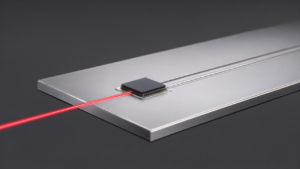
Thin-film lithium niobate is considered an ideal material for high-efficiency and high-speed optical modulators due to its superior electro-optic properties. HyperLight Corp. has leveraged advanced nanoscale fabrication techniques to significantly reduce the size of these modulators, minimizing both drive voltage and energy consumption. This technology fully exploits the strong electro-optic effect inherent in lithium niobate while overcoming the integration challenges historically associated with bulk lithium niobate devices. Specifically, these modulators are readily integrable into high-density photonic integrated systems, enabling high-speed and low-power control of optical signals.
Background & Context
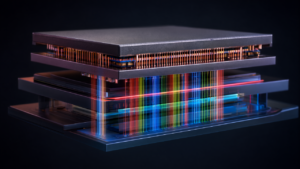
In data centers and AI supercomputers, as data transfer rates increase, the power consumption of optical modulators has become a dominant factor influencing overall system energy efficiency. Current silicon photonics-based modulators, while effective, still incur notable power consumption. HyperLight Corp.’s LNOI modulators address this by drastically reducing power usage, thereby supporting the expansion of AI workloads from a power perspective. This technology is closely aligned with industry trends such as Co-Packaged Optics (CPO) and Near-Packaged Optics (NPO), championed by companies like NVIDIA, which aim to accelerate the integration of optical and electronic circuits. It holds the potential to become a core technology for next-generation AI infrastructure.
Strategic Significance & Outlook
The ultra-low-power LNOI optical modulators developed by HyperLight Corp. are poised to revolutionize AI computing, high-speed data center interconnects, and on-chip optical communication. Widespread adoption of this technology could not only significantly reduce the operational costs and environmental footprint of data centers but also enable the integration of high-performance optical communication functionalities into power-constrained applications such as edge AI devices and autonomous vehicles. In the future, this low-energy modulation technology is expected to facilitate the realization of more complex and larger-scale photonic integrated circuits, further advancing the practical implementation of optical computing.