Key Findings
A research team at the Massachusetts Institute of Technology (MIT) has successfully achieved the world’s first direct visualization of the complex chemical reaction sequence that occurs when carbon dioxide (CO2) is injected into cement paste as it hardens. This pioneering observation represents a crucial step towards deeply understanding the fundamental chemistry of CO2-injected concrete technology, which aims to both store CO2 and enhance concrete strength.
Technical / Clinical Details
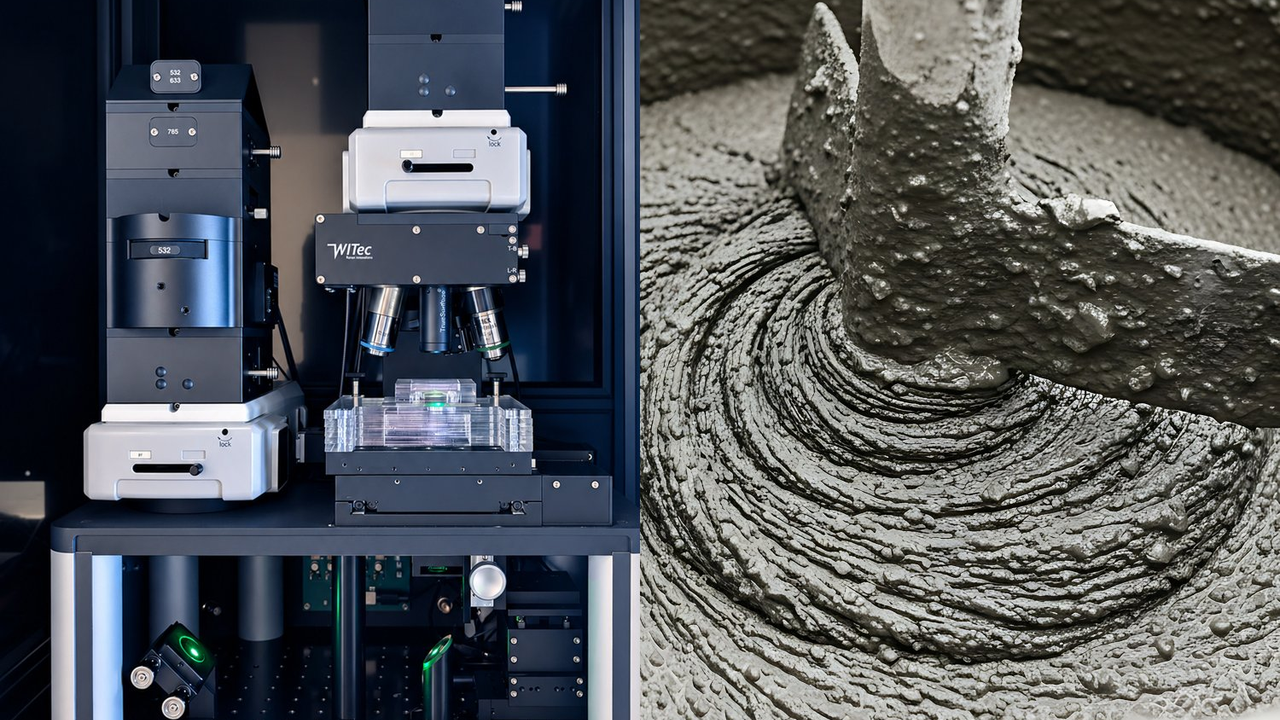
The research team employed advanced spectroscopic analysis techniques, specifically Raman confocal microscopy, to observe the chemical changes occurring in real-time and at high resolution after CO2 contacts fresh cement paste. This enabled them to track, at a molecular level, the process of CO2 reacting with calcium hydroxide (Ca(OH)2) in cement to form calcium carbonate (CaCO3)—known as carbonation reaction—along with the formation of other hydration products and the overall structural changes within the cement matrix. This direct visualization elucidated detailed mechanisms of how carbonation contributes to the cement’s setting process and strength development, and how CO2 is incorporated into the cement’s microstructure. These insights provide new knowledge for predicting and optimizing the performance of CO2-injected concrete.
Background & Context
Concrete is the most widely used construction material globally, but the production of its primary component, cement, is a major contributor to global CO2 emissions, accounting for approximately 8% of the total. As mitigating CO2 emissions becomes an urgent priority in addressing climate change, ‘CO2-injected concrete’ technology, which stores CO2 within construction materials, is gaining attention as an effective solution. However, to maximize the potential of this technology, a fundamental understanding of the chemical and physical mechanisms by which CO2 affects cement properties was indispensable. MIT’s current research significantly deepens this fundamental understanding, holding crucial implications for accelerating the practical implementation and widespread adoption of CO2-injected concrete.
Strategic Significance & Outlook
These research findings will have a significant impact on the development of sustainable construction materials. Designers of CO2-injected concrete can now leverage this new knowledge to optimize formulations and processes that more efficiently store CO2 while simultaneously enhancing concrete strength and durability. In the future, this is expected to accelerate technological innovations towards achieving net-zero or even carbon-negative concrete, significantly reducing the environmental footprint of the entire construction industry. Furthermore, this real-time visualization technique could be applied to research on chemical reactions and material degradation in other areas of materials science, potentially opening new avenues for material discovery.
Source: https://news.mit.edu/2026/carbon-dioxide-rewires-how-cement-sets-0611