Key Findings
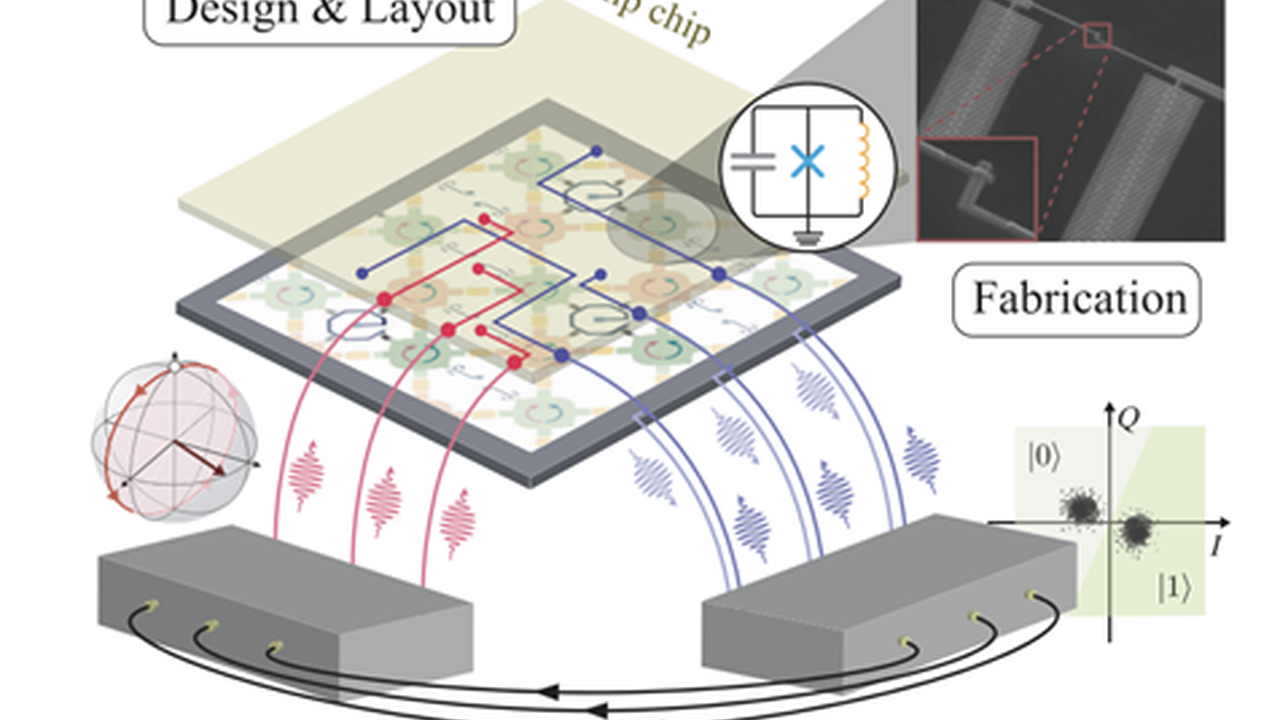
The U.S. Department of Energy has announced a groundbreaking advancement poised to shape the future of quantum computing: the development of a blueprint for a new high-performance quantum processor architecture built upon ‘artificial atoms’ called fluxonium qubits. This design promises both high fidelity and scalability, outlining a crucial path forward for the construction of next-generation quantum computers.
Technical Details
Fluxonium qubits are artificial atoms created using superconducting circuits, with their defining characteristic being exceptional controllability. This property allows fluxonium qubits to potentially achieve longer coherence times and lower error rates compared to many other types of superconducting qubits and even trapped-ion qubits. The architecture developed by the research team presents design principles for effectively integrating these fluxonium qubits and enabling them to interact. This includes mechanisms for precisely tuning coupling strengths between qubits and control layouts for efficiently executing complex quantum circuits. This blueprint offers a concrete approach for performing high-fidelity quantum gate operations at scale, thereby strengthening the hardware foundation required for the realization of fault-tolerant quantum computing.
Background and Industry Context
The evolution of quantum computing is heavily dependent on qubit performance (coherence time, fidelity) and scalability. To date, superconducting qubits (e.g., IBM’s transmons) and trapped-ion qubits (e.g., IonQ’s ion traps) have been developed as primary modalities, each facing its own challenges in scaling and error correction. Fluxonium qubits emerge as a promising new candidate to overcome some of these challenges, and their development diversifies quantum hardware options, promoting long-term progress. This research by the U.S. Department of Energy is part of a national strategy to maintain U.S. leadership in quantum technology and build the foundation for future innovation.
Strategic Significance and Outlook
This blueprint for a processor architecture based on fluxonium qubits will have a significant impact on the design and construction of next-generation quantum computers. Researchers will now proceed with developing concrete prototypes and experiments to realize this blueprint in actual hardware. If successful, this technology could form the basis for more powerful and reliable quantum computers capable of solving computational problems previously impossible across a wide range of fields, including drug discovery, materials science, financial modeling, and artificial intelligence. The combination of high fidelity and scalability is a critical step for quantum computing to transition from the laboratory stage to practical commercial applications.