Explosive Growth of AI Data Centers and Demand for Optical Modules
The exponential proliferation of generative AI is accelerating the construction of hyperscale AI data centers, leading to a surge in demand for ultra-high-speed optical transceivers like 800G and 1.6T. TrendForce forecasts an increase in 800G+ optical transceiver shipments from approximately 24 million units in 2025 to 63 million in 2026, with 1.6T-related demand projected to double or triple in 2026. To meet such demands, the development and deployment of Co-Packaged Optics (CPO) and high-bandwidth pluggable transceivers are underway.
Limitations of Silicon Photonics and the Indispensability of InP
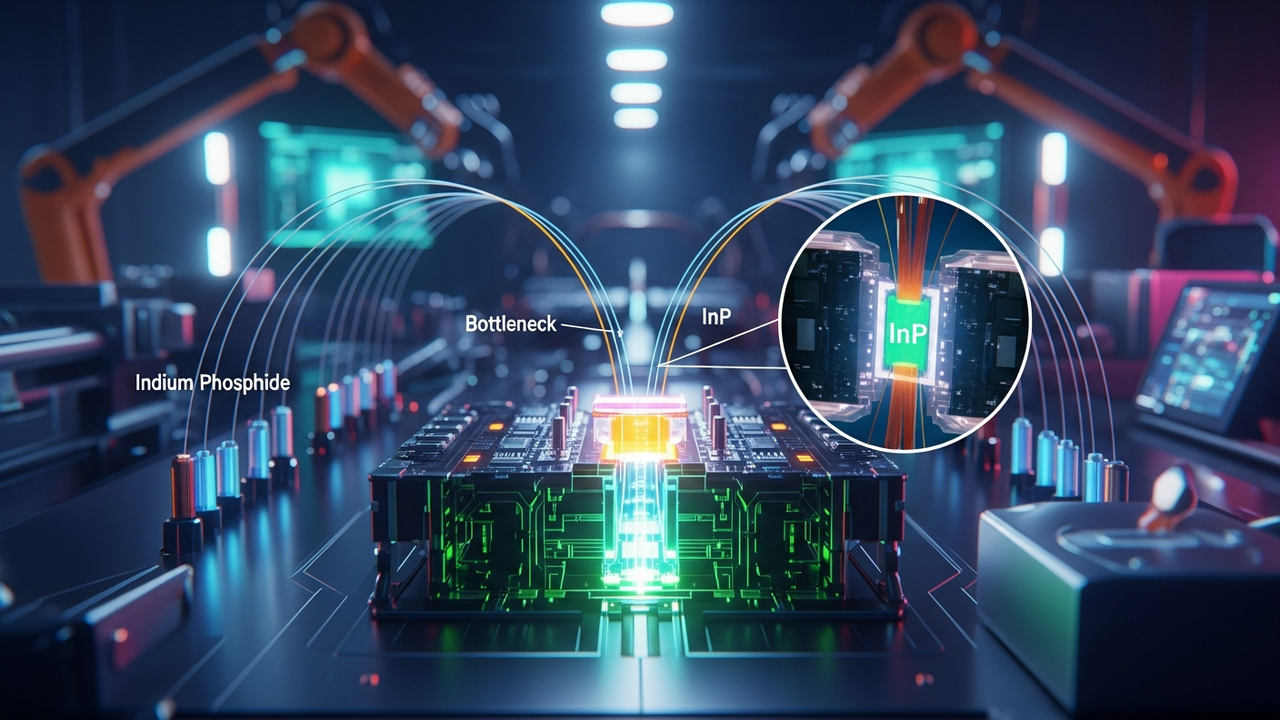
While silicon photonics (SiPh) is garnering attention as the foundation for integrated optical circuits, silicon inherently cannot emit light. Therefore, an external light source is crucial for generating optical signals, and currently, Indium Phosphide (InP)-based lasers fulfill this role. InP lasers provide high output, reliability, and high-speed modulation capabilities essential for CPO and NPO architectures, making them indispensable components for enhancing AI data center performance. However, the supply capacity of these InP lasers is being identified as the primary bottleneck—the ‘true chokepoint’—for optical modules in AI applications.
Bottlenecks in InP Supply Chain and Major Players’ Responses
Specifically, Electro-Absorption Modulated Lasers (EMLs) at 200G/lane, required for 1.6T pluggable optical transceivers, are currently volume-supplied solely by Lumentum. To address this supply constraint, NVIDIA has reportedly entered into a pre-contract with Lumentum to secure EML supply capacity for 2027 and beyond. Coherent is also making significant investments to expand supply, planning to double InP production capacity in 2026 and again in 2027, including the industry’s first transition to 6-inch InP wafers. Nevertheless, expanding InP wafer production capacity, particularly for EMLs, is an urgent need, and resolving the overall supply chain bottleneck is anticipated to take several years.
Industry Impact and Future Outlook
This InP supply shortage directly impacts the construction speed and costs of AI data centers, posing a potential risk that could impede the explosive growth of AI infrastructure. For optical device manufacturers, increasing production and technological development of InP-related components is an urgent challenge, while for AI data center operators, it represents a procurement risk. Moving forward, strengthening the entire InP supply chain, developing alternative technologies, and diversifying material and component supply will be crucial for ensuring the sustainable growth of the AI-era optical communications industry.








Comments