
Background and Technical Challenges
All-solid-state batteries (ASSBs) are leading candidates for next-generation battery technology, promising high safety, long lifespan, and high energy density. However, their commercialization faces several significant hurdles. Specifically, ‘interfacial resistance’ between the solid electrolyte and electrodes has been a major factor hindering efficient lithium ion transfer and degrading battery performance. While oxide-based solid electrolytes offer high chemical stability, their inherent rigidity leads to poor adhesion with electrodes and often requires external pressure during operation, complicating battery pack design and increasing manufacturing costs. Low compatibility with existing lithium-ion battery production equipment has also been a barrier to large-scale ASSB mass production.
Key Findings and Technical Breakthroughs
ProLogium Technology, a Taiwanese all-solid-state battery startup, has developed a proprietary ‘All-Inorganic Super Flow’ solid electrolyte technology to overcome these challenges. This innovative approach features groundbreaking characteristics:
- ‘Super Flow’ Solid Electrolyte: Successfully resolved the major weakness of oxide-based solid electrolytes—interfacial resistance—without requiring external pressure. This is attributed to achieving a ‘super flow’ state where the solid electrolyte smoothly conducts lithium ions across the electrode surface, akin to a liquid. This fundamentally resolves the issue of poor contact between solids.
- Ultra-Fast Charging: Achieved ultra-fast charging performance, capable of charging to 80% in just 5 minutes. This has the potential to reduce EV charging times to a level comparable to gasoline refueling.
- High Ionic Conductivity: ProLogium’s solid electrolyte is reported to have astonishing ionic conductivity, 5-6 times higher than sulfide-based or liquid electrolytes.
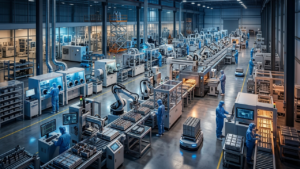
- PCR Framework: Established a ‘PCR (Production Cost Reduction) framework’ that allows over 70% reuse of existing lithium-ion battery production equipment. This significantly reduces manufacturing costs and environmental impact for all-solid-state batteries, lowering the barrier to mass production.
ProLogium is pursuing strategic partnerships with major automotive companies like Mercedes-Benz and is constructing Europe’s first gigafactory (Fab 1) in France (targeting operation in 2028). These moves indicate that the company’s technology is entering the commercial validation phase.
Technical Significance and Outlook
ProLogium’s ‘All-Inorganic Super Flow’ all-solid-state battery technology holds the potential to revolutionize not only the EV market but also a wide range of sectors including robotics, aerospace, and consumer electronics. In particular, the characteristic of not requiring external pressure dramatically increases battery pack design freedom and contributes to overall system weight reduction and simplification. The cost reduction strategy via the PCR framework is also crucial for accelerating the adoption of all-solid-state batteries.
This technology, with its high energy density, ultra-fast charging, and superior safety, will alleviate range anxiety in EVs and reduce dependence on charging infrastructure, paving the way for a future of sustainable mobility. Future challenges include ensuring the French gigafactory proceeds as planned, maintaining performance in large-scale mass-produced cells, and further cost reductions. Nevertheless, ProLogium’s technology will continue to attract attention as one of the most promising paths to the practical implementation of all-solid-state batteries.





Comments