Background
Thermoelectric materials are expected to play an indispensable role in achieving a sustainable society as technologies that directly convert thermal energy into electrical energy, for applications such as waste heat recovery systems and solid-state refrigerators. The performance of these materials is evaluated by the dimensionless figure of merit (ZT value), with higher ZT values indicating higher conversion efficiency. The ZT value depends on three key physical quantities: the Seebeck coefficient (S), electrical conductivity (σ), and thermal conductivity (κ). An ideal thermoelectric material must simultaneously possess high S and σ, and low κ. However, these are often contradictory properties, making their optimal balance the greatest challenge in material design. Notably, materials with layered structures are attracting attention in thermoelectric material research due to their ability to individually control these properties more easily through crystal anisotropy.
Key Findings / Results
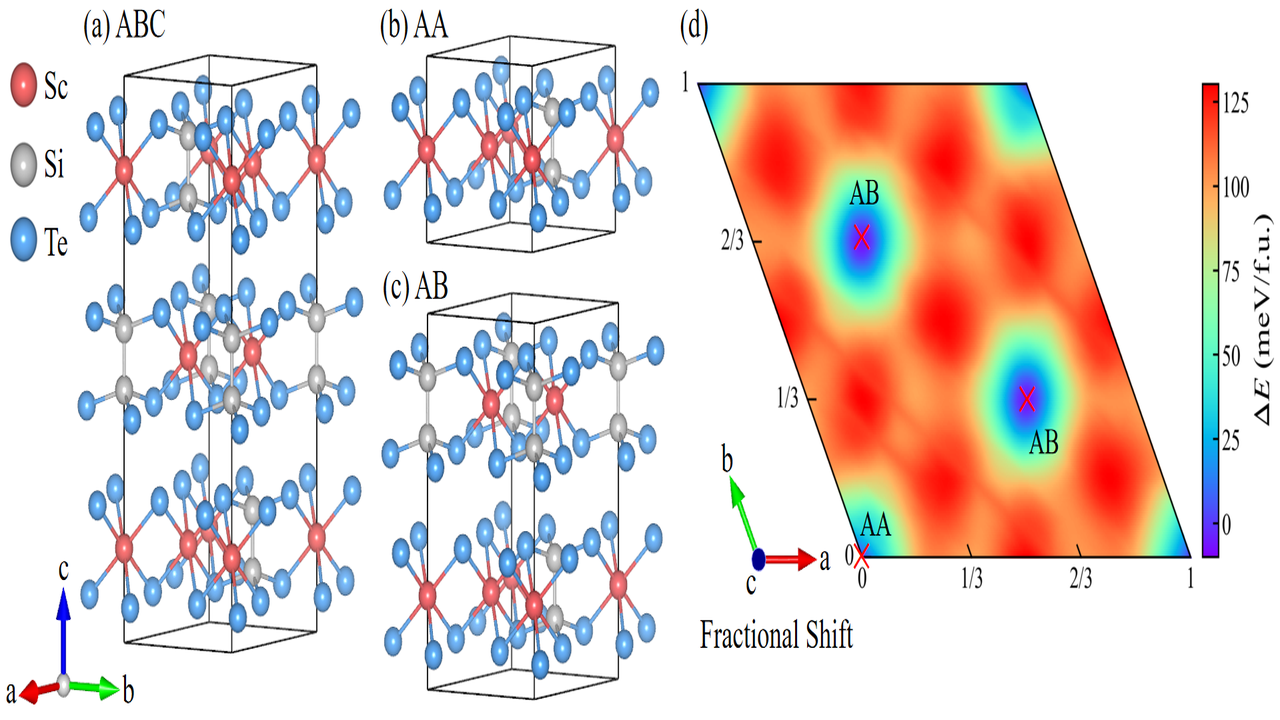
This paper employs first-principles calculations, a method that predicts the electronic states and physical properties of materials based on the fundamental laws of quantum mechanics, to conduct a detailed study of the thermoelectric transport properties of a novel layered semiconductor, Sc2Si2Te6. The main focus of the research is to elucidate how the stacking structure of Sc2Si2Te6 affects its thermoelectric performance.
- Material Selection: Sc2Si2Te6 is a layered semiconductor, and the combination of its constituent elements—scandium (Sc), silicon (Si), and tellurium (Te)—is expected to offer the potential for optimizing the balance of thermoelectric properties.
- First-Principles Calculation Approach: The research team calculated the electronic band structure, phonon dispersion, and based on these, the electrical conductivity, Seebeck coefficient, and thermal conductivity. This allows for the theoretical prediction of how the atomic-level structure impacts carrier transport and heat transport.
- Importance of Stacking Structure: In layered materials, the way atomic layers are stacked (stacking sequence) significantly influences how electrons and phonons move through the material. This study investigates how different stacking patterns lead to changes in the electronic structure and phonon conduction of Sc2Si2Te6, and consequently, how the ZT value is modulated. For instance, it explores the possibility of certain stacking patterns simultaneously maintaining high electrical conductivity while reducing thermal conductivity by increasing phonon scattering.
This theoretical approach enables the evaluation of a material’s potential thermoelectric performance and provides guidance for promising material systems and structural designs before experimental work.
Technical Significance & Outlook
This first-principles calculation study on layered Sc2Si2Te6 makes a significant contribution to deepening the fundamental understanding of thermoelectric materials science. By comprehensively elucidating the impact of stacking structure on thermoelectric properties, it provides valuable information for establishing principles for designing more efficient thermoelectric materials. This will serve as a guideline for exploring new materials to surpass the limitations of existing thermoelectric materials (e.g., layered materials like Bi2Te3 and SnSe) and develop next-generation high-efficiency thermoelectric devices.
In terms of applications, these research findings hold the potential to accelerate technological innovation in fields such as power generation systems through waste heat recovery, automotive exhaust heat utilization, portable power supply devices, and environmentally friendly solid-state refrigerators. Future challenges include experimentally verifying theoretical predictions, synthesizing Sc2Si2Te6 with optimal stacking structures, and demonstrating its performance. Practical considerations such as material stability, manufacturing costs, and scalability also need continuous attention. This fundamental research is a crucial step in shaping the future of sustainable energy technologies.




