
Background and Strategic Imperatives
Amkor Technology is undertaking a significant strategic pivot towards advanced packaging, aiming to capture growth in critical sectors such as artificial intelligence (AI), high-performance computing (HPC), automotive, and next-generation communications. The company’s vision, outlined at its 2026 Investor Day, emphasizes substantial reinforcement of its U.S. manufacturing capabilities, a move designed to bolster supply chain resilience amidst evolving geopolitical landscapes. Government support, particularly through the U.S. CHIPS Act, serves as a crucial accelerator for this ambitious endeavor.
Massive Investment in Arizona Facilities
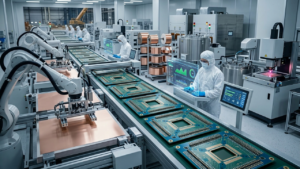
Central to Amkor’s growth strategy is a colossal $7 billion investment dedicated to its advanced packaging and test campus in Arizona. This investment is planned in two distinct phases, with high-volume manufacturing from the initial phase projected to commence by 2028. The new facility is designed to feature 355,000 square feet of state-of-the-art clean room space. Additionally, Amkor has proactively secured an extra 67 acres of land, ensuring ample capacity for future expansion needs. This project benefits from significant governmental backing, including approximately $400 million in incentives facilitated by the CHIPS Act.
Market Impact and Future Outlook
Upon reaching full operational capacity, the Arizona facility is expected to contribute approximately $1 billion in annual revenue, establishing itself as the first high-volume advanced packaging Outsourced Semiconductor Assembly and Test (OSAT) operation within the United States. This development is pivotal for integrating advanced packaging capabilities into the domestic semiconductor ecosystem, serving as a vital component for AI chips and related high-demand technologies. The investment is a cornerstone of Amkor’s broader objective to achieve over $11 billion in annual revenue by 2030. Furthermore, the establishment of advanced packaging capabilities within the U.S. is anticipated to contribute significantly to the diversification and security of the global semiconductor supply chain, addressing growing concerns about geographical concentration of critical manufacturing processes.






Comments