Background: The Energy Crunch Driven by the AI Boom
The rapid advancement of Artificial Intelligence (AI) technologies has triggered an explosive increase in power demand from data centers. Training and operating large-scale AI models require immense computational resources, leading to a dramatic surge in data center electricity consumption. Existing grid infrastructure and utility-led upgrades often struggle to keep pace with this demand growth, frequently incurring delays of several years. This “energy crunch” poses a significant challenge to the further development and expansion of AI data centers.
Innovation and Large-Scale Deployment of Battery Storage for Data Centers
To address these power challenges, Battery Energy Storage Systems (BESS) are expected to play a crucial role in enhancing the reliability and efficiency of AI data centers. In the U.S., operational battery storage capacity reached 26 GW by the end of 2024, with an additional 18 GW in the interconnection queue, indicating a significant scale-up contributing to AI data center capacity solutions.
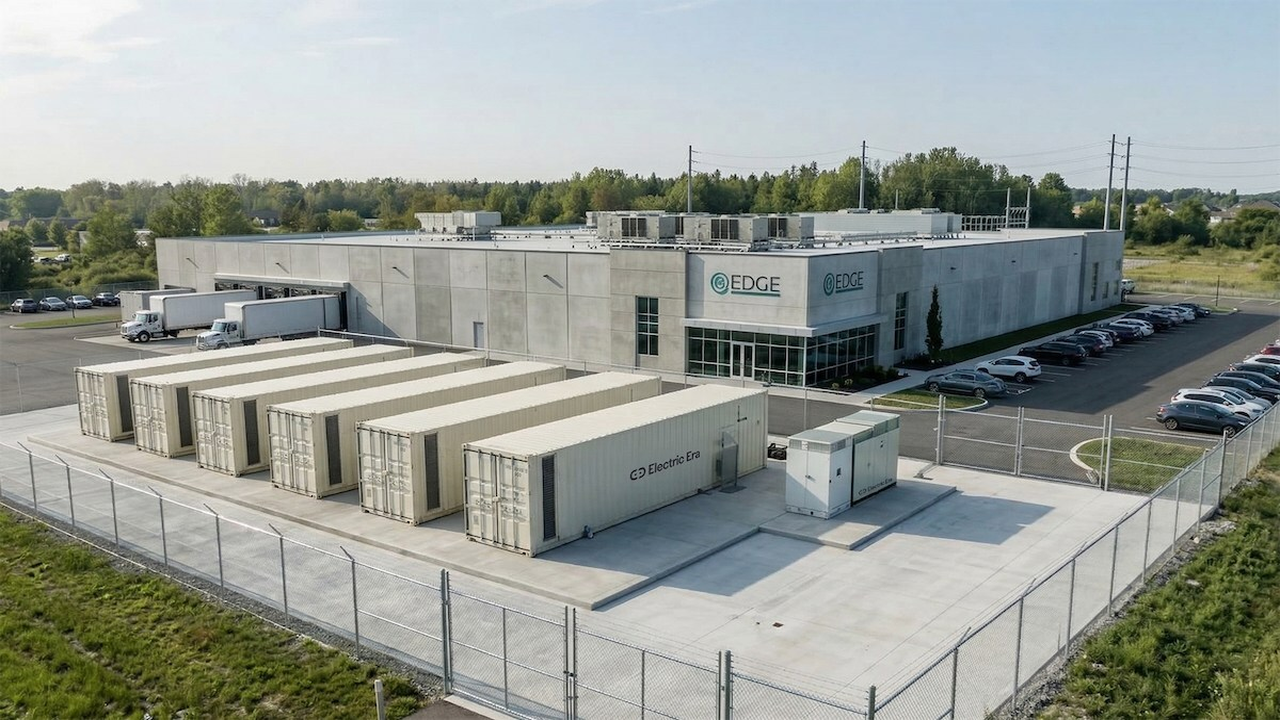
- Electric Era’s “CoPower Platform”: Seattle-based EV startup Electric Era has introduced the “CoPower Platform,” a battery system specifically designed for data centers. This platform aims to circumvent the typical multi-year delays (often exceeding five years) associated with utility grid upgrades, enabling rapid system installation within just 12-18 months. Utilizing LG Energy Solution battery cells, the system is offered in 2.5 MW modular building blocks, scalable to over 100 MW of storage capacity.
- Enbridge and Meta Partnership: Canadian energy company Enbridge is developing the “Cowboy project” in Wyoming, a 365 MW solar PV facility coupled with 1.6 GWh of battery storage, specifically to power technology giant Meta’s growing data center operations. This integrated approach ensures a sustainable and stable power supply by combining renewable generation with large-scale storage. The partnership between Enbridge and Meta now encompasses approximately 1.6 GW of contracted clean energy capacity across North America.
- Off-Grid Solutions: Companies like SAVRN are deploying off-grid AI infrastructure campus models, promising modular compute pods with on-site power generation and battery storage within 6-12 months. This reduces reliance on the main grid and dramatically shortens deployment times for new AI computing resources.
Future Outlook and Market Impact
As AI data center power demand is projected to continue its upward trajectory, battery storage systems are increasingly proving their value as critical solutions to meet this demand. The falling installation cost of utility-scale 4-hour lithium-ion battery storage, which decreased to approximately $290/kWh in 2024, further incentivizes the adoption of BESS in data center applications.
These innovative approaches not only support the advancement of AI technology but also contribute to the decentralization and resilience of power infrastructure, laying the foundation for a more sustainable and efficient digital economy. The combination of rapid deployment capabilities, integration with renewable energy, and proactive engagement with utility partners will be key trends shaping the future BESS market for data centers.







Comments