
The Promise of Perovskite Solar Cells in Space
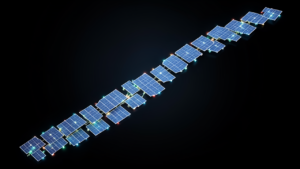
For space missions and satellite power generation, lightweight and highly efficient solar cells are constantly sought after. Traditional silicon-based solar cells are heavy, rigid, and impose constraints on rocket launch costs and deployment. In response to these challenges, perovskite solar cells are garnering significant attention as a next-generation power source for space, owing to their thin, lightweight, and flexible characteristics. Enecoat Technologies, a Japanese startup, is making headlines with its concrete commercialization targets in this field.
Enecoat Technologies’ Strategy and Technology
Enecoat Technologies, built on perovskite technology cultivated at Kyoto University, is pursuing an ambitious plan to commercialize space-grade perovskite solar cells by 2035. Their technology has been adopted by the Japan Aerospace Exploration Agency (JAXA) for its “Space Strategic Fund Project,” underscoring its high technical merit.
- Exceptional Lightweight Property: Enecoat’s perovskite solar cells can reduce weight by more than tenfold compared to silicon-based solar cells producing equivalent power. This is a critical factor for significantly cutting rocket launch fuel requirements and enhancing spacecraft payload capacity.
- High Efficiency and Flexibility: Achieving over 20% power conversion efficiency in small cells, they can generate power efficiently in the confined spaces of orbit. Furthermore, their flexible nature allows for application on complex curved surfaces and deployable structures, increasing satellite design freedom.
- Adaptation to Harsh Space Environments: Space is characterized by extreme temperature fluctuations, high-energy particle radiation, and vacuum conditions. Enecoat is focusing on developing materials, device structures, and encapsulation techniques to ensure durability under these demanding environments.
Commercialization Roadmap and Future Developments
Before direct space application, Enecoat Technologies plans to mature its technology through terrestrial product deployment. The company is set to launch a new factory in Uji, Kyoto Prefecture, in 2027, where it will begin production of small perovskite solar cells for wearable devices such as smartwatches. By building a track record with these products, Enecoat aims to establish mass production technology and reliability, gradually entering the space market. Space-grade perovskite solar cells are expected to open new possibilities in space exploration, Earth observation satellites, and communication satellites, while also contributing to strengthening Japan’s competitiveness in the space industry.
Source: https://www.ryoex.com/en/market-news/20260524181387/








Comments