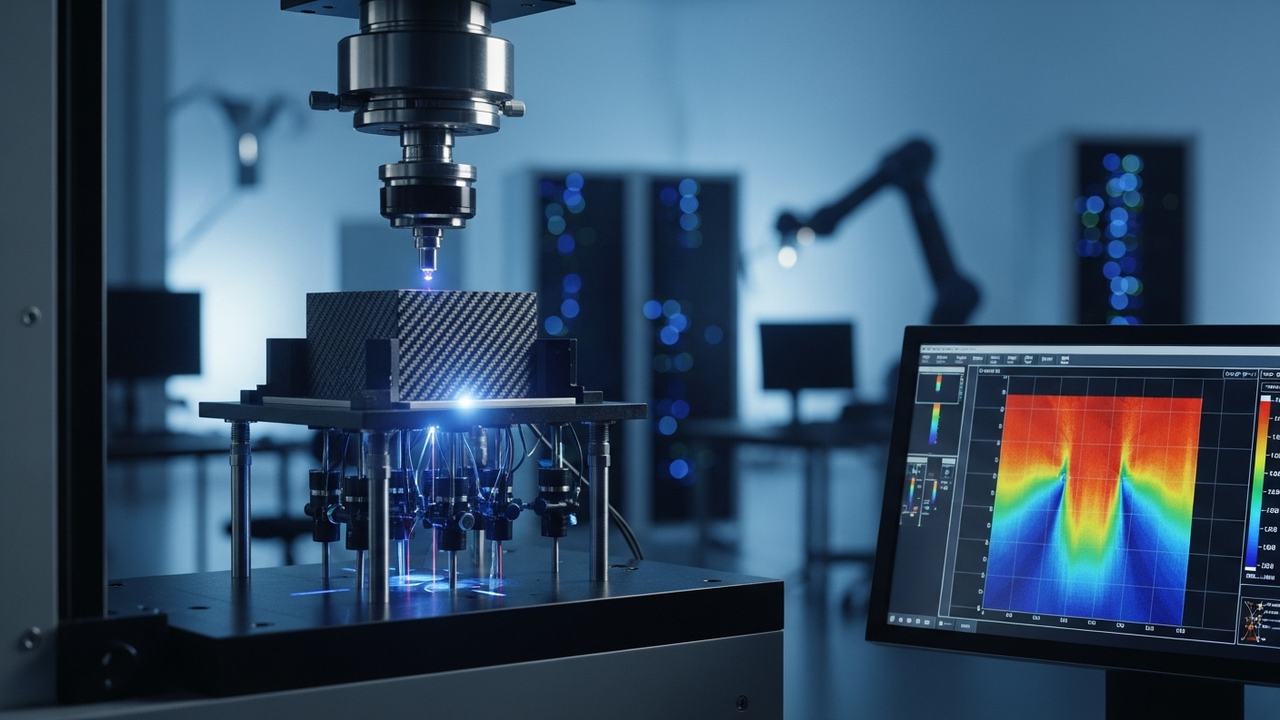
Background: Proliferation of CFRPs and Dimensional Stability Challenges
Carbon Fiber Reinforced Plastics (CFRPs) are rapidly adopted across diverse industries, including aerospace, automotive, wind energy, and sports equipment, hailed as ‘dream materials’ due to their lightweight, high strength, high stiffness, and excellent corrosion resistance. While these high-performance materials contribute to improved fuel efficiency, enhanced performance, and extended lifespans, dimensional stability, particularly ‘warpage’ behavior during manufacturing and under operational conditions, remains a significant design and manufacturing challenge. CFRP warpage results from a complex interplay of factors, including thermal history during molding, fiber orientation, laminate stacking sequence, and resin curing shrinkage, directly impacting product assembly precision, performance, and reliability.
Key Findings: Precision Analysis and Mitigation of Warpage Under Load
Recent research has focused on developing precise analytical methods to better understand, predict, and control warpage behavior in CFRPs under load. This research specifically addresses the following points:
- Simulation and Modeling: Utilizes numerical analysis methods such as Finite Element Method (FEM) to predict deformation behavior of CFRP parts when subjected to external loads and thermal stresses. High-precision models are constructed, considering fiber orientation, layer composition, and material anisotropy, to elucidate warpage mechanisms.
- Characterization of Thermoplastic CFRPs: Beyond thermoset CFRPs, the research details the impact of manufacturing processes (e.g., compression molding, injection molding) on the dimensional stability of thermoplastic CFRPs (TP-CFRPs), which are easier to recycle and offer higher productivity. TP-CFRPs, while tough, can be affected by crystallization behavior during molding, influencing warpage.
- Importance of Dimensional Accuracy: Applications such as aerospace fuselage panels (e.g., parts of wings and fuselage) and automotive structural components (e.g., chassis and body panels) require micron-level dimensional precision due to the precise assembly of multiple parts. Technologies to predict and compensate for CFRP warpage at the design stage are indispensable.
- Recycling Solutions: To reduce the environmental footprint of end-of-life CFRP components, pyrolysis (decomposing the matrix resin to recover carbon fibers) and solvolysis (using solvents to dissolve the resin and recover fibers) are highlighted as effective recycling methods. These recycling technologies are crucial for enhancing the overall sustainability of CFRPs throughout their lifecycle.
Through these analyses, the research aims to identify the root causes of warpage and establish design guidelines that minimize it through optimized material selection, laminate design, and molding conditions.
Technical Significance & Outlook: Applications in Next-Generation Structural Materials and Sustainability
Advances in understanding and controlling CFRP warpage under load will directly contribute to lightweight structures and fuel efficiency in aerospace, reduced vehicle weight and improved safety in automotive, and larger, more efficient wind turbine blades. This will particularly bolster the expanded adoption of CFRPs in applications demanding high reliability over long durations in harsh environments.
Furthermore, the development of recycling technologies addresses the waste management issues associated with CFRPs, enhancing their material sustainability. This could enable CFRPs to evolve from merely high-performance materials to environmentally friendlier, next-generation structural materials. This research, through its interdisciplinary approach at the boundary of materials science, manufacturing engineering, and structural mechanics, is expected to maximize the potential of CFRPs and deliver significant industrial impact.
Source: https://eureka.patsnap.com/report-warpage-analysis-in-carbon-fiber-reinforced-plastics-under-load






Comments