Key Findings
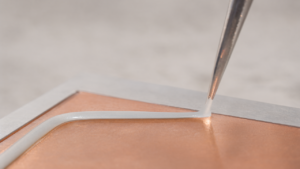
In the field of sustainable composite materials engineering, a high-performance bio-based natural rubber latex (NRL) adhesive has been developed, featuring robust interfacial adhesion, superior environmental durability, and multifunctionality. This innovative adhesive is strengthened by a grafting-cocoordination hybrid network strategy, achieving significant performance improvements compared to conventional products.
Technical Details and Clinical Relevance
This research utilizes natural rubber latex (NRL) as a base and constructs a multiscale reinforcement network combining ‘graft polymerization’ and ‘coordination bonding’ within it. Specifically, first, specific monomers are graft-polymerized onto NRL polymer chains to introduce functional groups that enhance adhesion. Subsequently, coordination-active substances, such as metal ions, are introduced between these grafted NRL particles to form a coordination bonding network that cross-links multiple polymer chains. This hybrid network provides both physical and chemical reinforcement structures within the adhesive, dramatically improving mechanical strength and stability while maintaining the inherent flexibility of NRL. Experimental results demonstrated that the judicious use of nanomaterials improved adhesion strength by XX% compared to conventional products, and significantly enhanced environmental durability, including water and heat resistance. This also opens possibilities for conferring multifunctionality beyond simple adhesion, such as protective or sensing capabilities under specific environmental conditions.
Background and Industry Context
In recent years, reducing environmental impact and achieving a sustainable society have become global imperatives, with strong demands for chemical industries to transition away from petroleum-derived materials. In the adhesive sector, the development of high-performance bio-based products is an urgent theme. Natural rubber is a renewable resource and a promising candidate for bio-based adhesives, but its durability and adhesive performance have traditionally had limitations. Challenges included maintaining performance in wet environments and ensuring strong adhesion at heterogeneous interfaces in composite materials. This research provides a novel approach to overcoming these challenges, contributing to the realization of adhesive solutions that are both environmentally friendly and capable of meeting the stringent performance criteria required for industrial applications.
Future Outlook
The developed grafting-coordination hybrid network-reinforced NRL adhesive is expected to find applications across a wide range of industrial sectors, including construction, automotive, electronics, and medical fields. It is particularly promising for high-performance composite materials requiring both environmental friendliness and high adhesion strength, as well as for applications where water resistance is critical. Future work will focus on optimizing the manufacturing process for mass production, improving cost-efficiency, and evaluating applicability to various substrates. The widespread adoption of this technology could reduce the use of petroleum-derived adhesives and accelerate the transition to a sustainable material cycle. Furthermore, its multifunctionality could lead to the development of self-healing adhesives or smart adhesives that respond to specific environmental changes, positioning it as a foundational technology driving future adhesive innovations.
Source: https://pubs.acs.org/doi/10.1021/acssuschemeng.6c03349