Key Findings
Researchers at the National University of Singapore (NUS) have designed a groundbreaking catalyst capable of efficiently producing urea fertilizer, essential for crop growth, from carbon dioxide (CO2)—a major greenhouse gas—and nitrogenous waste (nitrates). This achievement, accomplished by integrating a computationally guided strategy using Large Language Models (LLMs) and Density Functional Theory (DFT) with experimental validation, opens new avenues for sustainable chemical synthesis.
Technical / Clinical Details
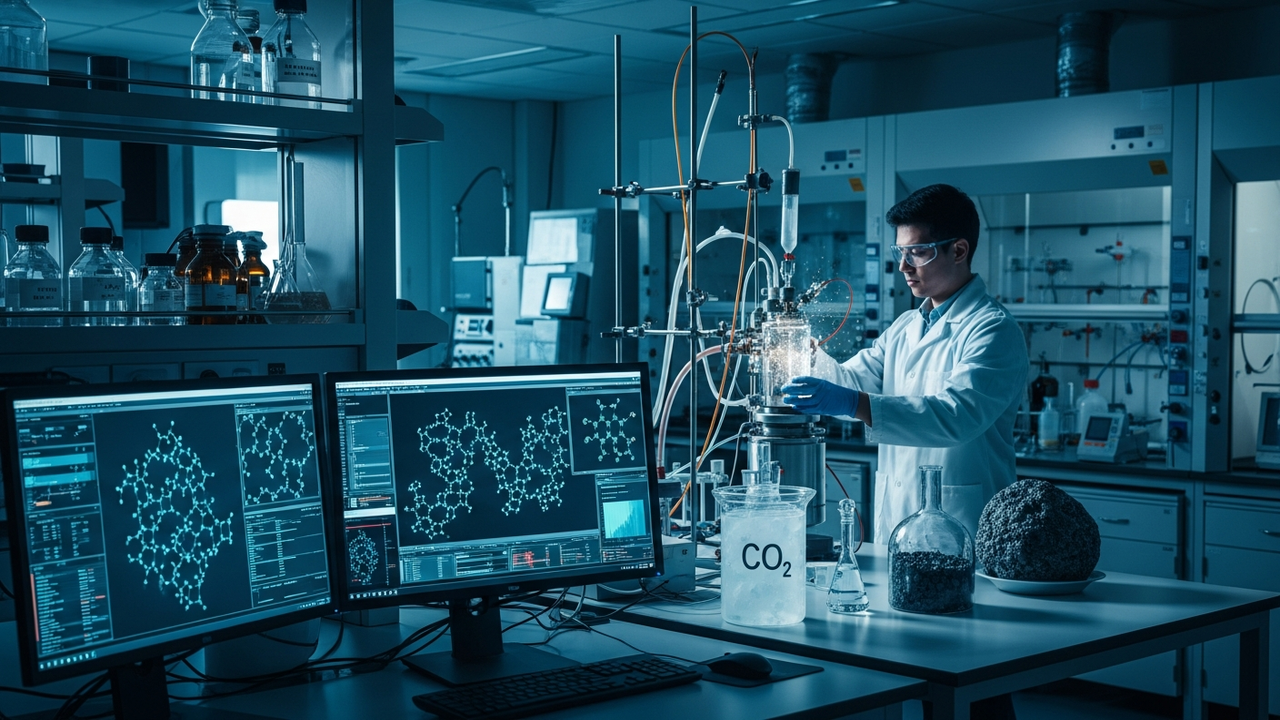
The research team focused on an electrochemical process to convert CO2 and nitrates into urea. To streamline this process, they first leveraged LLMs to extract extensive information on candidate catalyst materials from existing scientific literature and databases, identifying promising elemental combinations and structural motifs. Next, DFT calculations were employed to simulate the electronic structure and reaction pathways of these candidates in atomic detail, deriving design principles to maximize catalytic activity and selectivity. Based on these computational results, the team synthesized a cadmium-modified iron oxide catalyst. Experimental validation confirmed that this catalyst exhibited high efficiency and selectivity in producing urea from CO2 and nitrates, effectively suppressing undesirable side reactions (e.g., generation of nitrogen gas or ammonia) that have been challenges with conventional methods. This tripartite approach—knowledge discovery via LLMs, theoretical optimization via DFT, and experimental validation—proved key to breaking bottlenecks in catalyst design for complex chemical transformations.
Background & Context
Reducing CO2 emissions and valorizing nitrogenous waste are among the most pressing environmental challenges facing modern society. Simultaneously, the sustainable production of urea fertilizer is critically important due to increasing global food demand. Traditional urea production is energy-intensive and emits significant CO2. The NUS research offers a potential solution to both these problems, embodying the concept of ‘carbon recycling’ by transforming CO2 from a mere waste product into a valuable chemical. Advancements in AI and computational science are enabling innovation in such complex catalyst design with speeds and accuracies previously unattainable by conventional methods.Strategic Significance & Outlook
While the designed cadmium-modified iron oxide catalyst is currently a laboratory-scale achievement, its high efficiency and selectivity suggest significant potential for future scaling and commercialization. The research team will focus on improving catalyst durability, reducing costs, and evaluating performance under a wider range of reaction conditions. If this technology is commercialized, it is expected to contribute to reducing CO2 emissions in the chemical industry and advancing sustainable agriculture. Moreover, this computationally guided strategy, integrating LLMs, DFT, and experimentation, will pave the way for applications in other multiphase catalytic reactions and complex molecular design, serving as a model case for further expanding the role of AI in materials science.