Background
Quantum networks are poised to form the bedrock for next-generation technological innovations, encompassing distributed quantum computing, ultimately secure quantum key distribution (QKD), and ultra-precise measurements leveraging networked quantum sensors. However, long-distance transmission of quantum states has historically faced formidable challenges, primarily due to coherence loss from environmental noise and significant transmission losses. Previous research was largely confined to proof-of-concept demonstrations over relatively short distances. This success in remote ion-ion entanglement over 50km therefore represents a major stride towards practical implementation. Trapped-ion qubits are increasingly recognized as a highly promising modality for both quantum computing and quantum networking, owing to their inherently high fidelity and extended coherence times.
Key Findings
A collaborative research team from the University of Innsbruck and Alpine Quantum Technologies (AQT) has achieved a groundbreaking advance in quantum networking technology. They successfully demonstrated remote ion-ion entanglement over an impressive 50km optical fiber channel. This pivotal achievement was made possible by employing compact, rack-mountable quantum network nodes in conjunction with high-fidelity trapped 40Ca+ (calcium ion) qubits.
Technical Details
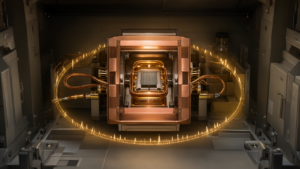
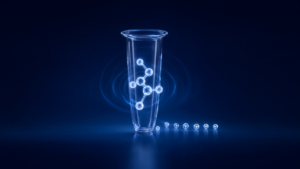
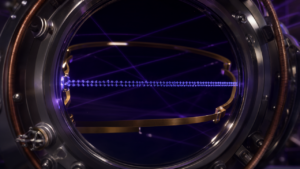
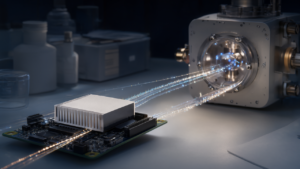
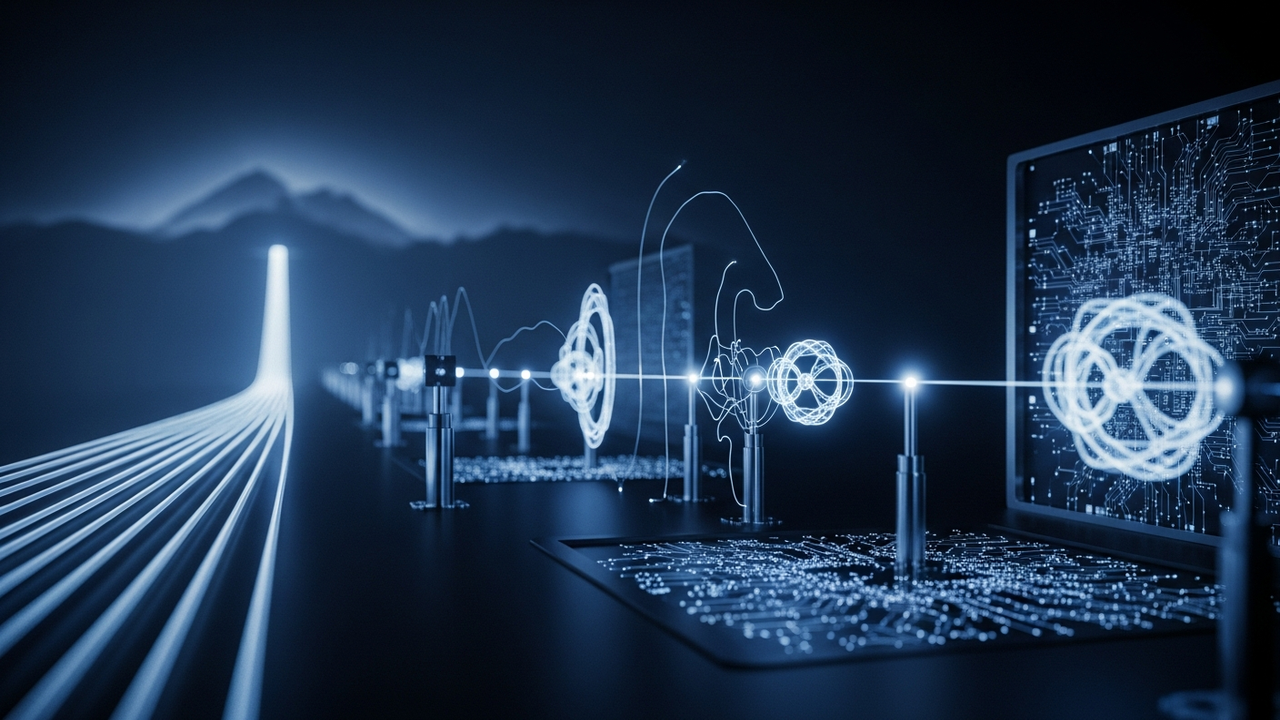
At the core of this experiment lies the sophisticated integration of highly controlled ion-trap technology with a quantum interface. This interface efficiently converts the quantum states of the ions into photons, enabling their transmission over long distances. The research team utilized 40Ca+ ions as their qubits, encoding their quantum states into single photons. These photons were then transmitted through commercial optical fiber cables to a receiving node located 50km away. At this remote end, another quantum network node performed the inverse operation, converting the photons back into the quantum state of an ion, thereby establishing robust quantum entanglement between the two geographically separated ions. A critical design feature of this system is its compact, rack-mountable architecture, which significantly facilitates its integration into future large-scale network infrastructures. This modularity underscores the scalability and practicality essential for the construction of metropolitan-scale quantum networks.
Strategic Significance and Outlook
This unprecedented demonstration of remote ion-ion entanglement over a 50km fiber channel dramatically enhances the feasibility of realizing quantum networks that span entire metropolitan areas. This breakthrough transforms secure quantum key distribution between cities into a tangible reality, accelerating its potential adoption in high-security sectors such as financial institutions and government agencies. Furthermore, this technology provides a fundamental building block for ‘distributed quantum computing,’ enabling the connection of multiple geographically dispersed quantum computers to function as a single, vastly more powerful quantum computing resource. Looking ahead, the continued development of this research is anticipated to be a crucial step towards constructing wider regional, and ultimately global, quantum internets, potentially incorporating satellite-based quantum links.