Key Findings
In the United States, lithium-ion battery recycling projects have rapidly escalated to a valuation of $5.5 billion, reflecting a national commitment to strengthen the domestic battery supply chain and reduce reliance on virgin materials. Upon completion, these facilities aim to recover sufficient battery materials for over 500,000 electric vehicles (EVs) annually. Notably, Redwood Materials’ Ridgeville facility in South Carolina is projected to be completed by the end of 2026, and Cirba Solutions’ Lancaster plant in Ohio is expected to finish by mid-2026, significantly expanding U.S. recycling capabilities.
Technical Details
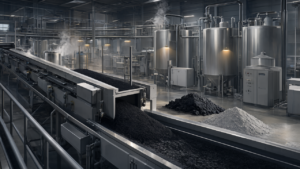
Modern battery recycling processes primarily focus on hydrometallurgical technologies. This process efficiently separates and recovers valuable metals such as lithium, cobalt, and nickel from the “black mass” (pulverized electrode materials) of spent batteries with high purity. Hydrometallurgy achieves high recovery rates (over 95% for lithium and cobalt, 97% for nickel) with zero wastewater discharge, minimizing environmental impact while supplying high-quality precursor materials necessary for manufacturing new batteries. The U.S. Department of Energy (DOE) is further supporting innovation and efficiency in recycling technologies by funding eight projects with $44.8 million, aimed at reducing costs associated with the transportation, dismantling, preprocessing, and recycling of plastic and polymeric accessory components from end-of-life EV batteries.
Background and Industry Context
The explosive growth of the EV market and the proliferation of renewable energy storage systems have led to a surge in demand for lithium-ion batteries, consequently increasing the volume of end-of-life batteries. This makes End-of-Life (EoL) battery management a critical issue not only for environmental concerns but also for the supply security and sustainability of critical minerals. As China dominates the global battery material supply chain, the U.S. is striving to mitigate this geopolitical risk and accelerate the transition to a circular economy model by enhancing domestic recycling capabilities. Battery recycling not only reduces the need for virgin mining and alleviates environmental impact but also creates new value and jobs within the domestic economy.
Outlook
The advancement of the $5.5 billion lithium-ion battery recycling projects in the U.S. is expected to significantly enhance the resilience of the domestic supply chain and contribute to a stable supply of battery materials. The operationalization of these large-scale facilities in 2026 will ensure a sustainable material supply for the U.S. EV industry and energy storage sector, and is projected to stabilize manufacturing costs. Future efforts will focus on further technological innovations to improve battery recycling rates and efficiency, as well as establishing robust quality control systems to ensure that recycled materials perform at par with, or even surpass, virgin materials. Investors and policymakers are keen on the value creation across the entire battery lifecycle and its impact on environmental and economic objectives.