Key Findings
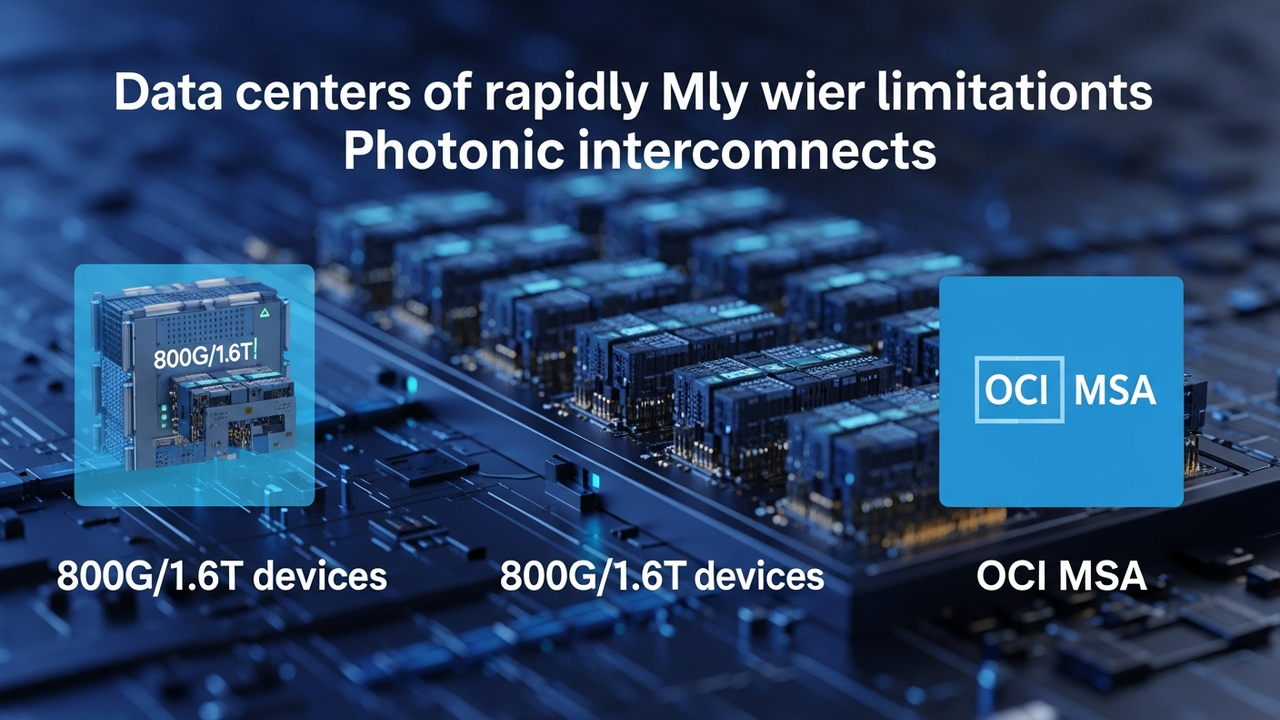
The AI data center industry is rapidly accelerating its transition to photonic interconnects, driven by the physical limitations encountered with traditional copper interconnects. Shipments of 800G pluggable devices are surging, and next-generation 1.6T modules are beginning to emerge in the market. To facilitate this shift and ensure industry-wide interoperability, leading technology companies have formed the Optical Compute Interconnect (OCI) Multi-Source Agreement, actively defining a common optical physical layer.
Technical Details and Industry Standardization
- Limitations of Copper Technology: AI workloads demand several terabits per second of bandwidth and extremely low latency within GPU clusters. Copper cables face challenges such as signal attenuation, high power consumption, and physical cabling constraints when attempting to meet these requirements. Performance degradation of copper becomes particularly pronounced over longer intra-rack and inter-rack distances.
- Advantages of Photonic Interconnects: Optical fibers and photonic devices offer significantly higher bandwidth, lower signal loss, and greater energy efficiency compared to copper. This enables AI data centers to transmit vast amounts of data at high speeds, improving the efficiency of AI model training and inference.
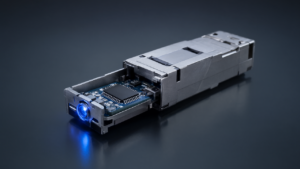
- 800G and 1.6T Pluggable Devices: 800G pluggable transceivers provide the flexibility to be easily integrated into existing network infrastructure, enabling capacity expansion for AI clusters. Furthermore, the introduction of 1.6T modules is a critical step to meet the bandwidth demands of next-generation AI applications. These devices achieve higher bit rates and energy efficiency.
- OCI Multi-Source Agreement (MSA): Industry giants including AMD, Broadcom, Meta, Microsoft, Nvidia, and OpenAI have formed the OCI MSA to define a common optical physical layer for scale-up systems (chip-to-chip, or connections between adjacent chips and racks). This standardization is crucial for guaranteeing interoperability, diversifying the supply chain, and enhancing cost efficiency in building large-scale AI infrastructure.
Background and Industry Context
The increasing complexity of generative AI and machine learning models is forcing fundamental changes in data center architectures. In AI clusters where hundreds to thousands of GPUs work in close collaboration, communication between nodes becomes a bottleneck that dictates overall performance. Traditional copper-dependent infrastructure cannot meet this need, compelling the AI industry to position optical communication technology as an ‘essential element’ and accelerate its adoption. This movement blurs the lines between the semiconductor and optical communication industries, fostering a new ecosystem.
Strategic Significance and Outlook
The establishment of common standards by the OCI MSA will further accelerate the adoption of photonic interconnects in AI data centers. This will improve interoperability among vendors, stimulate technological innovation, and lead to cost reductions. In the future, higher-density, lower-power optical integration technologies such as optical chiplets and Co-Packaged Optics (CPO) will be key to dramatically enhancing AI computing performance. This technological roadmap will support the further evolution of AI, bringing revolutionary impacts to diverse fields like autonomous driving, healthcare, scientific research, and virtual reality. Investors should recognize optical communication’s role as the foundation for digital infrastructure in the AI era.
Get our weekly technology intelligence — free
Receive an infographic that lets you judge at a glance whether each field’s analysis report is worth reading.
Subscribe Free — Weekly Tech Intelligence
By subscribing, you’ll receive Troy-Technical’s weekly technology intelligence newsletter.
- Your email and selected fields are used only to deliver the newsletter.
- We never share your information with third parties.
- You can unsubscribe anytime via the link in each email.
See our Privacy Policy for details.
Takes about a minute · Unsubscribe anytime