Key Findings
NVIDIA and Broadcom have commenced mass production of Co-Packaged Optics (CPO) switches, a pivotal development poised to enable significant advancements in data center infrastructure. This technology is positioned as the leading architecture for next-generation high-bandwidth switches, particularly in AI and high-performance computing (HPC) environments, by substantially reducing power consumption and data transmission latency.
Technical / Clinical Details
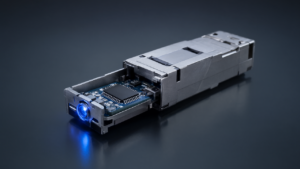
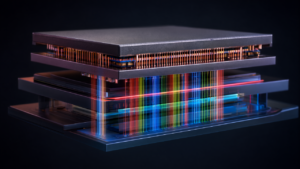
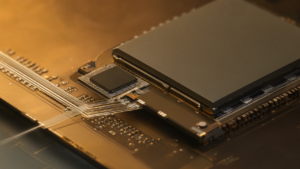
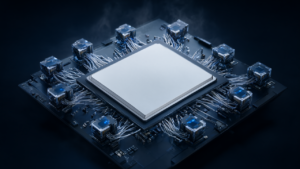
NVIDIA’s Spectrum-X CPO switch, developed in collaboration with TSMC’s COUPE packaging technology, has already entered its production phase. Broadcom’s Bailly CPO switch is also in mass production. The core innovation of these CPO switches lies in the direct integration of the optical engine with the switch ASIC (Application-Specific Integrated Circuit). This reduces the distance for electrical-to-optical signal conversion compared to traditional pluggable optical transceivers, leading to a dramatic decrease in signal loss and power consumption. In a scenario where inter-chip interconnects consume up to 30% of current data center power, TSMC silicon photonics in NVIDIA’s 1.6T CPO switch promises to reduce data center power consumption by up to 3.5 times. Further production expansion is anticipated in the latter half of 2026, and the transition to CPO is considered essential for 400Gbits/sec serdes technology, expected around 2027-2028, given the physical limits of electrical interconnects.
Background & Context
As AI models increase in scale and complexity, data centers face exacerbated challenges related to power consumption and data transmission bandwidth bottlenecks. Conventional electrical interconnects are approaching their physical limits, with escalating energy consumption and heat generation as speeds increase. To address these issues, CPO, which integrates optical communication technology at the chip level, is gaining significant industry attention as the next-generation interconnect technology. NVIDIA and Broadcom are key suppliers in the AI and HPC sectors, and their initiation of CPO mass production clearly indicates that this technology has transitioned from a research phase to commercial deployment.
Strategic Significance & Outlook
The commencement of mass production for CPO switches by NVIDIA and Broadcom is set to revolutionize data center infrastructure design and operation. The significant reduction in power consumption will contribute to lower operational costs and improved sustainability, while simultaneously boosting the processing capabilities for AI and HPC workloads. With silicon photonics modules predicted to account for 50-70% of the 800Gbit and 1.6Tbit optical module market by the end of 2026, CPO is highly likely to become a standard technology in data centers within the next few years. This foundational shift will enable the further development of AI technology and the realization of even larger and more complex AI models, accelerating the growth of the entire digital economy.
Get our weekly technology intelligence — free
Receive an infographic that lets you judge at a glance whether each field’s analysis report is worth reading.
Subscribe Free — Weekly Tech Intelligence
By subscribing, you’ll receive Troy-Technical’s weekly technology intelligence newsletter.
- Your email and selected fields are used only to deliver the newsletter.
- We never share your information with third parties.
- You can unsubscribe anytime via the link in each email.
See our Privacy Policy for details.
Takes about a minute · Unsubscribe anytime