Key Findings
Northrop Grumman has successfully launched its autonomous Mission Robotic Vehicle (MRV), designed for a wide range of on-orbit satellite servicing missions. This MRV is set to significantly enhance the operational efficiency of both commercial and defense space assets by enabling satellite life extension, upgrades, and repairs directly in space.
Technical Details
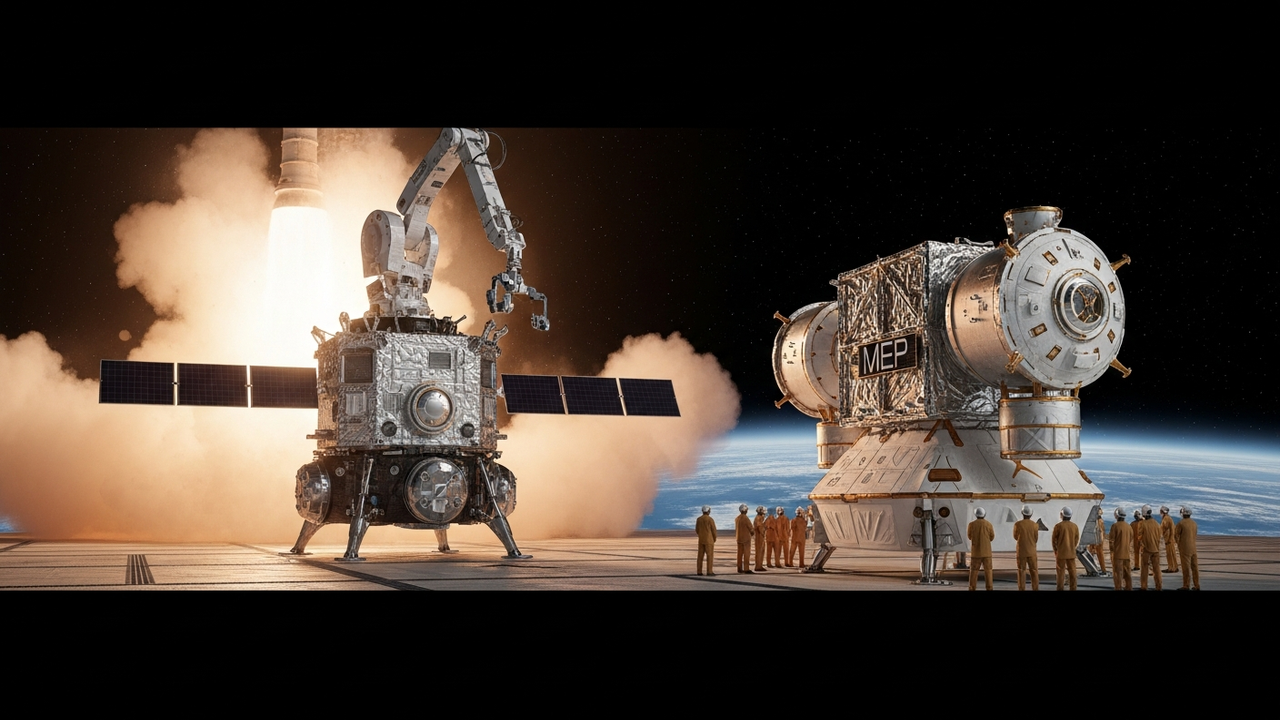
The MRV is equipped with advanced robotic arms and a diverse set of specialized tools, enabling it to perform precise operations in orbit. Its primary functions include inspection and diagnostics of malfunctioning satellites, repositioning through orbital maneuvers, repair of damaged components, software and hardware upgrades, and life extension via propellant replenishment. Notably, the MRV supports Mission Extension Pods (MEP) and Passive Refueling Modules (PRM). MEPs dock with propellant-depleted satellites, providing additional propulsion to extend operational life by several years. PRMs offer a passive interface for future in-orbit refueling technologies, possessing the potential to enable even longer operational durations by replenishing fuel for satellites nearing depletion. The MRV’s autonomous capabilities are crucial for safely and efficiently executing complex rendezvous and proximity operations.
Background & Context
Investment in space assets (such as satellites) has grown substantially in recent years, yet these satellites have traditionally been subject to the limitation that, once in orbit, repairs or upgrades are impossible. This led to an inefficiency where expensive satellites would cease missions upon malfunction or fuel depletion. On-Orbit Servicing (OOS) is envisioned as a next-generation technology to address this challenge and maximize the value of space assets. Northrop Grumman’s MRV launch is attracting significant attention from within and outside the industry as it elevates the technological maturity in the OOS sector and opens up a new paradigm for space utilization. This represents a crucial step towards realizing sustainable and economical space operations.
Strategic Significance & Outlook
The operational deployment of the MRV will enable space organizations in both commercial and defense sectors to extend spacecraft lifespans, improve operational flexibility, and optimize the use of space as an infrastructure. This technology will serve as a foundation for a wide array of future space activities, including satellite constellation management, space debris removal, and the development of new in-orbit manufacturing capabilities. Northrop Grumman aims to establish itself as a leading provider of on-orbit services through the MRV program, contributing to the development of the space economy. In the future, it is anticipated that more advanced robotic technologies and AI will be integrated to develop next-generation OOS platforms capable of autonomously performing even more complex orbital tasks. The MRV is poised to be a precursor to a ‘maintenance revolution’ in space.
Get our weekly technology intelligence — free
Receive an infographic that lets you judge at a glance whether each field’s analysis report is worth reading.
Subscribe Free — Weekly Tech Intelligence
By subscribing, you’ll receive Troy-Technical’s weekly technology intelligence newsletter.
- Your email and selected fields are used only to deliver the newsletter.
- We never share your information with third parties.
- You can unsubscribe anytime via the link in each email.
See our Privacy Policy for details.
Takes about a minute · Unsubscribe anytime