Background
Tandem solar cells are the most promising candidates to break through the theoretical efficiency limits of conventional single-junction silicon solar cells, and WBG perovskites are essential as top sub-cells. However, the instability of WBG perovskites has been a major bottleneck for the commercialization of this technology. “Crystallization modulation,” which precisely controls the crystallization process, is recognized as a powerful tool for fundamentally improving the quality and stability of perovskite thin films. This review consolidates the latest research findings in this field and outlines future directions for R&D.
Key Findings
A comprehensive review paper has been published, focusing on crystallization modulation strategies to overcome critical challenges such as phase segregation, defect formation, and stability in wide-bandgap (WBG) perovskite solar cells and modules. The review reports high power conversion efficiencies (PCE) of 22.3% for single-junction PSCs and 31.2% for perovskite/silicon tandem devices, providing indispensable technological insights for achieving high performance and long-term stabilization of WBG perovskites.
Technical Details
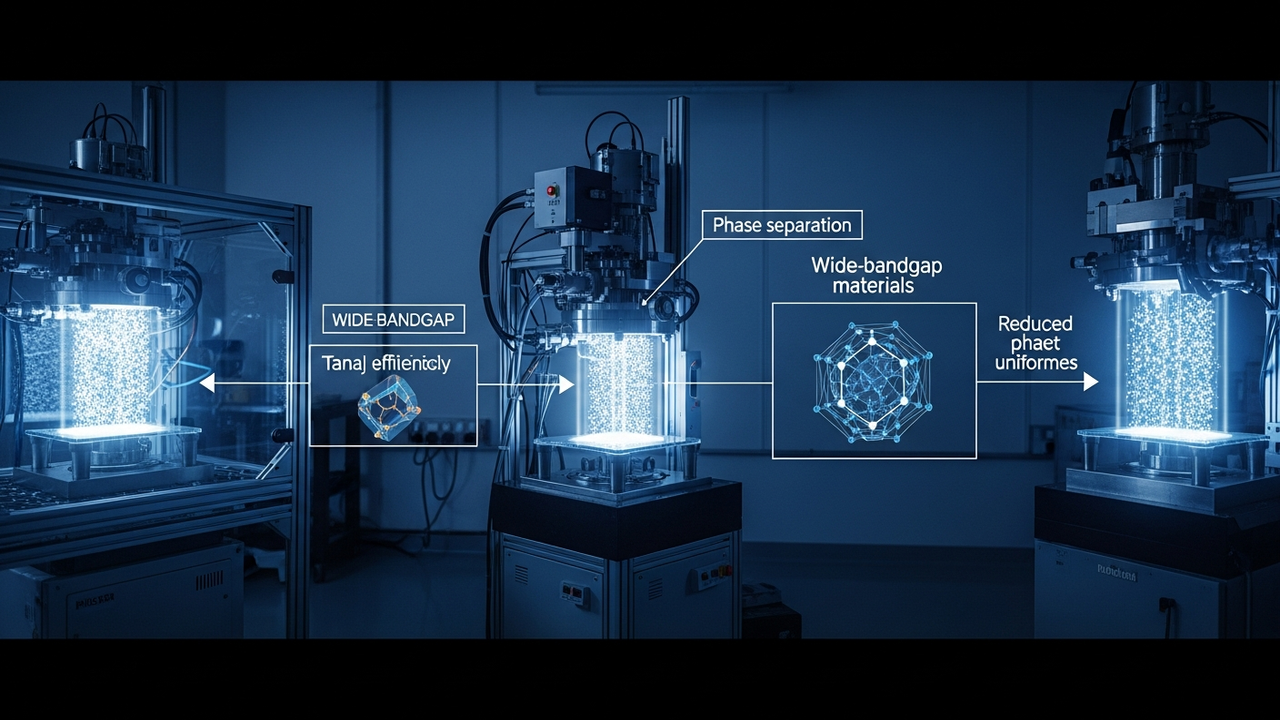
WBG perovskites, due to their wide bandgap characteristics, are ideal as top sub-cells in tandem solar cells. However, issues like phase segregation in mixed-halide systems and the presence of defect states have hindered device stability and efficiency. The review highlights the following crystallization modulation strategies to address these challenges:
- Use of Coordinating Solvents: In large-scale manufacturing processes like blade coating, adding coordinating solvents such as 2-pyrrolidinone (2-P) to the perovskite precursor solution helps maintain a uniform halide distribution and optimize the crystallization process. This aims to suppress phase segregation and improve crystal quality.
- Co-SAMs (Co-Self-Assembled Monolayers) Strategy: Introducing Co-SAMs at the device interface passivates defects at the interface between the perovskite film and the charge transport layer, significantly enhancing thermal stability. SAMs facilitate charge transport while also serving as a protective layer against environmental factors.
These strategies span from material design to process control, externally complementing the intrinsic instabilities of WBG perovskites. The reported 31.2% tandem efficiency underscores the high effectiveness of these modulation techniques.
Strategic Significance & Outlook
The crystallization modulation strategies presented in this review are expected to further accelerate the high performance and stabilization of WBG perovskite solar cells. Particularly, increased applicability to large-scale manufacturing processes is anticipated to hasten the market introduction of perovskite/silicon tandem solar cells. Moving forward, the focus will be on developing large-area modules integrating these technologies, validating long-term durability, and reducing costs. This insight is essential for realizing highly efficient and reliable next-generation solar cells, thereby strengthening contributions to a sustainable energy society.
Get our weekly technology intelligence — free
Receive an infographic that lets you judge at a glance whether each field’s analysis report is worth reading.
Subscribe Free — Weekly Tech Intelligence
By subscribing, you’ll receive Troy-Technical’s weekly technology intelligence newsletter.
- Your email and selected fields are used only to deliver the newsletter.
- We never share your information with third parties.
- You can unsubscribe anytime via the link in each email.
See our Privacy Policy for details.
Takes about a minute · Unsubscribe anytime