Key Findings
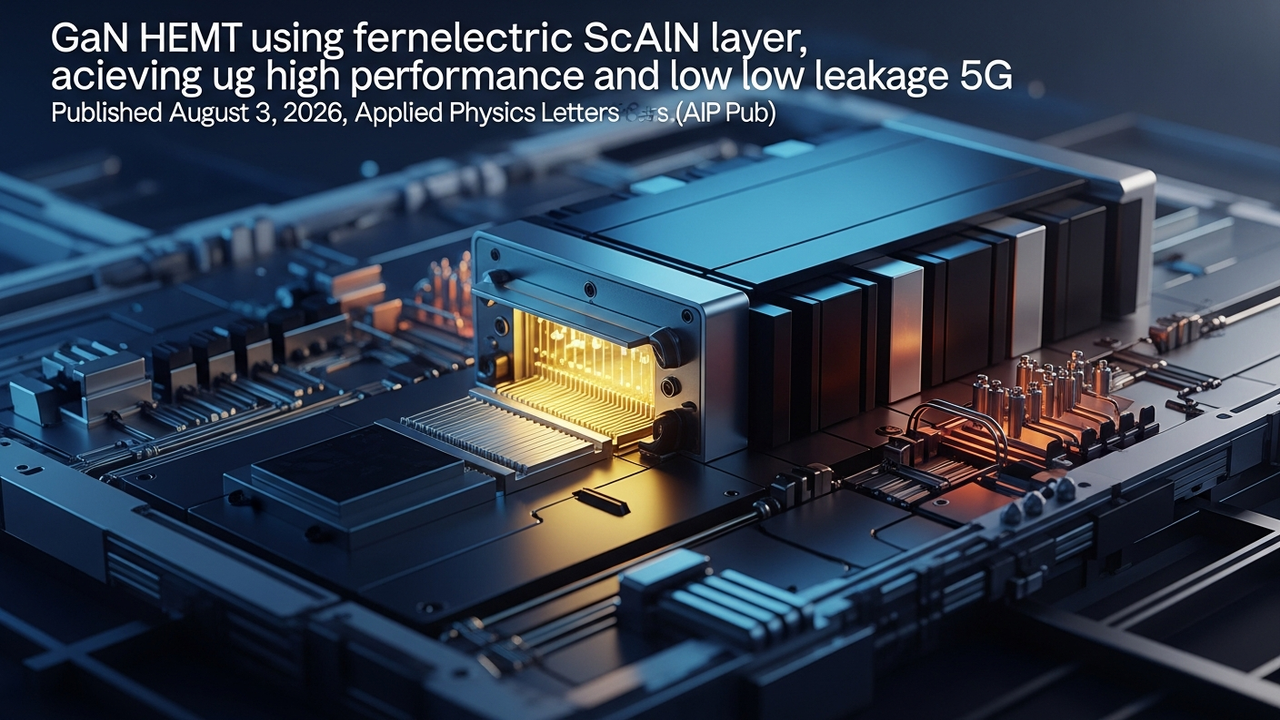
A recent study published in Applied Physics Letters reports a significant advancement in GaN channel high electron mobility transistors (HEMTs). By engineering AlN-on-sapphire templates with ferroelectric Sc0.18Al0.82N epilayers, researchers have demonstrated fully strained GaN channel HEMTs with vastly improved performance. This innovative approach effectively suppresses leakage current, making these devices highly reliable and ideal for demanding applications in 5G communications and radar systems.
Technical / Clinical Details
The core of this research involves incorporating an ultrathin Sc0.18Al0.82N layer as the barrier for GaN channel HEMTs. Scandium aluminum nitride (ScAlN) is a ferroelectric material capable of generating a larger polarization field compared to conventional AlGaN barrier layers. This enhanced polarization field effectively modulates the two-dimensional electron gas (2DEG) density within the GaN channel, allowing for high electron mobility while enabling precise tuning of the device’s threshold voltage. Furthermore, the introduction of the Sc0.18Al0.82N layer effectively mitigates leakage current pathways at the device surface, resulting in extremely low off-state leakage and a high on/off ratio. This significantly boosts reliability and stability during high-power and high-frequency operations. The ultrathin GaN channel also contributes to suppressing short-channel effects, facilitating device miniaturization and enhanced performance.
Background & Context
GaN (gallium nitride) HEMTs are considered next-generation semiconductor materials for high-frequency and high-power applications, including 5G base stations, radar systems, electric vehicles, and industrial power converters, due to their superior electron mobility, wide bandgap, and high breakdown voltage. The proliferation of 5G communications has created an urgent demand for more efficient and reliable wireless infrastructure, making GaN HEMT performance improvement a critical need. Traditional GaN HEMTs faced challenges in controlling interface properties between the barrier and channel layers and managing leakage currents. The integration of ferroelectric materials offers a novel solution to these issues, pushing the performance limits of GaN devices even further.
Strategic Significance & Outlook
This GaN HEMT technology, utilizing ferroelectric ScAlN, promises a dramatic enhancement in device performance for a broad range of high-frequency applications, including 5G/6G communication systems, next-generation radar, satellite communications, and electronic warfare systems. The combination of low leakage current and high reliability directly translates to reduced system power consumption and extended operational lifetimes, accelerating adoption in mission-critical sectors like defense and aerospace. For commercialization, key challenges include ensuring the reproducibility of ScAlN epitaxial growth, developing cost-effective large-scale manufacturing processes, and conducting extensive long-term reliability tests. Despite these, its potential market value is considered immense, as this technology is poised to be a cornerstone for the future of high-frequency power electronics globally.
Source: #
Get our weekly technology intelligence — free
Receive an infographic that lets you judge at a glance whether each field’s analysis report is worth reading.
Subscribe Free — Weekly Tech Intelligence
By subscribing, you’ll receive Troy-Technical’s weekly technology intelligence newsletter.
- Your email and selected fields are used only to deliver the newsletter.
- We never share your information with third parties.
- You can unsubscribe anytime via the link in each email.
See our Privacy Policy for details.
Takes about a minute · Unsubscribe anytime