Background: Evolution of High-Power, High-Frequency Electronic Systems and Material Challenges
Modern electronic devices, such as power electronics for electric vehicles, 5G/6G communication modules, high-performance servers, and renewable energy conversion systems, are increasingly becoming high-power and high-frequency. In these systems, numerous heat sources concentrate in limited spaces, and high power density coupled with high-speed signal processing are required, making heat generation and subsequent temperature rise primary causes of device performance degradation and failure. Conventional Printed Circuit Board (PCB) materials, being organic resin-based, typically have low thermal conductivity and suffer from issues like dimensional instability and dielectric property degradation at high temperatures. Therefore, new substrate materials that combine excellent thermal management capabilities with stable electrical properties are indispensable.
Key Findings: Superiority of Ceramic Substrates and the CERALINK Platform
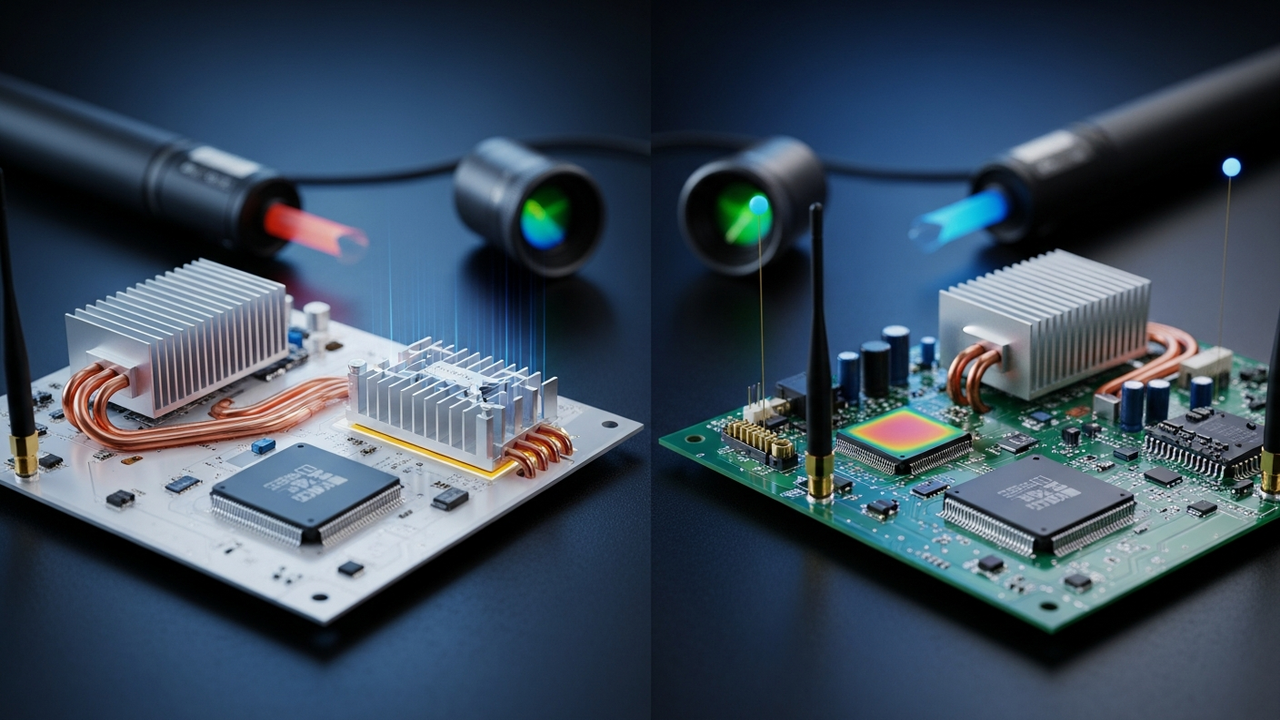
This article compares the thermal performance of ceramic substrates with traditional PCB materials in high-power, high-frequency electronic systems, emphasizing the significant advantages of ceramic substrates. Ceramic materials, due to their molecular structure, possess the following characteristics:
- Excellent Thermal Conductivity: Ceramics boast significantly higher thermal conductivity compared to many organic PCB materials. This enables efficient heat dissipation from semiconductor chips, suppressing junction temperature rise, which is critical for improving device lifespan and reliability.
- High Heat Resistance: With much higher melting or decomposition temperatures than organic materials, ceramics maintain their mechanical strength and electrical properties even in high-temperature environments, ensuring stable operation of high-power devices.
- Low Dielectric Loss: Stable dielectric constant and low dielectric loss at high frequencies minimize signal attenuation, maintaining the fidelity of high-speed signal transmission.
- Low Coefficient of Thermal Expansion (CTE): Ceramics have CTEs close to semiconductor materials, reducing thermal stress between the substrate and chip due to temperature changes and enhancing joint reliability.
TDK Electronics AG’s “CERALINK technology platform” maximizes these benefits of ceramic materials. CERALINK integrates advanced ceramic processing and precise metallization technologies to offer substrates with features such as:
- Guaranteed High-Temperature Operation: Ensures stable operation at junction temperatures up to 175°C, enabling use in demanding thermal environments like automotive power modules.
- High Power Density Capability: Supports higher power density system designs through superior heat dissipation and electrical properties.
- High Reliability: Achieves long-term system reliability by suppressing thermal stress and electrical degradation.
This technology is based on ceramic materials like alumina, aluminum nitride, and silicon carbide, providing optimal properties depending on the application.
Technical Significance & Outlook: Innovation in Automotive Power Modules and Next-Generation Electronics
Ceramic substrates, particularly advanced technologies like TDK’s CERALINK platform, offer a decisive advantage in automotive power modules. In components demanding both high power and high reliability, such as electric vehicle inverters and chargers, superior thermal management dictates overall system performance and safety. CERALINK technology addresses these challenges, enabling smaller, more efficient, and longer-lasting power modules, thereby accelerating the adoption of electric vehicles.
Furthermore, this technology has broad potential applications in other high-reliability and high-power fields, including aerospace, renewable energy, industrial electronics, and medical devices. The evolution of ceramic substrates is pushing the performance limits of electronic devices and is highly anticipated as a foundation for future technological innovation.
Source: https://eureka.patsnap.com/report-ceramic-substrates-vs-pcb-materials-thermal-performance-comparison




Comments