Industry Context
The development of sustainable materials is an urgent imperative for reducing environmental impact and realizing a circular economy. Bioplastics like poly(lactic acid) (PLA) and poly(ε-caprolactone) (PCL) have garnered significant attention due to their biodegradability and renewability. However, they have historically faced challenges regarding inferior mechanical and electrical properties compared to conventional plastics. Consequently, active research has focused on improving bioplastic performance through the incorporation of high-performance nanofillers. The outcomes of this study represent a crucial step towards establishing bioplastics not merely as alternative materials, but as high-functional engineering materials in their own right.
Key Findings
A high-strength, high-conductivity nanocomposite material, derived from a sustainable poly(lactic acid) (PLA)/poly(ε-caprolactone) (PCL) blend reinforced with multi-walled carbon nanotubes (MWCNT) and graphene nanoplatelets (G), has been developed. This composite material demonstrates a 309% increase in impact strength compared to pure PLA, achieves an electrical conductivity of approximately 6.79 × 10⁻⁵ S/cm, and exhibits enhanced electromagnetic shielding performance in the 8.2–18 GHz frequency range.
Technical Details
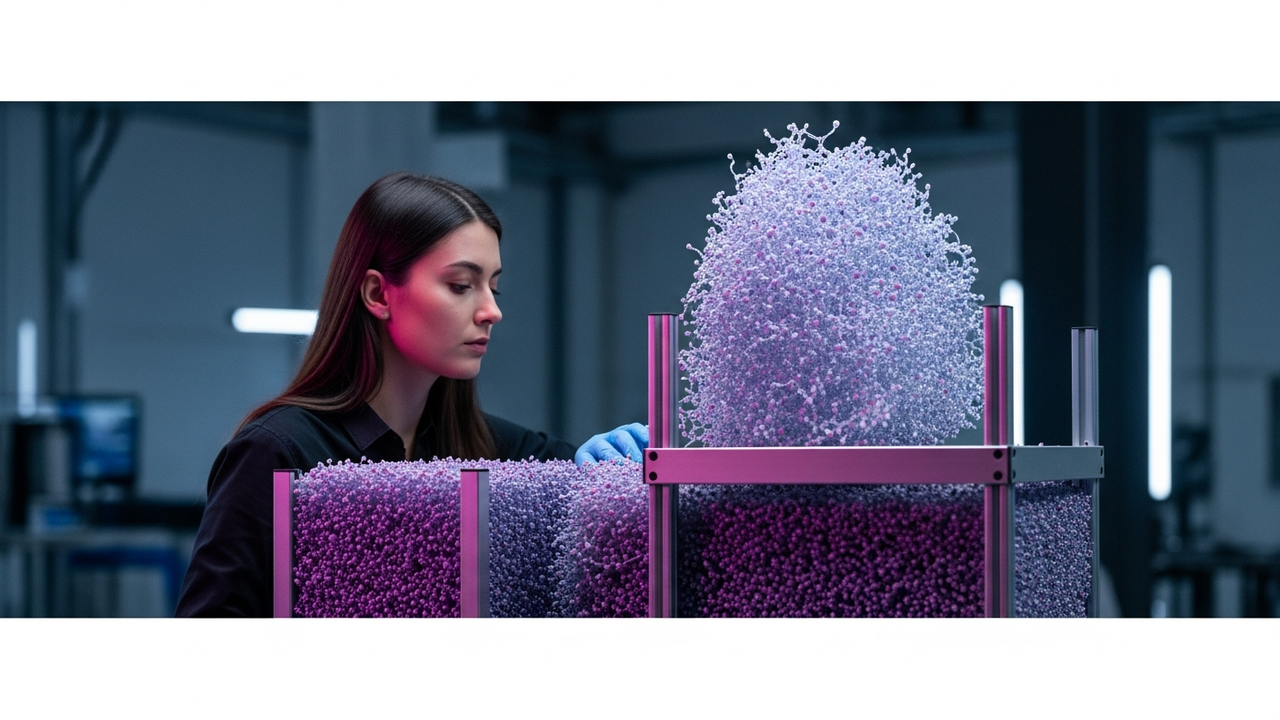
This research incorporated MWCNT and graphene nanoplatelets at a specific ratio (4/2 phr) into a PLA and PCL blend. The material was fabricated using twin-screw extrusion and injection molding, processes known for their ease of industrial scale-up. This manufacturing approach ensured uniform dispersion of the nanofillers within the composite, contributing to the overall enhancement of material properties. Notably, the composite overcame the inherent brittleness of pure PLA, boosting its impact strength by 309%. This improvement is attributed to the effective formation of stress transfer pathways and energy absorption mechanisms by MWCNTs and graphene within the material structure. Furthermore, maintaining the heat deflection temperature (HDT) is crucial for ensuring structural stability in high-temperature environments. Regarding electrical conductivity, the MWCNTs and graphene established a conductive network within the composite, achieving a practical level of approximately 6.79 × 10⁻⁵ S/cm, and confirming its electromagnetic shielding capabilities.
Future Outlook
This sustainable, high-strength, and highly conductive nanocomposite material holds promise for a wide range of applications, including electronic device casings, automotive components, sports equipment, and construction materials. Given its ability to combine lightweight properties with high mechanical strength and electromagnetic shielding performance, it is particularly well-suited for electronic devices requiring electromagnetic noise countermeasures and transportation equipment where weight reduction is critical. Future research will likely focus on further optimizing nanofiller types and blending ratios, evaluating long-term durability, and investigating methods to reduce manufacturing costs. These efforts are expected to significantly contribute to both the realization of a sustainable society and the widespread adoption of high-performance materials.