Key Findings
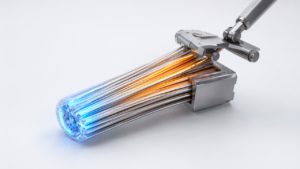
Researchers at the Chinese Academy of Sciences have developed a pioneering flexible sensor that simultaneously performs gesture recognition and temperature perception with integrated self-compensation capabilities. This dual-functionality sensor represents a significant advancement for wearable electronics, intelligent robotics, and electronic skin applications, overcoming challenges related to signal crosstalk and temperature-induced inaccuracies. Published in Advanced Functional Materials, the device employs a single Bi2Te3/polyimide film that strategically harnesses both thermoelectric and piezoresistive effects for efficient signal decoupling and intrinsic temperature drift compensation.
Technical / Clinical Details
- Dual-Functionality: The sensor is designed to detect mechanical strain (for gesture recognition) and thermal variations (for temperature perception) concurrently from a single device. This eliminates the need for separate sensors or complex post-processing to disentangle signals.
- Bi2Te3/Polyimide Film: The core of the sensor is a composite film of bismuth telluride (Bi2Te3) and polyimide (PI). Bi2Te3 is a well-known thermoelectric material, generating voltage in response to temperature gradients (Seebeck effect). Polyimide provides mechanical flexibility and durability, while its embedded structures enable piezoresistive sensing, where electrical resistance changes with mechanical deformation.
- Self-Compensation Mechanism: A critical innovation is the self-compensation for temperature drift. Temperature fluctuations can significantly alter the readings of piezoresistive sensors. By integrating the thermoelectric effect, the sensor can measure and actively compensate for these temperature-induced changes in real-time, ensuring highly accurate and stable gesture recognition regardless of ambient temperature.
- Efficient Signal Decoupling: The distinct physical origins of the thermoelectric (temperature-dependent) and piezoresistive (strain-dependent) signals allow for their effective separation and processing. This synergistic integration within a single material simplifies device architecture and enhances overall performance.
Background & Context
The growing demand for advanced wearable devices and highly interactive robotics necessitates sensors that are not only flexible and compact but also capable of discerning multiple environmental stimuli accurately. Conventional approaches often involve combining multiple discrete sensors, leading to bulkier designs, increased power consumption, and challenges in managing signal interference. The development of a single, integrated, and self-compensating sensor is a crucial step forward in addressing these limitations and pushing the boundaries of human-machine interfaces.
Strategic Significance & Outlook
This innovative self-compensating flexible sensor has transformative potential across several high-growth sectors. In wearable electronics, it could lead to more intuitive and reliable smartwatches, fitness trackers, and health monitoring devices, offering enhanced user interaction and precise physiological data collection. For intelligent robotics, it provides a crucial component for advanced electronic skin, enabling robots to perceive their environment and interact with objects with greater dexterity and sensitivity. The simplified design and high integration capabilities of this solution promise to accelerate the development of next-generation multifunctional sensing platforms, making advanced human-computer interaction and smart autonomous systems more accessible and robust across industrial and consumer applications.
Source: https://english.cas.cn/newsroom/research-news/202606/t20260603_1161046.shtml