Key Findings
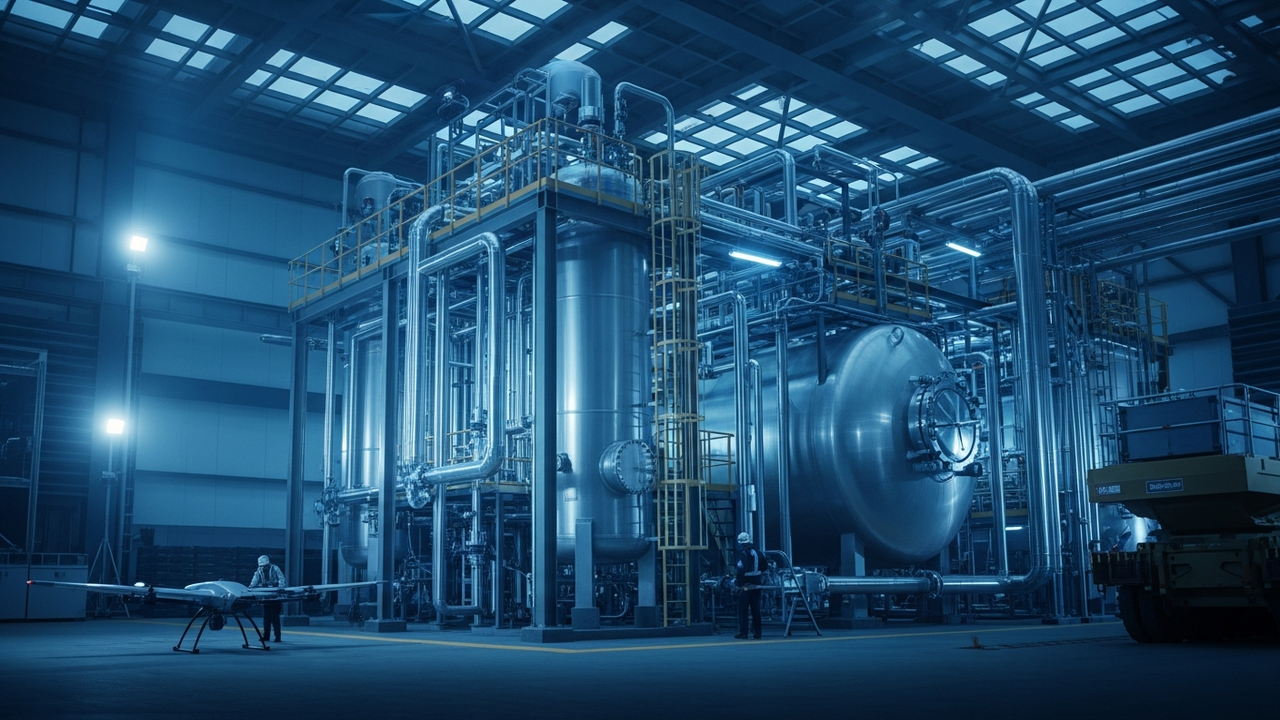
China’s first domestically produced 5-ton-per-day hydrogen liquefaction facility has commenced operations. This facility has achieved a remarkable reduction in energy consumption for its core liquefaction system, reaching 11.84 kWh per kilogram, which represents an improvement of over 40% compared to traditional processes. This technological innovation enables a significant reduction in the production cost of liquefied hydrogen, powerfully advancing China’s hydrogen energy infrastructure and the clean energy transition in key industries such as the low-altitude economy, fuel cell heavy trucks, maritime transport, high-end manufacturing, and new energy storage in the Beijing-Tianjin-Hebei region.
Technical & Operational Details
This newly established hydrogen liquefaction facility represents a crucial advancement in hydrogen storage and transport. Liquefied hydrogen (LH2) offers significantly higher energy density per unit volume compared to gaseous hydrogen, making it advantageous for long-distance transportation and large-scale storage. However, hydrogen liquefaction requires extremely low temperatures (-253°C) and substantial energy, making efficiency in the liquefaction process key to cost reduction. The facility’s achievement of over 40% energy consumption reduction is likely due to advanced cooling technologies, optimized heat exchangers, and process integration. This enables the supply of competitively priced liquefied hydrogen, paving the way for expanded commercial utilization.
Background & Industry Context
China is pursuing hydrogen energy development as a national strategy, aiming to strengthen the entire value chain from hydrogen production to storage, transport, and utilization. Decarbonizing the transportation sector is an urgent priority, and supplying liquefied hydrogen to fuel cell heavy trucks and maritime vessels holds great promise for both emission reduction and energy efficiency improvement. The Beijing-Tianjin-Hebei region, a major economic zone with dense industrial activity and population, will directly benefit from the supply of high-quality, low-cost liquefied hydrogen, contributing to regional decarbonization goals. While China’s fuel cell vehicle market is still in its early stages, such infrastructure development lays the groundwork for future FCEV adoption.
Strategic Significance & Outlook
The commissioning of this domestically produced hydrogen liquefaction facility holds significant implications for China’s self-sufficiency in hydrogen technology and its global competitiveness in the hydrogen supply chain. The reduction in liquefaction costs will remove economic barriers to hydrogen adoption across more industrial sectors, accelerating the decarbonization of heavy industry, long-distance transport of renewable energy, and the transformation of the mobility sector. As similar efficient liquefaction facilities are deployed across China, the widespread adoption of hydrogen energy is expected to further contribute to the nation’s energy transition and sustainable development. This technology also has the potential to serve as a benchmark for global hydrogen liquefaction technologies.