Key Findings
Research presented by Mouyang Cheng and colleagues at the Massachusetts Institute of Technology (MIT) marks a significant breakthrough in generative AI for inverse materials design, addressing the critical challenge of ensuring chemical validity in generated structures. They successfully developed a method that incorporates structural motif constraints using diffusion models and a novel valence-constrained generative framework called ‘CrysVCD,’ enabling AI to autonomously generate chemically valid and stable crystal structures.
Technical / Clinical Details
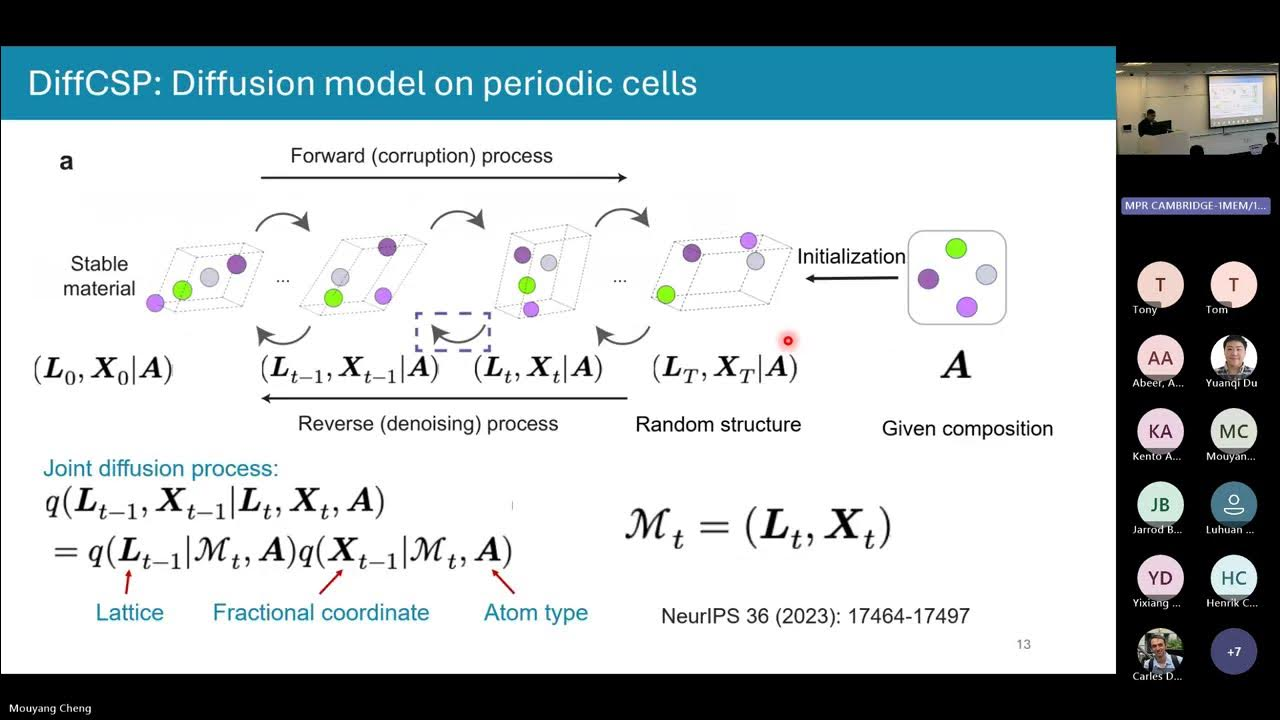
Conventional generative AI models, while capable of producing a vast number of material candidates, often struggle with generating structures that are chemically unstable or physically impractical. The MIT team’s approach tackles this limitation by introducing two primary constraint mechanisms. First, diffusion models are trained to learn and embed stable structural motifs—fundamental patterns of atomic arrangements—into the generation process, ensuring structural integrity. Second, and more profoundly, ‘CrysVCD’ integrates the fundamental chemical principle of valence directly into the generative framework. This guides the atomic bonding to occur within chemically plausible ranges. As a result, the AI transcends mere statistical pattern generation, enabling an efficient exploration of meaningful crystal structures based on elemental bonding characteristics. This technology has the potential to dramatically narrow the search space for designing materials with specific functionalities, thereby accelerating the development timeline.
Background & Context
Inverse materials design—the process of determining material structure and composition from desired functionalities—is one of the most challenging and crucial problems in contemporary materials science. With increasing demand for new materials meeting specific performance requirements in energy, electronics, and biomedical fields, traditional trial-and-error development methods have reached their limits. Generative AI has emerged as a promising solution for inverse design, but its practical application has been hampered by the lack of mechanisms to guarantee the chemical and physical validity of generated materials. The MIT research effectively bridges this gap, representing a significant step towards the practical implementation of AI-driven materials development.
Strategic Significance & Outlook
The advent of constrained generative AI frameworks like CrysVCD provides materials scientists with a powerful tool for discovering and designing new materials more efficiently and reliably. This will accelerate the search for materials with specific catalytic activities, highly efficient thermoelectric properties, or particular biocompatibility. Future research will likely focus on integrating more complex chemical and physical constraints, experimental validation of the generated materials, and enhancing scalability. This technology holds the potential to fundamentally transform the material design process and contribute to the realization of a sustainable society.