Key Findings
As part of the Artemis program, aimed at humanity’s sustainable return to the Moon and the establishment of long-term lunar operations, NASA announced its first three lunar base missions (Moon Base I, II, and III) in May 2026. To support these missions, NASA has forged new partnerships with several private companies, including Astrolab, Lunar Outpost, Blue Origin, and Firefly Aerospace. This strategic move is designed to accelerate the development of In-Situ Resource Utilization (ISRU) and nuclear power systems on the lunar surface, thereby laying the groundwork for future lunar habitation and scientific exploration.
Technical Details
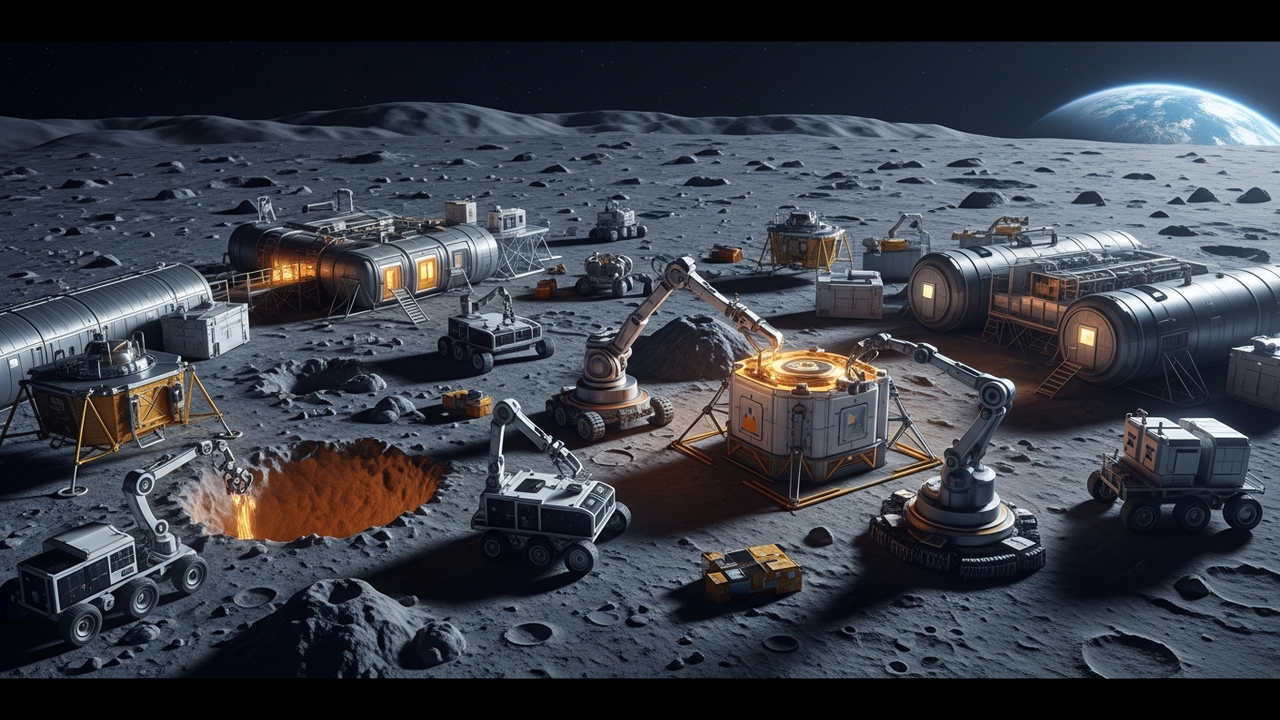
Specifically, Astrolab and Lunar Outpost have been selected for the initial phase of developing lunar rovers tailored for operations in the lunar environment. These rovers will play a crucial role in testing ISRU technologies, enabling the extraction of water ice and other valuable resources from lunar regolith (lunar soil). Blue Origin is tasked with providing the landing systems for safely and efficiently delivering these rovers to the lunar surface. Furthermore, Firefly Aerospace will manufacture the spacecraft responsible for transporting NASA’s MoonFall drones to the Moon. Regarding power supply, a radioisotope power system named ‘Harmonia’ is being developed in collaboration with Zeno Power to sustain operations during the harsh lunar night. Blue Origin’s ‘Blue Alchemist’ program, adopted by NASA’s Tipping Point initiative, is a commercial system for manufacturing solar panels from lunar regolith, contributing to the construction of self-sufficient infrastructure on the Moon. For the long term, the plan outlines the deployment of solar arrays and radioisotope power plants in Phase 2, followed by fission surface power systems in Phase 3, aiming for an evolved lunar power infrastructure capable of providing stable electricity even during extended lunar nights.
Background and Industry Context
Lunar exploration is gaining increasing strategic importance as a stepping stone for human deep-space exploration and as a preparatory measure for potential depletion of Earth’s resources. Establishing a sustainable presence on the Moon necessitates not just reliance on Earth-based supply chains, but maximized utilization of local resources through ISRU technologies, coupled with robust power systems capable of enduring the long, cold, and dark lunar nights. NASA’s current partnerships aim to overcome these challenges by accelerating technology development and leveraging the expertise and capabilities of the commercial sector. Such public-private collaborations are seen as a new model for reducing the costs of space development and fostering innovation.
Future Outlook
These lunar base missions and partnerships hold the potential to dramatically expand the scope and sustainability of human lunar activities. Advancements in ISRU and nuclear power technologies are essential for achieving self-sufficiency in food, oxygen, fuel, and construction materials on the Moon, thereby increasing the feasibility of future lunar cities and crewed missions to Mars. This initiative will not only accelerate scientific discovery but also contribute to the creation of a new space economy. Specifically, resolving the challenge of long-term lunar night power supply will enable continuous scientific observation and exploration, marking a significant step toward the commercial utilization of water ice in the Moon’s polar regions.