Key Findings
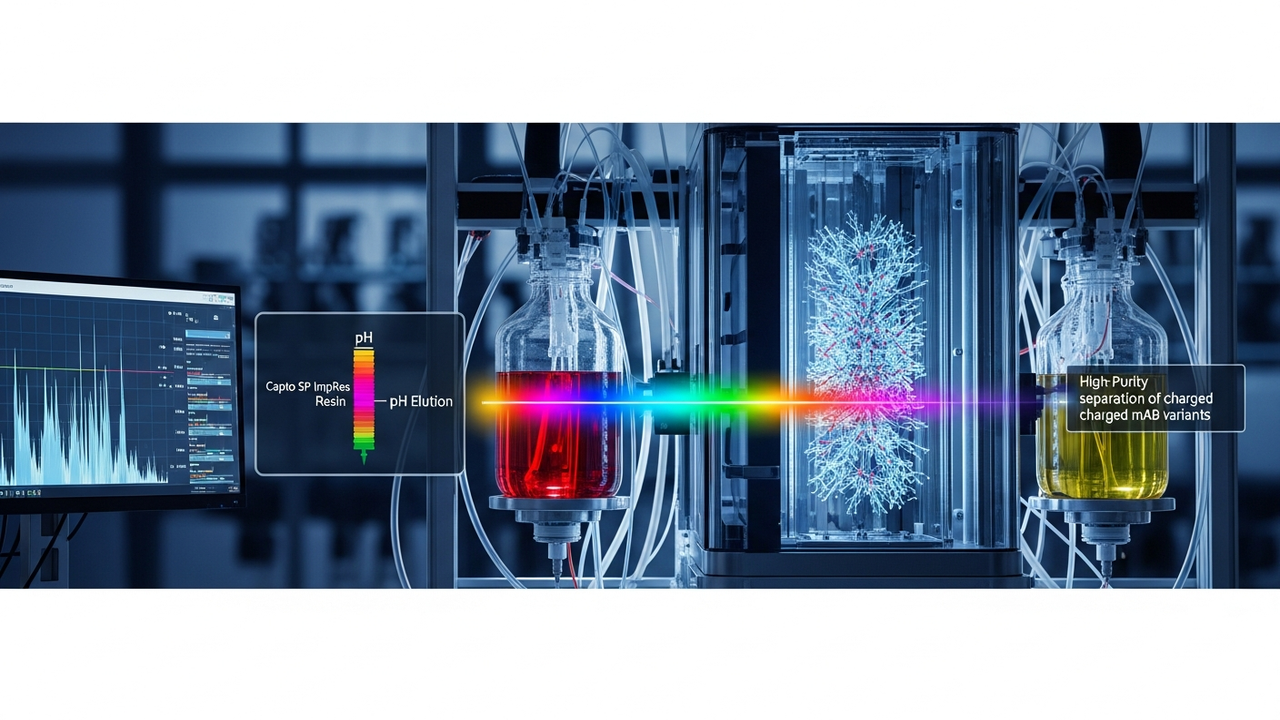
Cytiva has achieved substantial advancements in the separation and purification of charged monoclonal antibody (mAb) variants using ion exchange (IEX) and multimodal resins. Crucially, by optimizing the elution pH with high-performance resins such as Capto SP ImpRes, the study demonstrated a significant improvement in resolution, leading to a higher ratio of the desired main mAb to acidic variants and ultimately superior final product purity.
Technical / Clinical Details
- IEX and Multimodal Resins: In the downstream processing of biopharmaceuticals, the removal of impurities and variants is a critical step directly impacting product quality. IEX chromatography is a standard technique for separating proteins based on charge, while multimodal resins combine multiple interaction modes (e.g., ion exchange, hydrophobic interaction) to address more complex separation challenges with enhanced selectivity.
- Capto SP ImpRes Resin: This advanced resin is engineered to deliver high resolution simultaneously with high flow rates, offering exceptional performance in separating charged variants. Its robust design allows for efficient purification even with challenging feedstocks.
- Elution pH Optimization: The research underscored that fine-tuning the pH during the elution step critically influences the separation behavior of mAb variants. Precise pH control enables sharper distinctions between variants, even those with very similar charge characteristics, which is a common challenge in mAb purification.
- Purity Enhancement at High Loading: Efficient manufacturing processes demand high-load (high-throughput) operations, which often involve a trade-off with separation resolution. However, this technology maintains an excellent separation ratio of the main mAb from acidic variants under high-load conditions, yielding a final product of high purity. This directly contributes to reducing manufacturing costs and increasing overall production capacity.
Background & Context
Monoclonal antibodies are leading biopharmaceutical products widely used in the treatment of cancers and autoimmune diseases. However, charge variants (e.g., deamidation, C-terminal lysine truncation) generated during the manufacturing process can impact therapeutic efficacy and stability. Strict quality control and efficient removal of these variants are therefore essential. Technologies that enable cost-effective and efficient separation of these variants are paramount for reducing biopharmaceutical manufacturing costs and ensuring product quality.
Strategic Significance & Outlook
Cytiva’s advancement provides biopharmaceutical manufacturers with a new solution to enhance the quality, purity, and manufacturing efficiency of their mAb products. Optimized IEX and multimodal chromatography techniques are poised to become a standard approach in the downstream process design for future biopharmaceuticals, particularly for next-generation biologics with complex molecular structures. This development is expected to stabilize the supply of high-quality biopharmaceuticals, ensuring that more patients receive safe and effective treatments globally.







Comments