Key Findings
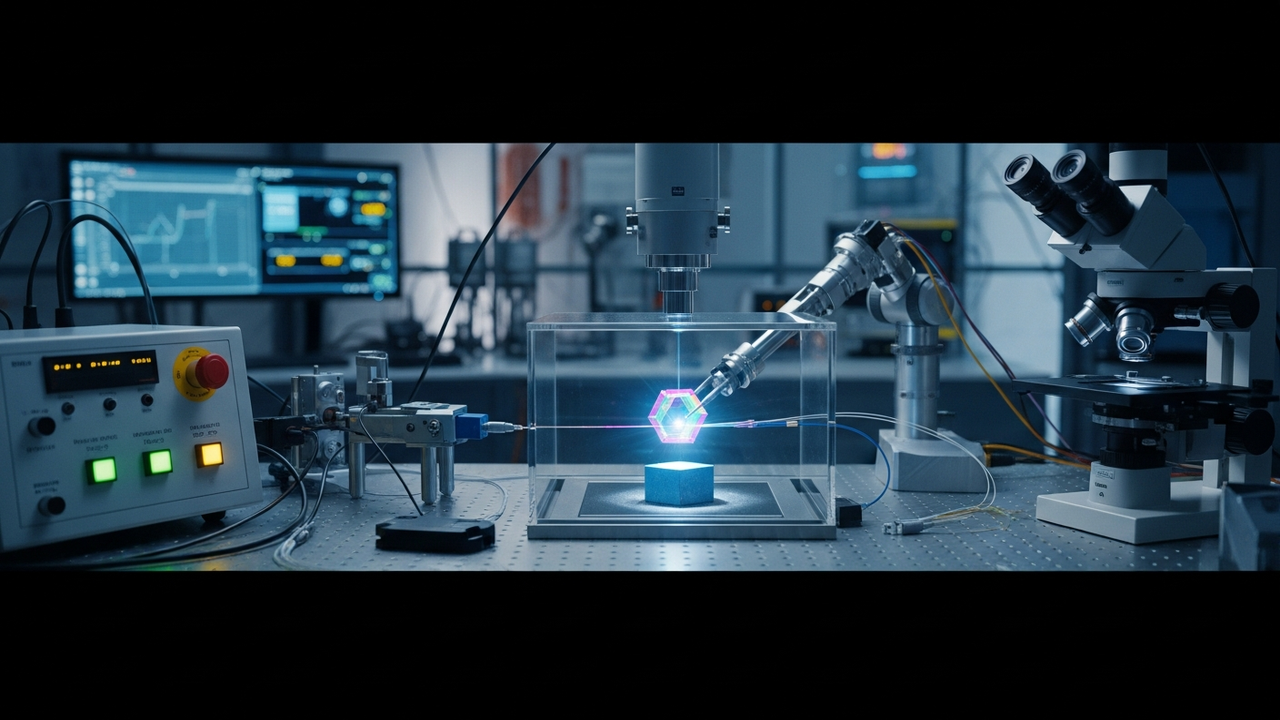
It has been demonstrated that negatively charged boron vacancies (V B⁻) are exceptionally promising quantum defects in hexagonal boron nitride (hBN) for advanced quantum sensing applications. Specifically, by subjecting hBN single crystals enriched with boron-10 and isotopically enriched nitrogen-15 to neutron irradiation, it was shown that boron vacancies suitable for quantum sensing, exhibiting high contrast and coherence, can be efficiently generated. This method paves the way for next-generation sensor technologies capable of sensing pressure, temperature, and magnetic fields with high spatial resolution.
Technical / Clinical Details
The research employed hBN single crystals intentionally enriched with boron-10, rather than the naturally dominant boron-11 isotope. Furthermore, enrichment with nitrogen-15, which possesses a nuclear spin (I=1/2), leads to reduced hyperfine interaction between the quantum defect (V B⁻) and surrounding nuclear spins. This reduction results in improved quantum coherence times, which is critical for preserving quantum bit information for extended periods. During the neutron irradiation process, boron-10 atoms absorb thermal neutrons and undergo nuclear transmutation into lithium-7 atoms. This process leaves behind vacant lattice sites previously occupied by boron atoms, thereby generating the desired V B⁻ defects. This precise technique enables the controlled creation of defects essential for quantum sensing.
Background & Context
Quantum sensors are expected to bring revolutionary advancements to medical diagnostics, geological surveys, navigation, and fundamental scientific research due to their extraordinary sensitivity and spatial resolution. Quantum sensors based on solid-state defects, in particular, are highly anticipated for practical applications given their ability to operate at room temperature. While diamond nitrogen-vacancy (NV) centers are well-known, V B⁻ defects in hBN offer new possibilities in device integration and surface sensitivity due to hBN’s atomic-scale thinness. However, a key challenge has been the efficient and controlled generation of V B⁻ defects. This study provides a clear solution to this challenge, significantly advancing the practical implementation of hBN quantum sensors.
Strategic Significance & Outlook
The successful generation of V B⁻ defects via neutron irradiation in boron-10 and nitrogen-15 enriched hBN single crystals represents a crucial step toward the practical implementation of high-performance hBN-based quantum sensors. This technology is particularly promising for applications in extreme environment sensing and highly sensitive detection of biomolecules, areas where previous methods faced significant difficulties. In the long term, it envisions use in ultra-sensitive magnetic field sensors operating at room temperature and as qubits for quantum computing. This research is poised to accelerate the development of quantum technologies and bring about revolutionary impacts on information technology and medical fields, warranting close attention to future research and application development.
Get our weekly technology intelligence — free
Receive an infographic that lets you judge at a glance whether each field’s analysis report is worth reading.
Subscribe Free — Weekly Tech Intelligence
By subscribing, you’ll receive Troy-Technical’s weekly technology intelligence newsletter.
- Your email and selected fields are used only to deliver the newsletter.
- We never share your information with third parties.
- You can unsubscribe anytime via the link in each email.
See our Privacy Policy for details.
Takes about a minute · Unsubscribe anytime