Background
Photonics technology is foundational across diverse fields, including optical communication, advanced sensors, quantum computing, and medical imaging. Yet, designing high-performance optical components, particularly nanoscale metamaterials and photonic crystals with their complex electromagnetic interactions, remains a challenging and time-intensive endeavor. Traditional design methodologies involved manual exploration of vast parameter spaces or relied on computationally expensive optimization algorithms, proving largely inefficient. The advent of AI is poised to surmount this design bottleneck, facilitating faster and more effective development of innovative optical devices. Physics-informed AI, such as QNM-Net, offers practical solutions to real-world design challenges by combining accuracy with reduced data demands.
Key Findings
Swedish researchers have introduced ‘QNM-Net,’ a novel method that significantly accelerates the inverse design of photonic components by integrating machine learning with physics-based calculations. This hybrid approach achieves superior spectral accuracy using substantially less data than traditional neural networks, streamlining the design of complex optical structures like photonic crystal slabs and metasurfaces.
Technical Details
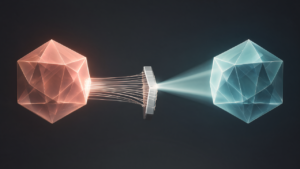
QNM-Net, or Quasi-Normal Mode Network, boosts efficiency by directly embedding fundamental physical laws derived from Quasi-Normal Mode (QNM) theory into its neural network architecture. This allows the AI model to inherently learn physical constraints, drastically reducing the data volume required for training. Unlike conventional data-driven AI models that demand extensive simulation and experimental datasets, QNM-Net’s physics-informed approach enhances data efficiency and shortens training durations. The method proves particularly effective in designing metasurfaces for specific wavelength transmission or reflection, and in optimizing photonic crystal slabs for precise light signal control. In inverse design applications, QNM-Net directly outputs the optimal material structure corresponding to a desired optical response, such as specific transmission or reflection spectra.
Strategic Significance & Outlook
The development of QNM-Net unequivocally showcases the transformative potential of fusing physics and AI to unlock new frontiers in science and technology. Looking ahead, this methodology is anticipated to extend beyond photonics to other design problems governed by fundamental physical laws, encompassing materials science, acoustics, and electromagnetism. Future developments include the automation of design for increasingly complex optical systems, such as integrated photonic circuits and adaptive optical systems, potentially even incorporating synthesis processes. This will profoundly accelerate the development of quantum computing hardware, ultra-high-speed communication devices, and next-generation imaging technologies, yielding significant impacts across a spectrum of fields, from fundamental scientific research to diverse industrial applications.
Source: https://www.optica-opn.org/home/newsroom/2026/june/a_little_physics_improves_ai_optical_design/
Get our weekly technology intelligence — free
Receive an infographic that lets you judge at a glance whether each field’s analysis report is worth reading.
Subscribe Free — Weekly Tech Intelligence
By subscribing, you’ll receive Troy-Technical’s weekly technology intelligence newsletter.
- Your email and selected fields are used only to deliver the newsletter.
- We never share your information with third parties.
- You can unsubscribe anytime via the link in each email.
See our Privacy Policy for details.
Takes about a minute · Unsubscribe anytime