Key Findings
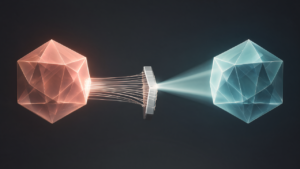
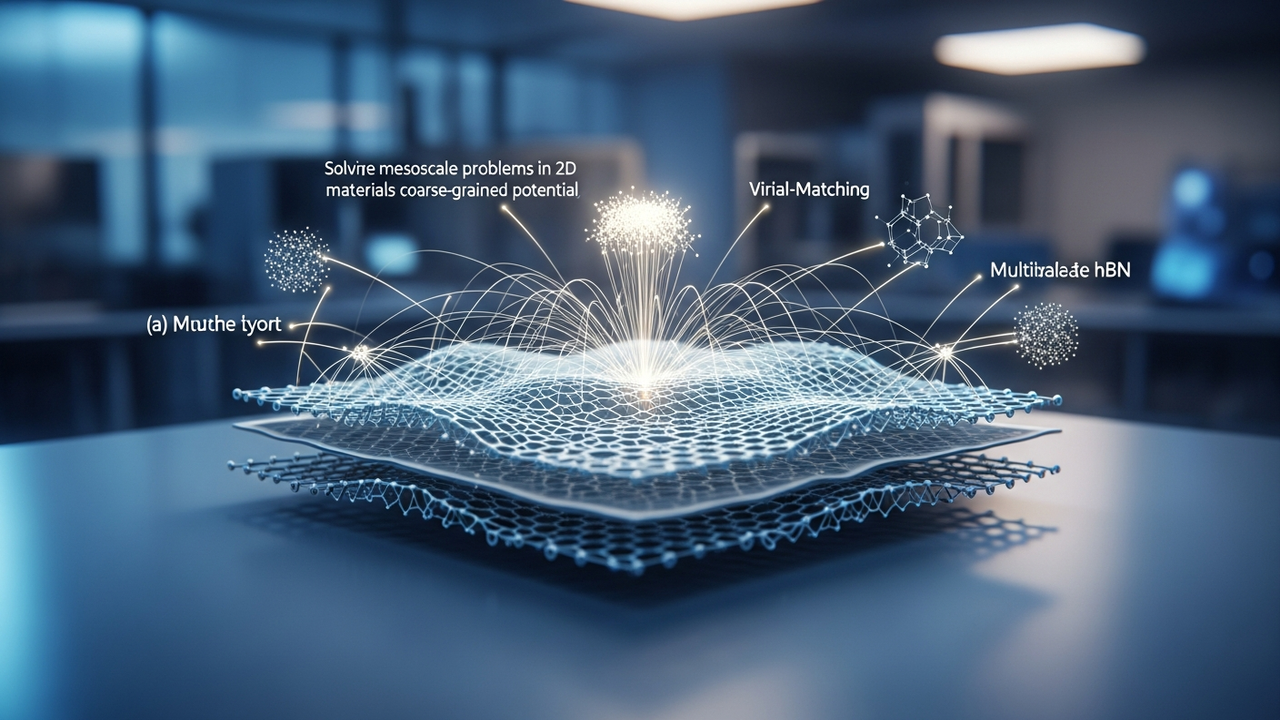
A novel bottom-up virial-matching coarse-graining (CG) method, based on machine learning potentials, has been proposed for multi-component 2D materials like multilayer hexagonal boron nitride (hBN). This innovative approach dramatically mitigates the exponential computational burden associated with analyzing mesoscale mechanical problems in 2D materials and addresses the long-standing scarcity of effective CG potentials.
Technical / Clinical Details
Coarse-graining (CG) modeling is a powerful technique that allows for simulations of larger systems and longer timescales by abstracting some atomistic details. However, constructing CG potentials while maintaining atomistic accuracy has been challenging. The virial-matching CG method proposed in this study operates in the following steps: First, machine learning potentials are trained to describe the interactions between coarse-grained ‘beads’ using force and virial information (a measure of pressure contribution) obtained from atomistic simulations (e.g., Density Functional Theory (DFT) or high-accuracy interatomic potentials). This training aims to faithfully reproduce atomistic physical behaviors (forces and stresses) at the coarse-grained scale. In the case of multilayer hBN, in-plane atoms of each hBN sheet are treated as coarse-grained beads, allowing for efficient modeling of interlayer interactions and in-plane deformation behaviors. This approach enables accurate simulation of mesoscale phenomena such as strain, crack propagation, and heat transport, which were computationally intractable with conventional atomistic simulations, but now at significantly reduced computational cost.
Background & Context
2D materials, exemplified by graphene and hBN, are highly anticipated for widespread applications in next-generation electronics, sensors, energy storage, and composite materials due to their superior electrical, mechanical, and thermal properties. However, to understand how these nanoscale materials behave when integrated into macroscopic devices, multi-scale simulations bridging atomistic, mesoscale, and even macroscale phenomena are essential. Traditional atomistic simulations, due to their high computational cost, are often limited to scales of tens of thousands of atoms and a few nanoseconds, making it difficult to capture mesoscale phenomena (millions of atoms, microseconds). CG potentials offer a solution to bridge this gap, but constructing high-accuracy CG potentials for complex multi-component 2D materials, with their intricate interactions between heterogeneous atoms, has remained a significant challenge. The introduction of machine learning overcomes this hurdle, opening new avenues for efficiently translating atomistic information into coarse-grained descriptions.
Strategic Significance & Outlook
This machine learning-based virial-matching coarse-graining method holds vast potential for application not only to multilayer hBN but also to various other multi-component 2D material systems, including graphene, MoS₂, and MXenes. Moving forward, this framework is expected to be extended to predict the behavior of 2D materials in more complex environments (e.g., in liquid solvents, polymer composites) and to simulate dynamic phenomena such as chemical reactions and phase transition processes. This will accelerate the development of next-generation high-performance devices, including flexible electronics, high-efficiency thermoelectric devices, and robust composite materials. Ultimately, this technology, which combines atomistic accuracy with mesoscale efficiency, is projected to dramatically advance the practical application and industrial implementation of 2D materials, significantly contributing to societal technological progress.
Source: https://pubs.acs.org/doi/10.1021/acs.jpcc.6c01847
Get our weekly technology intelligence — free
Receive an infographic that lets you judge at a glance whether each field’s analysis report is worth reading.
Subscribe Free — Weekly Tech Intelligence
By subscribing, you’ll receive Troy-Technical’s weekly technology intelligence newsletter.
- Your email and selected fields are used only to deliver the newsletter.
- We never share your information with third parties.
- You can unsubscribe anytime via the link in each email.
See our Privacy Policy for details.
Takes about a minute · Unsubscribe anytime