Key Findings
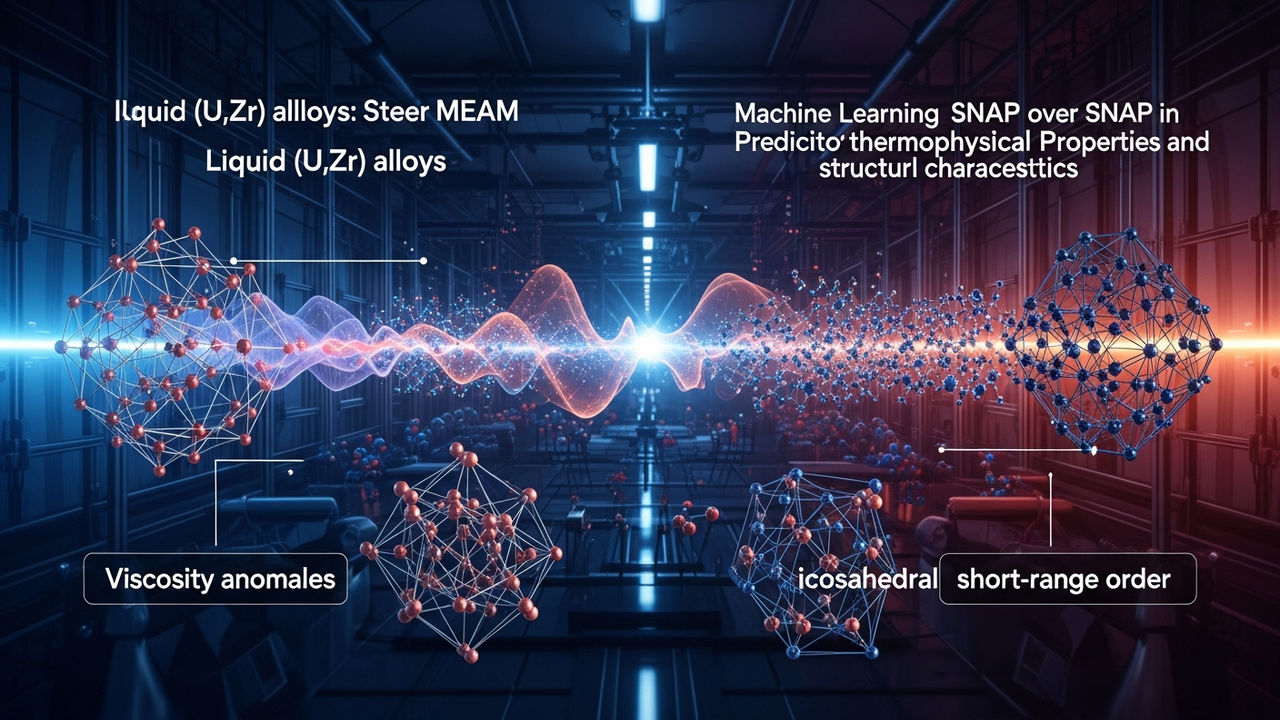
In the prediction of thermophysical and structural properties of liquid Uranium-Zirconium (U,Zr) mixtures, the machine learning-based Spectral Neighbor Analysis Potential (SNAP) demonstrated superior predictive capabilities and greater accuracy compared to the conventional empirical potential, the Modified-Embedded Atom Model (MEAM). This research provides new insights into complex structural formation mechanisms unique to liquid alloys, such as viscosity anomalies and icosahedral short-range order.
Technical / Clinical Details
The study began by performing first-principles calculations, such as Density Functional Theory (DFT), for liquid (U,Zr) mixtures to generate high-accuracy interatomic interaction data. This data was then used to train and evaluate two types of interatomic potential models: SNAP and MEAM. MEAM is an empirical potential that describes interatomic interactions and has relatively low computational cost, but its ability to describe complex many-body interactions is limited. SNAP, on the other hand, is a machine learning-based potential that describes the local atomic environment spectrally, allowing it to capture higher-dimensional interactions. The evaluation results showed that SNAP exhibited excellent agreement with DFT calculation results for both thermophysical properties—such as density, diffusion coefficient, viscosity, and specific heat—and structural properties—such as atomic pair correlation functions and local structural order (e.g., formation of icosahedral structures)—of liquid (U,Zr), outperforming MEAM. Specifically, SNAP more accurately reproduced phenomena like viscosity anomalies at high temperatures, which are believed to originate from the complex short-range order in liquid metals.
Background & Context
Uranium-Zirconium alloys are widely used as nuclear fuel materials in fast reactors and research reactors. Understanding their behavior at high temperatures, particularly their properties in the liquid state, is crucial for safety assessment during core meltdown accidents and for designing new fuels. The thermophysical properties of liquid metals influence convection, heat transfer, material corrosion, and solidification processes. However, experiments under these extreme conditions are difficult, making computational simulations indispensable. Traditional empirical potentials have struggled to adequately describe the complex many-body interactions in liquid metals, leading to challenges in predictive accuracy. Machine Learning Interatomic Potentials (MLIPs) are garnering significant expectations in this field for their ability to combine DFT accuracy with a dramatic improvement in MD simulation computational efficiency. This research provides important evidence for the superiority of MLIPs in simulating materials used under harsh environments.
Strategic Significance & Outlook
The utilization of high-performance MLIPs like SNAP will be widely applied not only to nuclear fuel materials but also to other material systems where liquid state properties are critical, such as high-temperature superalloys, metallic glasses, and liquid metal coolants. Moving forward, this technology is expected to improve the reliability of core simulations and contribute to the design of safer and more efficient nuclear reactors. It will also be applied to the analysis of complex solidification processes and interfacial phenomena, enabling a deeper understanding of material microstructure control and defect behavior. The evolution of AI-driven interatomic potentials will empower materials scientists to design and optimize materials at scales and accuracies previously inaccessible, accelerating technological innovation in many strategic industries, including energy, defense, and aerospace. This serves as a prime example of how advances in fundamental science lead directly to industrial applications.
Source: https://pubmed.ncbi.nlm.nih.gov/42285141/
Get our weekly technology intelligence — free
Receive an infographic that lets you judge at a glance whether each field’s analysis report is worth reading.
Subscribe Free — Weekly Tech Intelligence
By subscribing, you’ll receive Troy-Technical’s weekly technology intelligence newsletter.
- Your email and selected fields are used only to deliver the newsletter.
- We never share your information with third parties.
- You can unsubscribe anytime via the link in each email.
See our Privacy Policy for details.
Takes about a minute · Unsubscribe anytime