Key Findings
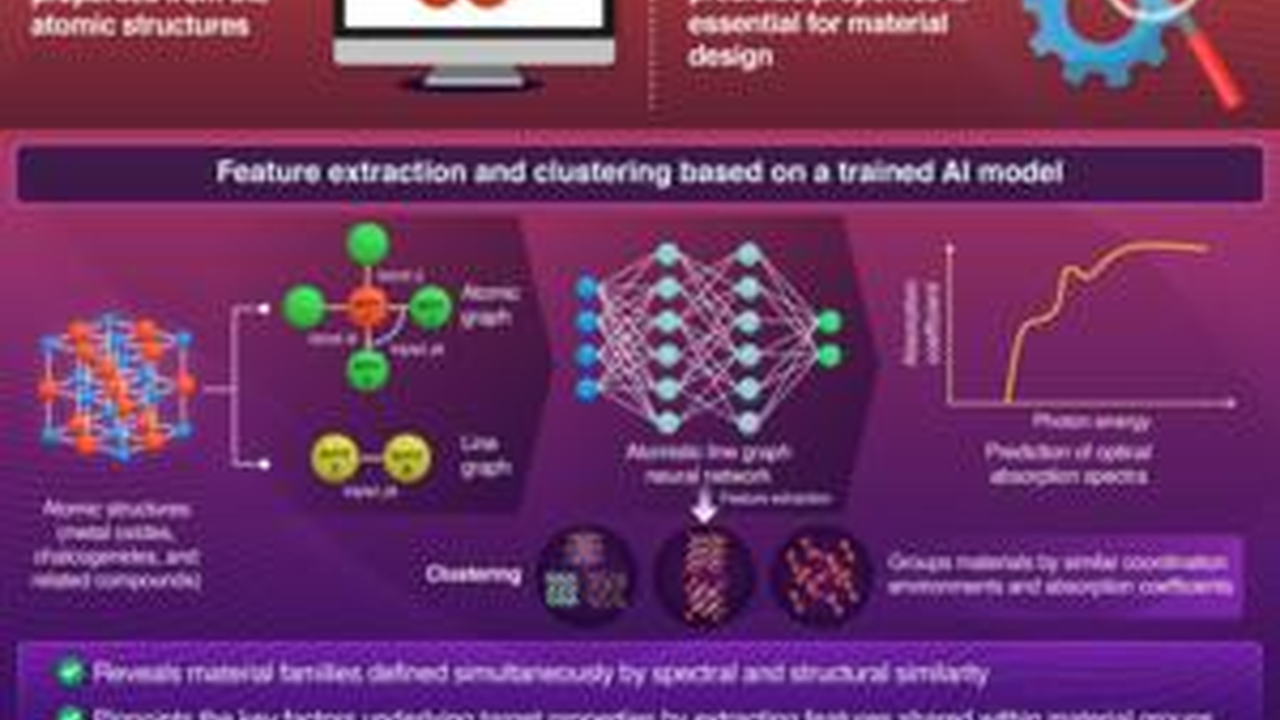
A research team at Tokyo University of Science has developed a groundbreaking method to explain how artificial intelligence (AI) models learn and predict the relationships between material structures and their properties. This ‘interpretable AI’ approach allows material scientists to peer inside the AI’s black box, fostering a deeper understanding of its predictive reasoning. Specifically, the ability to clearly extract key features that AI prioritizes when correlating complex crystal structures with optical spectra, and then to efficiently classify and group materials based on similar structural and spectral characteristics, holds the potential to fundamentally transform the paradigm of novel material development.
Technical Details
The newly developed technique focuses not only on the prediction results generated by AI models but also on visualizing the underlying mechanisms. It automatically identifies crucial features from vast datasets of material information that indicate how specific crystal structures influence particular optical spectra. This empowers researchers to understand ‘why’ the AI predicted a material would possess certain properties. For instance, if certain interatomic distances or bond angles significantly contribute to optical characteristics, the AI recognizes these as important features and presents them in an intuitively understandable manner. This approach classifies materials by considering both structural and spectral similarities, offering more precise insights than conventional methods relying on a single property. The research leverages advanced machine learning algorithms combined with large-scale data analysis to provide a new interpretive tool for complex problems in materials science.
Background & Context
In contemporary materials science, the discovery of materials with novel functionalities is crucial across diverse fields, from environmental solutions to medicine and electronics. However, traditional methods for identifying optimal materials from a vast number of candidates have historically incurred immense time and cost. While AI has emerged as a powerful tool to accelerate material discovery, the ‘black box problem’—where the reasoning behind AI’s predictions remains opaque—has been a persistent challenge. This research addresses this black box problem, enhancing the transparency and trustworthiness of AI predictions, thereby promoting broader adoption and utilization of AI in materials science research. In the future, based on the ‘interpretations’ provided by AI, researchers can formulate more precise experimental designs and devise more efficient material synthesis pathways.
Strategic Significance & Outlook
This interpretable AI technology has the potential to revolutionize the discovery and design of new materials. Researchers will be able to efficiently search for materials with specific optical properties or precisely design atomic arrangements to achieve desired characteristics, all guided by AI’s insights. This is expected to lead to breakthroughs in areas such as enhancing solar cell efficiency, improving LED performance, developing novel catalysts, and designing advanced quantum materials. Furthermore, the methodology is applicable beyond crystal structures and optical spectra, potentially extending to the design of all types of functional materials. This achievement by Tokyo University of Science represents a critical step towards increasing the reliability and efficiency of AI-driven materials science, thereby accelerating material innovation for a sustainable future on a global scale.
Source: https://www.eurekalert.org/news-releases/1131777
Get our weekly technology intelligence — free
Receive an infographic that lets you judge at a glance whether each field’s analysis report is worth reading.
Subscribe Free — Weekly Tech Intelligence
By subscribing, you’ll receive Troy-Technical’s weekly technology intelligence newsletter.
- Your email and selected fields are used only to deliver the newsletter.
- We never share your information with third parties.
- You can unsubscribe anytime via the link in each email.
See our Privacy Policy for details.
Takes about a minute · Unsubscribe anytime