Background
A fundamental hurdle in quantum computing has been the pervasive issues of qubit decoherence—the loss of quantum state—and inherently high error rates. While many research institutions and companies are investing heavily in quantum error correction (QEC) techniques, these often necessitate vast numbers of physical qubits and intricate control circuits to achieve fault tolerance. Microsoft, however, is pursuing a distinct strategy: topological quantum computing, which aims to address these fundamental challenges at their root. Majorana fermions, long a subject of theoretical physics, hold the promise of not only revolutionizing quantum computing but also offering profound implications for fundamental physics.
Key Findings
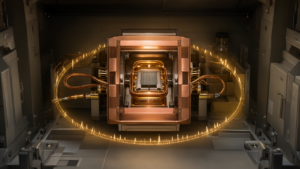
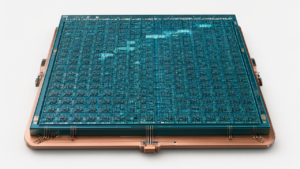
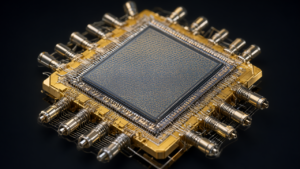
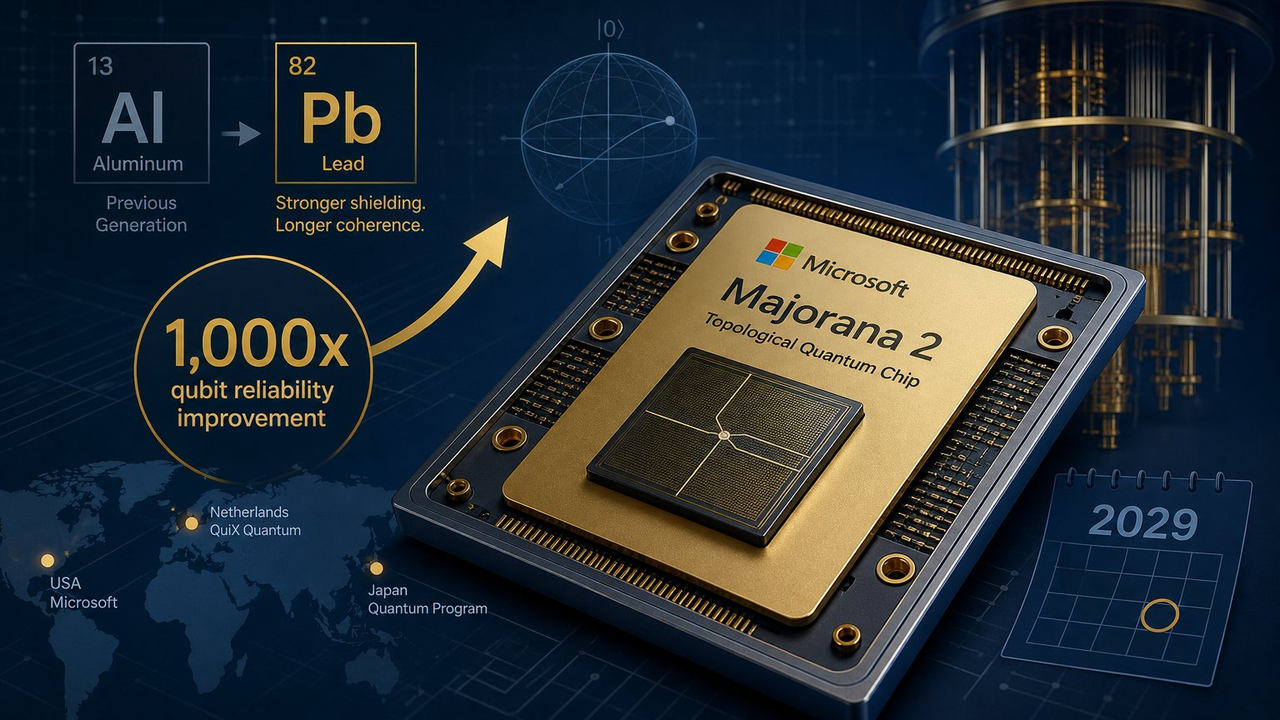
Microsoft has officially unveiled ‘Majorana 2,’ the next generation of its topological quantum chip, claiming an inherent 1000-fold increase in reliability compared to existing superconducting qubits. This represents a monumental leap in quantum computing technology, positioning the realization of a practical quantum computer by 2029 as a considerably more realistic objective.
Technical Details
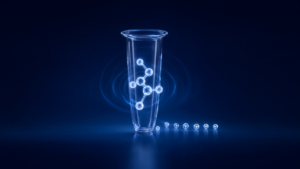
- The ‘Majorana 2’ chip pioneers a distinct technological paradigm: topological quantum computing. Unlike conventional qubits, which suffer from high susceptibility to environmental noise, this approach leverages exotic quasi-particles, specifically Majorana fermions, to encode quantum information. This inherent design choice results in significantly more robust qubits.
- By topologically protecting quantum information, these qubits are inherently resistant to localized noise and perturbations, drastically mitigating the extensive error correction typically required.
- Developed at Microsoft’s Quantum Lab in Copenhagen, this architectural advantage is projected to substantially decrease the error correction overhead indispensable for achieving fault-tolerant quantum computing.
- Where traditional quantum computing architectures might demand millions of physical qubits to safeguard a handful of logical qubits, topological qubits offer the potential to achieve comparable or even superior reliability with a far more modest physical footprint.
- The asserted ‘1000x improvement in reliability’ for Majorana 2 stems from a comprehensive evaluation across critical performance metrics, encompassing qubit lifetime, gate fidelity, and intrinsic resilience to environmental noise. This heightened stability facilitates the execution of more complex and extended quantum computations with unprecedented precision.
Strategic Significance & Outlook
The announcement of the ‘Majorana 2’ chip marks a pivotal milestone in Microsoft’s overarching quantum computing strategy. The advent of inherently reliable qubits significantly accelerates the path towards fault-tolerant quantum computers, while the ambitious 2029 timeline is poised to inject considerable excitement and intensify competition across the industry. Should this technology be validated and successfully scaled, it promises to unlock unprecedented computational capabilities across diverse fields, including novel materials discovery, advanced drug development, sophisticated financial modeling, and optimized AI solutions, thereby substantially catalyzing the commercialization of quantum computing. Microsoft’s vision includes integrating this advanced chip into its cloud-based Azure Quantum platform, fostering an accessible ecosystem for a broad spectrum of users and researchers.
Source: https://marcpope.com/blog/microsoft-s-majorana-2-is-the-quantum-chip-that-made-2029-feel-real
Get our weekly technology intelligence — free
Receive an infographic that lets you judge at a glance whether each field’s analysis report is worth reading.
Subscribe Free — Weekly Tech Intelligence
By subscribing, you’ll receive Troy-Technical’s weekly technology intelligence newsletter.
- Your email and selected fields are used only to deliver the newsletter.
- We never share your information with third parties.
- You can unsubscribe anytime via the link in each email.
See our Privacy Policy for details.
Takes about a minute · Unsubscribe anytime