Background
The burgeoning demand for on-chip photonics, fueled by advancements in artificial intelligence (AI), necessitates faster data transfer with significantly reduced heat generation. While powerful, traditional Deep Ultraviolet (DUV) lithography faces increasing complexity and cost challenges for scalable photonic chip manufacturing. Nanoimprint lithography (NIL) has re-emerged as a compelling alternative, offering high resolution, lower cost, and a simpler process ideal for patterning intricate photonic structures.
Historically, the NIL equipment market has been dominated by a few international players, particularly Japan’s Canon. Prinano’s achievement represents a pivotal development in China’s strategic drive for semiconductor self-sufficiency, aiming to reduce reliance on external technology and strengthen its domestic supply chain resilience.
Key Findings
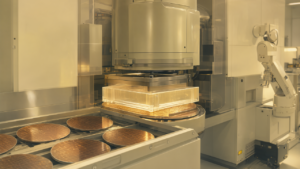
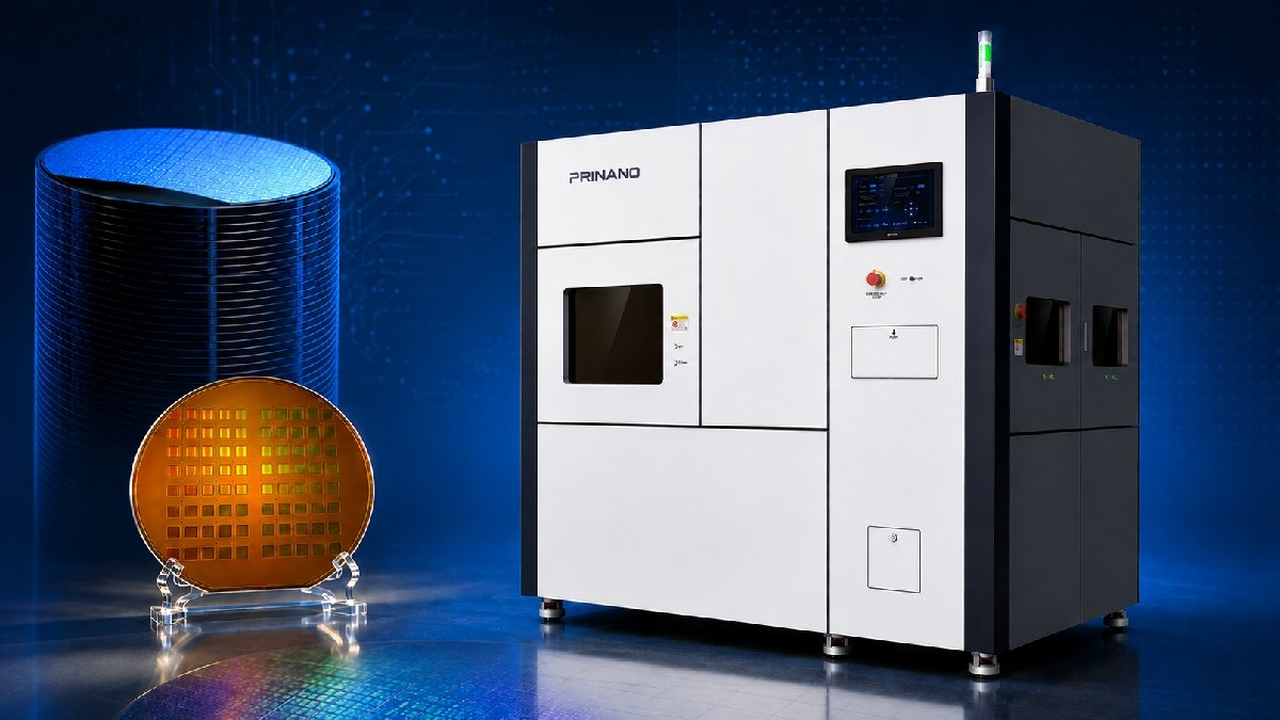
Chinese startup Prinano Technology has announced the successful validation of volume production for 8-inch photonic chip wafers using its indigenously developed PL-AS vacuum pneumatic wafer-level nanoimprint lithography (NIL) machine. This innovative system bypasses conventional Deep Ultraviolet (DUV) lithography, reportedly reducing manufacturing costs to approximately one-tenth of traditional DUV-based solutions, while achieving sub-2nm residual layer variation and sub-10nm feature sizes. This represents a strategically significant breakthrough for China’s semiconductor industry, challenging the long-standing dominance of international suppliers like ASML and Canon in high-end lithography.
Technical Details
- The Prinano PL-AS machine employs a proprietary vacuum air-cushion nanoimprint process, enabling highly uniform pressure distribution across the wafer and precise nanoscale pattern transfer.
- The system is claimed to achieve a residual layer variation of less than 2nm and feature sizes below 10nm, parameters critical for high-performance photonic devices where optical properties are intrinsically linked to physical geometry.
- Reported manufacturing cost reductions are substantial, estimated at approximately 90% compared to DUV lithography, positioning NIL as a highly cost-effective alternative.
- Furthermore, the lifespan of the imprint template is claimed to be five times longer than conventional methods, contributing to reduced consumable costs and improved production efficiency.
- The PL-AS is constructed with 100% domestically produced components, offering a robust solution against international tech sanctions and geopolitical supply chain risks, thereby bolstering China’s technological self-reliance.
- Beyond photonic chips, the technology is expected to find applications in optical communication modules and optical interconnect devices, indicating broad potential.
Strategic Significance & Outlook
The successful volume production validation of Prinano’s PL-AS machine signals China’s potential to establish independent high-end semiconductor manufacturing capabilities, circumventing reliance on international giants. Widespread adoption of this technology could drastically lower the cost of photonic chips, accelerating innovation across optical communications, data centers, and AI hardware. However, independent verification of yields and production volumes will be crucial to ascertain its true market impact and commercial viability. Canon is also aggressively pursuing the commercialization of its nanoimprint technology, targeting high-volume manufacturing adoption by 2027, indicating intensifying competition in this critical sector.
Get our weekly technology intelligence — free
Receive an infographic that lets you judge at a glance whether each field’s analysis report is worth reading.
Subscribe Free — Weekly Tech Intelligence
By subscribing, you’ll receive Troy-Technical’s weekly technology intelligence newsletter.
- Your email and selected fields are used only to deliver the newsletter.
- We never share your information with third parties.
- You can unsubscribe anytime via the link in each email.
See our Privacy Policy for details.
Takes about a minute · Unsubscribe anytime