Key Findings
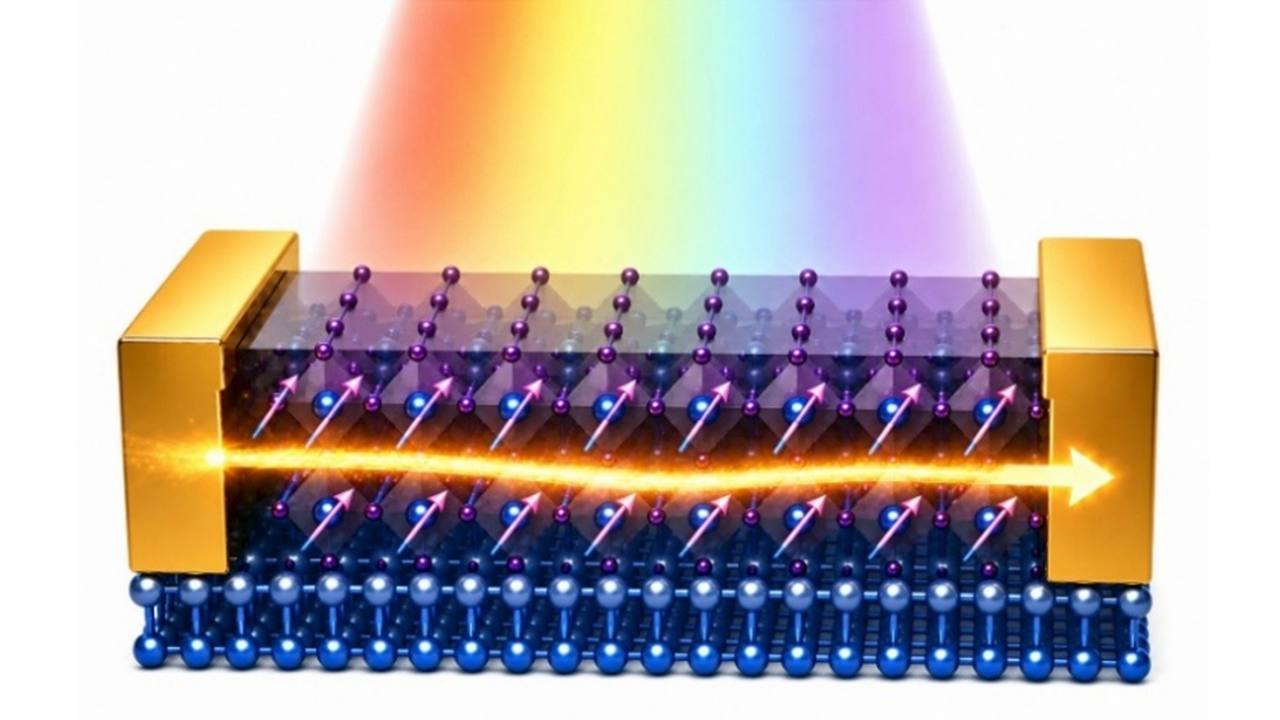
A research team from The University of Tokyo has successfully demonstrated the generation of an exceptionally large ‘shift current’ in CsGeI3, an environmentally friendly, lead-free halide perovskite material. This current is more than an order of magnitude higher than previously reported values. This pivotal discovery firmly establishes ferroelectric halide perovskites as highly promising materials for developing next-generation solar cells and optoelectronic devices that are both high-efficiency and environmentally conscious.
Technical / Clinical Details
Shift current is a unique type of photocurrent that arises from the absorption of light in a material without the need for an external electric field, operating on a different mechanism compared to conventional p-n junction solar cells. The research team measured this shift current using CsGeI3, a lead-free ferroelectric halide perovskite. The results revealed that the magnitude of the shift current generated by CsGeI3 vastly exceeded that of any previously reported ferroelectric material by orders of magnitude. This highly efficient shift current generation is believed to originate from the unique crystal and electronic band structures of CsGeI3. By entirely eliminating lead, this research addresses a significant environmental concern associated with many conventional perovskite solar cells, enabling the development of more sustainable photo-conversion technologies.
Background & Context
While perovskite solar cells have attracted considerable attention for their high conversion efficiencies, the use of toxic lead in most formulations has been a significant environmental concern. Consequently, research into lead-free perovskite materials is paramount for balancing the widespread adoption of solar cells with environmental sustainability. Previous lead-free perovskites often lagged behind their lead-containing counterparts in terms of efficiency and stability, but the dramatic improvement in shift current demonstrated here represents a major step towards bridging that performance gap. Harnessing shift currents in ferroelectric materials enables the design of photo-conversion devices based on new operating principles, contributing to devices with characteristics difficult to achieve with conventional technologies.
Strategic Significance & Outlook
This discovery suggests that lead-free ferroelectric halide perovskites could form the foundational material for high-efficiency, sustainable next-generation solar cells, photodetectors, and other optoelectronic devices. Specifically, the ability to generate photocurrent without an applied electric field through shift current enables simplified device structures and low-power operation, opening new application avenues in energy harvesting and sensor technologies. Moving forward, continued progress in enhancing the stability of this material and developing large-scale synthesis processes will accelerate the practical implementation of environmentally friendly, high-performance optoelectronic devices, significantly contributing to a sustainable society. This technology holds the potential to be a breakthrough in the renewable energy sector, offering a green alternative without compromising on performance.
Source: https://www.t.u-tokyo.ac.jp/en/press/pr2026-06-23-001
Get our weekly technology intelligence — free
Receive an infographic that lets you judge at a glance whether each field’s analysis report is worth reading.
Subscribe Free — Weekly Tech Intelligence
By subscribing, you’ll receive Troy-Technical’s weekly technology intelligence newsletter.
- Your email and selected fields are used only to deliver the newsletter.
- We never share your information with third parties.
- You can unsubscribe anytime via the link in each email.
See our Privacy Policy for details.
Takes about a minute · Unsubscribe anytime