Key Findings
A comprehensive review published in ACS Chemical Reviews elucidates how the inherent complexities and challenges within organic chemistry have acted as a powerful catalyst for conceptual and methodological innovation in the field of Artificial Intelligence (AI). This analysis details the profound ways chemistry has shaped the development of modern AI techniques and fostered entirely new research paradigms.
Technical / Clinical Details
Specific domains within organic chemistry have significantly influenced the advancement of AI technologies:
- Reaction Prediction: The problem of predicting reaction products from reactants has become a crucial benchmark for training machine learning models, leading to the development of more accurate predictive models and enhancing the efficiency of synthetic route design.
- Mechanistic Inference: AI’s capability to infer underlying chemical reaction mechanisms deepens our understanding of complex reaction networks and facilitates the discovery of novel reactions, demonstrating AI’s potential as a partner in scientific discovery, not merely a data processing tool.
- Retrosynthesis Planning: AI-driven retrosynthesis planning, which proposes optimal precursors for target molecules, is an invaluable tool for synthetic chemists. Advancements in this area significantly reduce time and cost, enabling the synthesis of previously challenging molecules.
- Multimodal Fusion for Chemical Reasoning: AI’s ability to integrate and analyze multiple data types—such as molecular structures, spectroscopic data, and reaction conditions—allows for more sophisticated chemical reasoning.
- Generative Molecular Design: AI’s autonomous capability to design new molecular structures opens vast possibilities for novel discoveries in pharmaceuticals and materials science.
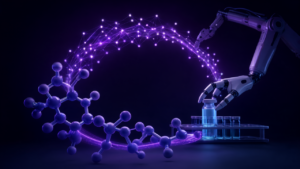
- Self-Driving Laboratories: Systems combining robotics and AI to automate experimental planning, execution, and data analysis accelerate research cycles and mitigate human bias in scientific inquiry.
Despite these advances, the field still contends with challenges such as “data sparsity”—where data for specific chemical phenomena is scarce—and the “benchmark-to-lab gap,” where model performance on theoretical benchmarks does not always translate to success in real-world laboratory settings.
Background & Context
Organic chemistry, with its vast molecular space, intricate reactivities, and time/resource-intensive experimental data acquisition, has consistently pushed the boundaries of human cognitive and computational abilities. This “non-data-rich” aspect has driven chemists to seek more efficient solutions, particularly through AI applications. In numerous industries influenced by chemistry, including drug discovery, new material design, and catalyst optimization, AI is increasingly recognized as an indispensable tool for overcoming conventional limitations.
Strategic Significance & Outlook
As suggested by this review, the co-evolution of organic chemistry and AI will continue to unlock new frontiers in scientific discovery and technological innovation. Key future research directions include improving data collection and curation, enhancing the interpretability of AI models, and achieving seamless integration with real-world chemical experimentation. AI’s potential to augment chemists’ capabilities and accelerate the creation of new drugs and functional materials for societal challenges is immeasurable. Further development of self-driving laboratories promises to dramatically alter the speed and scale of research, potentially redefining the scientific method itself.
Source: https://pubs.acs.org/doi/10.1021/acs.chemrev.5c01081
Get our weekly technology intelligence — free
Receive an infographic that lets you judge at a glance whether each field’s analysis report is worth reading.
Subscribe Free — Weekly Tech Intelligence
By subscribing, you’ll receive Troy-Technical’s weekly technology intelligence newsletter.
- Your email and selected fields are used only to deliver the newsletter.
- We never share your information with third parties.
- You can unsubscribe anytime via the link in each email.
See our Privacy Policy for details.
Takes about a minute · Unsubscribe anytime