Key Findings
A recent research paper published in Nature Energy reports the successful development of an innovative ‘cascade hole-transfer strategy’ for hybrid perovskite/organic solar cells. This strategy effectively suppresses charge recombination while simultaneously imparting inherent moisture stability. This breakthrough represents a significant advancement in overcoming the major hurdle of sensitivity to heat and humidity, which has critically limited the commercialization of perovskite solar cells.
Technical Details
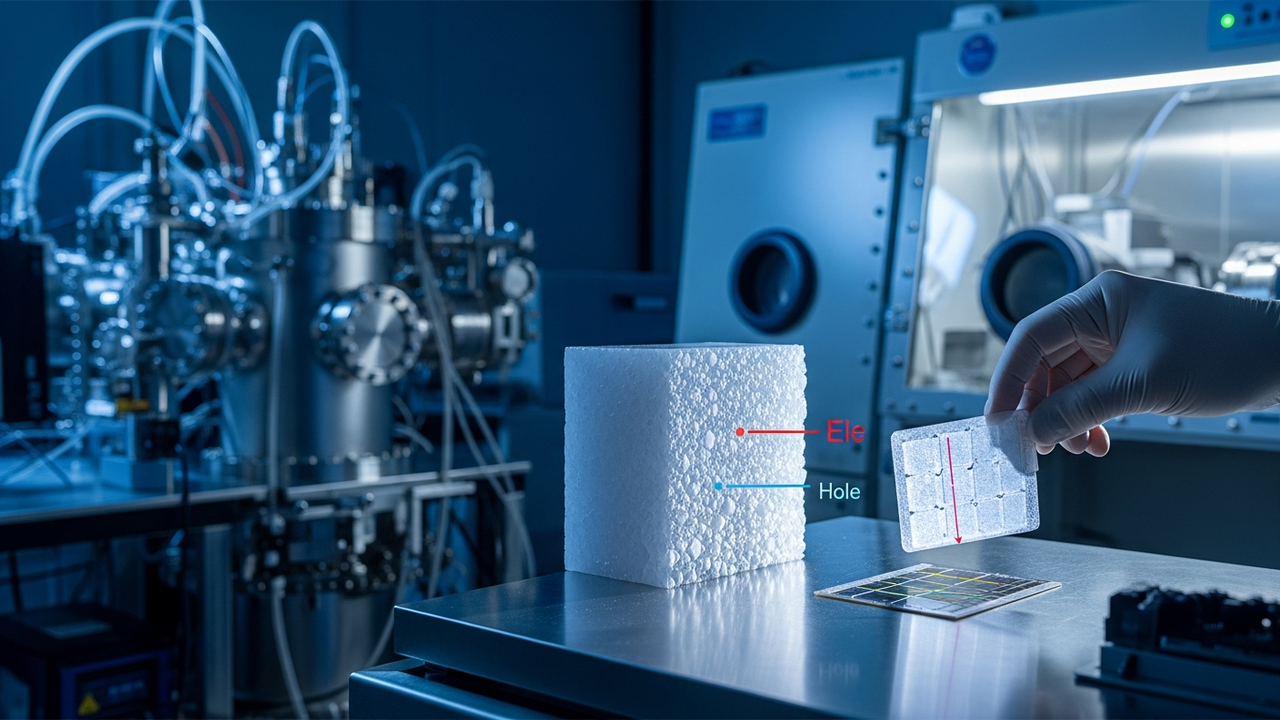
The cascade hole-transfer strategy developed in this study involves the sequential arrangement of multiple hole-transporting materials, creating an efficient pathway for the extraction of charge carriers (holes). This configuration ensures that holes generated within the perovskite layer smoothly migrate to the electrode, dramatically suppressing energy losses due to charge recombination. This strategy builds upon prior research that demonstrated the stable functionality of thiocyanate-incorporated perovskite materials even when processed in humid ambient air. Thiocyanate compounds are known to passivate defects within the perovskite crystal structure, thereby enhancing its resistance to degradation induced by moisture. The novel cascade hole-transfer strategy further amplifies this inherent moisture stability, leading to a synergistic improvement in the overall durability of the device. This provides a concrete solution to the long-standing challenge of simultaneously achieving high performance and long-term stability in perovskite solar cells.
Background & Context
Perovskite solar cells have seen a dramatic increase in power conversion efficiency over the past decade, positioning them as a leading candidate for next-generation photovoltaics. However, despite their high efficiency, vulnerability to environmental factors such as heat, humidity, and UV light has remained the most significant barrier to commercialization. Moisture, in particular, is a primary culprit, disrupting the perovskite crystal structure and causing performance degradation. Previous research efforts have focused on improving stability through material composition modifications and encapsulation techniques, but these have not fully resolved the intrinsic stability issues. The ‘cascade hole-transfer strategy’ is a highly anticipated breakthrough for the industry, as it addresses fundamental moisture stability from both material design and device architecture perspectives.
Strategic Significance & Outlook
The success of this cascade hole-transfer strategy clearly defines a pathway for perovskite solar cells to achieve reliable, long-term performance in outdoor environments. Enhanced moisture stability will extend the product lifespan of perovskite solar cells, potentially enabling them to match or even surpass the durability of conventional silicon solar cells. This breakthrough is expected to accelerate commercial deployment across a wide range of applications, including Building-Integrated Photovoltaics (BIPV), flexible solar cells, and transparent solar cells. Furthermore, if ambient-air processing remains applicable, it could lead to further reductions in manufacturing costs, representing a critical step towards making perovskite solar cells more affordable and widely accessible. This achievement solidifies the role of perovskite technology in the global clean energy transition.
Get our weekly technology intelligence — free
Receive an infographic that lets you judge at a glance whether each field’s analysis report is worth reading.
Subscribe Free — Weekly Tech Intelligence
By subscribing, you’ll receive Troy-Technical’s weekly technology intelligence newsletter.
- Your email and selected fields are used only to deliver the newsletter.
- We never share your information with third parties.
- You can unsubscribe anytime via the link in each email.
See our Privacy Policy for details.
Takes about a minute · Unsubscribe anytime