Key Findings
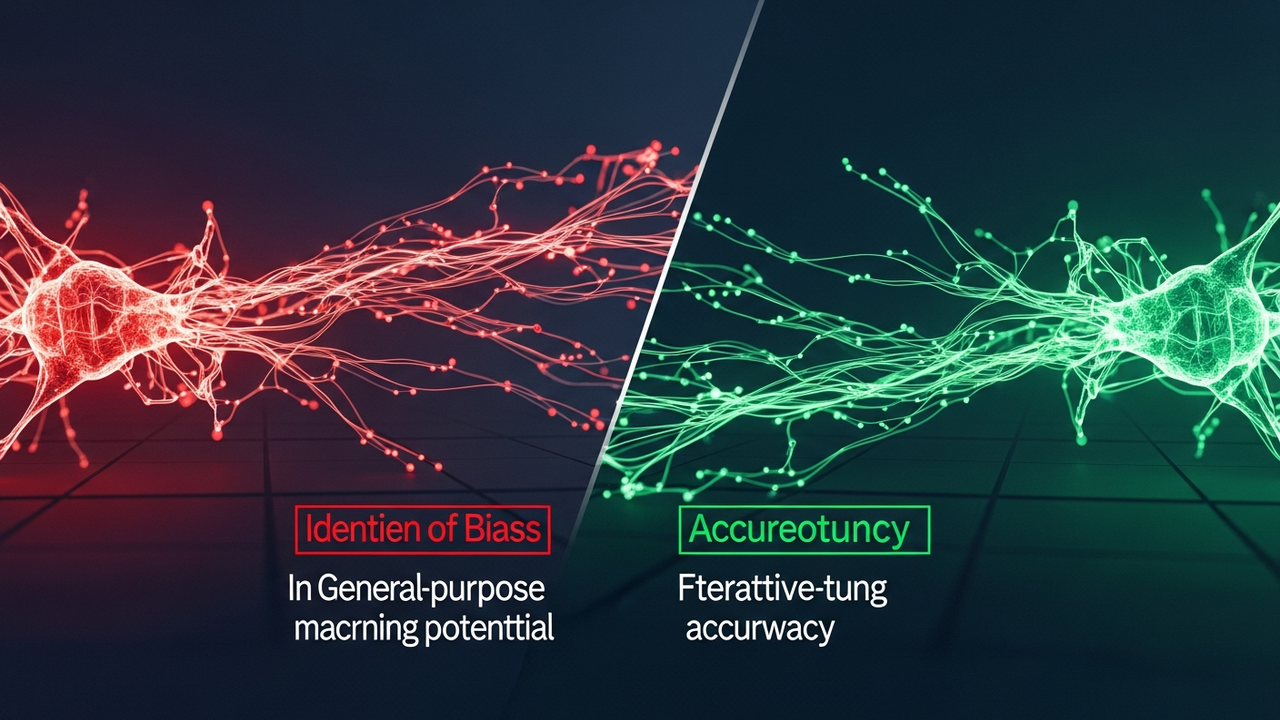
Intrinsic biases within universal machine-learned interatomic potentials (uMLIPs), such as MACE, have been identified as a major factor limiting the effectiveness of their fine-tuning. This study demonstrated that systematic predictive biases emerge in molecular dynamics (MD) simulation trajectories when uMLIPs are applied to chemical systems not covered by their training data. While a single step of fine-tuning struggles to fully eliminate these biases, applying multiple, iterative fine-tuning processes is suggested as a promising solution to effectively mitigate them and enhance the model’s predictive accuracy.
Technical / Clinical Details
Universal machine-learned interatomic potentials (uMLIPs) are pre-trained on vast datasets to describe interatomic interactions across diverse chemical environments. This provides excellent initial predictive performance for a wide range of material systems, but fine-tuning is often necessary when applying them to specific new systems or extreme conditions. The study revealed the following methodology and results:
- Bias Identification: Through detailed simulations and analysis, the research team showed that when uMLIPs were applied to chemical systems outside their training data range (e.g., specific inter-element interactions or extreme temperature/pressure conditions), systematic errors (biases) occurred in energy, forces, and molecular dynamics trajectories. This bias arises because the ‘averaged’ interactions learned by the uMLIP fail to capture the subtle chemical and physical characteristics of specific systems.
- Limitations of Fine-Tuning: It was found that conventional single-step fine-tuning, while improving predictive accuracy with a small amount of added high-precision data, did not completely remove the intrinsic biases. This is because the ‘prior knowledge’ embedded in the uMLIP’s initial training partially hinders learning from new data.
- Effectiveness of Iterative Fine-Tuning: As a solution, the study proposes an iterative fine-tuning process. This method involves repeatedly generating new simulation data from a fine-tuned model and then using that data for further fine-tuning. This iterative process was shown to gradually adapt the model to the specific characteristics of the chemical system, steadily reducing bias and improving both predictive accuracy and the reliability of MD simulations.
This finding has significant implications for establishing MLIPs as reliable computational tools.
Background & Context
Machine learning potentials are gaining significant attention as powerful tools that enable large-scale simulations in materials science by combining the accuracy of quantum chemistry calculations with the computational efficiency of classical molecular dynamics. However, their reliability and generalizability limitations have been major concerns, particularly in practical applications like new material design and process optimization. Understanding bias in uMLIPs and developing strategies to overcome it through fine-tuning are key to wider adoption of computational materials science in industry. Progress in this area impacts a broad range of industries, including drug design, battery materials, and catalyst development.
Strategic Significance & Outlook
The findings of this study are essential for establishing best practices in uMLIP applications and enhancing their reliability. Future research will focus on further automating iterative fine-tuning processes and establishing optimal criteria for selecting fine-tuning data. Additionally, it is anticipated that efforts will be made to design uMLIP architectures and pre-training strategies that can proactively identify and minimize bias. These advancements are expected to enable MLIPs to predict material behavior in more complex chemical systems and extreme environments with high confidence, contributing to the further acceleration of AI-driven materials development.
Source: https://pubs.acs.org/doi/10.1021/acs.jctc.6c00425
Get our weekly technology intelligence — free
Receive an infographic that lets you judge at a glance whether each field’s analysis report is worth reading.
Subscribe Free — Weekly Tech Intelligence
By subscribing, you’ll receive Troy-Technical’s weekly technology intelligence newsletter.
- Your email and selected fields are used only to deliver the newsletter.
- We never share your information with third parties.
- You can unsubscribe anytime via the link in each email.
See our Privacy Policy for details.
Takes about a minute · Unsubscribe anytime