Key Findings
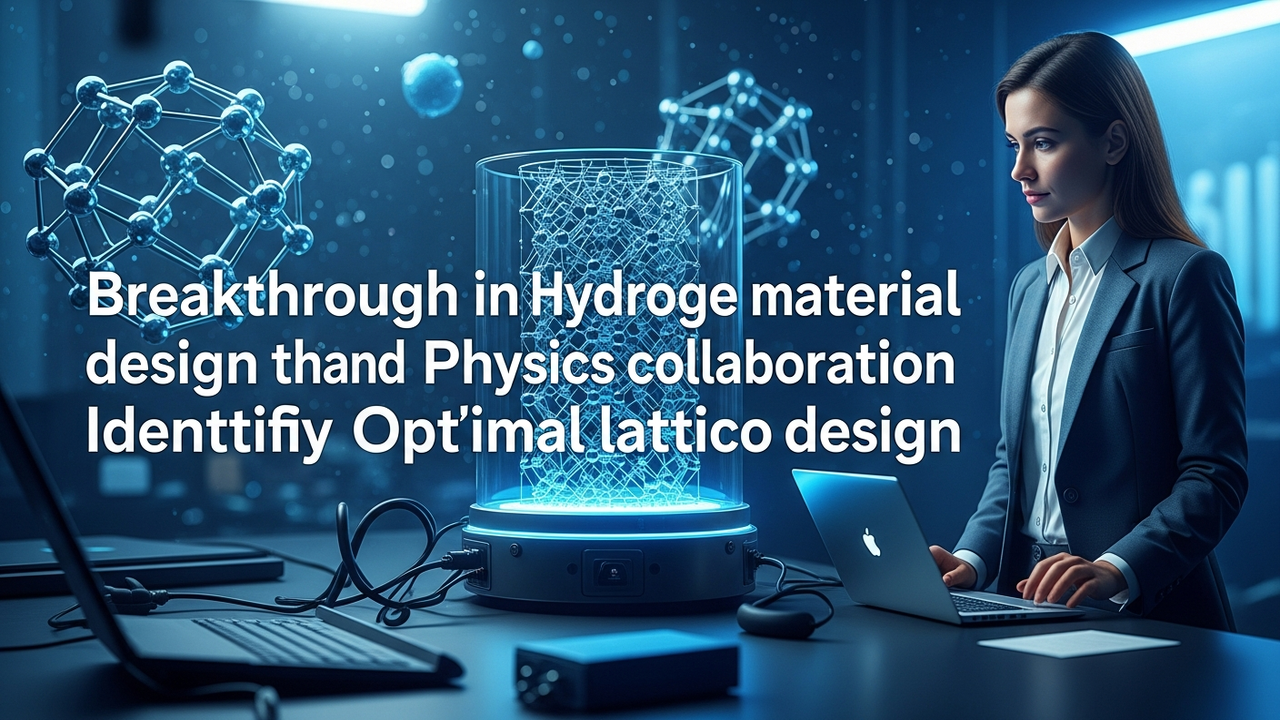
A pioneering interdisciplinary collaboration between Artificial Intelligence (AI) and physics has achieved a significant breakthrough in the design of highly efficient hydrogen storage materials. This research revealed a direct correlation between a material’s hydrogen storage capacity and both the atomic-scale geometry and thermal response properties of its metal lattice. Specifically, materials with an optimal metal atomic radius and a relatively soft lattice structure were shown to maximize both the volume of interstitial sites available for hydrogen occupation and the mobility of hydrogen within the lattice. This crucial insight is set to accelerate the development of next-generation hydrogen storage solutions.
Technical / Clinical Details
Hydrogen is a promising clean energy carrier, but its efficient and safe storage remains a major technical challenge. Previous hydrogen storage material development largely relied on trial-and-error or empirical rules. However, the fusion of AI and physics now enables a more systematic and predictive approach. This research employed the following technical methods:
- Data-Driven AI Models: AI models, trained on vast existing material data (composition, crystal structure, thermodynamic properties, etc.), screen promising material candidates for hydrogen storage and predict their properties. This significantly reduces the exploration space.
- Integration with First-Principles Calculations: AI model predictions are validated by highly accurate first-principles calculations, such as Density Functional Theory (DFT). DFT precisely describes electronic structures and interatomic interactions at the atomic level, ensuring the physical validity of AI-proposed material designs.
- Analysis of Lattice Parameters and Thermal Response: The research team, combining AI and DFT, meticulously analyzed hydrogen absorption/desorption behavior in various metal lattices. This revealed crucial correlations:
- Optimal Atomic Radius: When the radius of metal atoms falls within a specific range, the volume of interstitial sites within the lattice for hydrogen incorporation is maximized, allowing for greater hydrogen storage capacity.
- Soft Lattice Structure: Materials with lower lattice rigidity (relatively soft lattices) enable hydrogen atoms to move more easily within the lattice, leading to faster absorption/desorption rates and improved storage efficiency. This favors dynamic equilibrium in hydrogen storage.
- Thermal Response Properties: The material’s thermal response properties, such as thermal expansion and lattice vibrations, were shown to influence hydrogen stability and mobility. AI learns these complex interactions to predict optimal thermodynamic conditions.
These findings provide atomic-level material design guidelines, directly leading to the development of higher-performance hydrogen storage materials.
Background & Context
Addressing global warming necessitates a rapid shift away from fossil fuels towards renewable energy. Hydrogen energy, a clean fuel that emits no CO2 during combustion, is expected to play a central role in next-generation energy systems. However, storing and transporting hydrogen, which currently requires high-pressure gas or liquefaction, still faces challenges in terms of safety, cost, and energy efficiency. Developing highly efficient solid-state hydrogen storage materials is key to overcoming these challenges and accelerating the widespread adoption of a hydrogen energy society. The fusion of AI and physics offers an unprecedented speed and accuracy in solving this complex materials science problem, attracting significant attention from governments and industries worldwide.
Strategic Significance & Outlook
The design of hydrogen storage materials through AI-physics collaboration will continue to evolve. In the future, AI models are expected to be developed for predicting hydrogen storage behavior in more complex composite materials and under extreme environmental conditions. Furthermore, integration into ‘closed-loop material development’ systems, where AI-proposed material designs are automatically synthesized and evaluated by autonomous experimental systems, will advance. This is predicted to dramatically improve key performance indicators such as hydrogen storage capacity, absorption/desorption rates, cycling stability, and safety, accelerating hydrogen utilization in a wide range of applications, including fuel cell vehicles, stationary fuel cells, and renewable energy storage systems. This technology will play an extremely critical role in the roadmap toward achieving a hydrogen society.
Source: https://bioengineer.org/ai-and-physics-collaborate-to-design-advanced-hydrogen-storage-materials/
Get our weekly technology intelligence — free
Receive an infographic that lets you judge at a glance whether each field’s analysis report is worth reading.
Subscribe Free — Weekly Tech Intelligence
By subscribing, you’ll receive Troy-Technical’s weekly technology intelligence newsletter.
- Your email and selected fields are used only to deliver the newsletter.
- We never share your information with third parties.
- You can unsubscribe anytime via the link in each email.
See our Privacy Policy for details.
Takes about a minute · Unsubscribe anytime