Key Findings
As the slowdown of Moore’s Law becomes increasingly apparent, performance enhancements for artificial intelligence (AI) clusters have become heavily reliant on horizontal scaling (scale-out). This trend has led traditional electrical interconnects to confront physical limitations in terms of bandwidth, latency, and power consumption. Consequently, in 2026, the transition from copper to optical interconnects has established itself as one of the definitive trends in data center construction. Co-packaged optics (CPO), in particular, is a key technology accelerating this transition, dramatically reducing the power consumption of 800G ports from 14-16W in conventional pluggable solutions to a mere 5.2-5.6W, achieving a remarkable power efficiency improvement of 60-68%.
Technical / Clinical Details
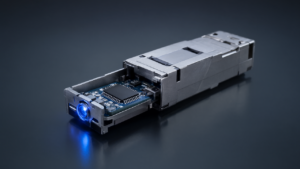
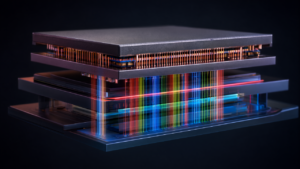
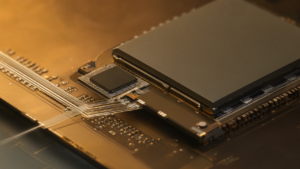
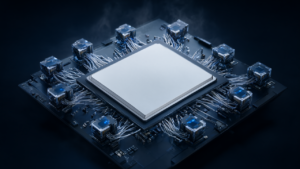
CPO is a technology that integrates the main components of optical transceivers within the same package as switch ASICs or GPU chips. This design allows the optical-to-electrical conversion to occur in extremely close proximity to the chip, thereby minimizing the electrical signal path length and substantially reducing signal loss, latency, and most importantly, power consumption. Compared to traditional pluggable optical modules, CPO shortens the distance that signals travel electrically from several centimeters to just millimeters, resulting in approximately 10W of power savings per 800G port. For large-scale AI data centers with hundreds or thousands of ports, these power savings translate into annual reductions of several megawatts, dramatically cutting operational costs and environmental impact. The proliferation of 1.6T optical modules is a direct consequence of CPO technology’s maturity and its ability to meet the high bandwidth and low power consumption requirements of AI workloads.
Background & Context
The training and inference of AI, especially large language models (LLMs) and generative AI, demand low-latency, high-bandwidth interconnections for thousands to tens of thousands of GPUs. This data movement currently constitutes the primary bottleneck for the overall performance and power efficiency of AI systems. Given that a significant portion of data center power consumption is attributed to cooling and data movement, technologies like CPO are indispensable for the sustainable growth of AI. Major hyperscalers and semiconductor companies are investing heavily in the development and deployment of CPO technology, anticipating it will become the mainstream data center interconnect in the latter half of the 2020s.
Strategic Significance & Outlook
The dramatic improvement in power efficiency offered by CPO will revolutionize the design and operation of AI data centers. The proliferation of 1.6T optical modules will extend the performance and efficiency benefits of CPO across the entire AI infrastructure, enabling the construction of denser, more energy-efficient GPU clusters. The advancement of this technology will not only further enhance AI computational capabilities and enable the creation of new applications but will also significantly contribute to reducing data center operational costs and environmental impact. CPO is poised to become an indispensable element in shaping the future of AI and laying the foundation for next-generation digital infrastructure.
Source: https://www.siplus-semi.com/en/detail/1328.html
Get our weekly technology intelligence — free
Receive an infographic that lets you judge at a glance whether each field’s analysis report is worth reading.
Subscribe Free — Weekly Tech Intelligence
By subscribing, you’ll receive Troy-Technical’s weekly technology intelligence newsletter.
- Your email and selected fields are used only to deliver the newsletter.
- We never share your information with third parties.
- You can unsubscribe anytime via the link in each email.
See our Privacy Policy for details.
Takes about a minute · Unsubscribe anytime