Key Findings
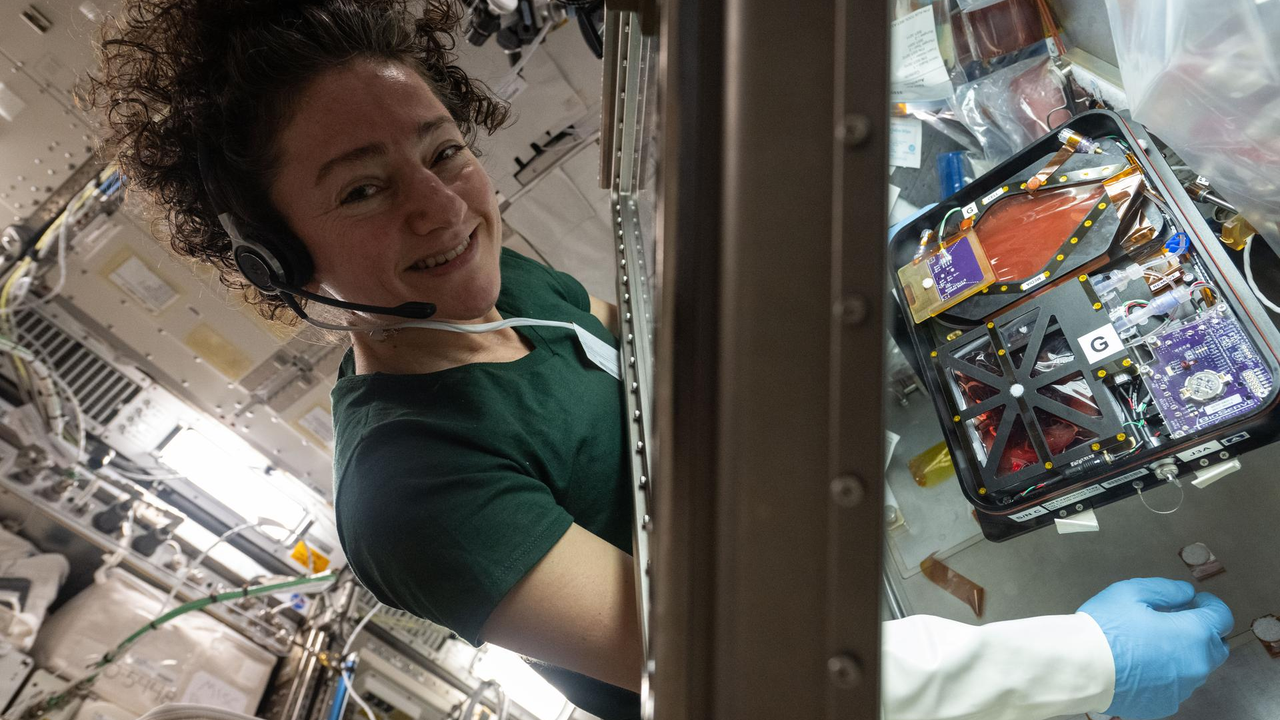
The Expedition 74 crew on the International Space Station (ISS) is focusing this week on two crucial scientific activities: bioengineering for cartilage tissue production and advanced materials manufacturing. Research into cartilage cell growth in a microgravity environment holds the potential for developing innovative treatments for terrestrial diseases such as arthritis and sports injuries. Concurrently, experiments aimed at elucidating how colloidal crystals form 3D structures in microgravity are progressing, which promises to open new avenues in next-generation materials science and technology development.
Technical and Clinical Details
The research into cartilage tissue manufacturing leverages the unique property of microgravity that allows for the formation of uniform, high-quality tissue structures, which are challenging to achieve on Earth. In the absence of gravity, cells float without sedimentation, making it easier for them to construct more natural, three-dimensional structures. This is expected to lead to the development of self-healing implants for repairing damaged articular cartilage and more effective regenerative medicine approaches. In the colloidal crystal 3D structure formation experiment, researchers meticulously observe how particle interactions and arrangements in microgravity produce materials with specific physical properties. These insights could be applied to the development of advanced materials such such as new photonic crystals, smart materials, or superconductors. The crew operates cells and particles within specialized microgravity experiment facilities, recording their growth and structural changes with high-resolution cameras.
Background and Industry Context
In-space manufacturing is gaining global attention as a new frontier for overcoming limitations faced by terrestrial industries. The microgravity environment offers unique advantages due to the absence of convection and sedimentation effects, benefiting drug crystallization, semiconductor manufacturing, optical fiber production, and biological tissue engineering. NASA has long utilized the ISS as an ‘orbital laboratory’ for life and materials sciences, and in recent years, private companies like Redwire and Varda Space Industries have also entered this field, driving commercial in-space manufacturing. Cartilage research holds dual value: its significance in space medicine for astronaut health (addressing bone and joint degradation during long missions) and its direct medical applications for patients on Earth.
Strategic Significance and Outlook
The outcomes of these in-space manufacturing experiments on the ISS will have immeasurable impacts on medicine and industry on Earth. Advancements in cartilage tissue manufacturing technology could offer new treatment options for patients suffering from chronic conditions like arthritis, thereby improving their quality of life. Research into advanced materials manufacturing may accelerate the development of higher-performance and more durable products, potentially revolutionizing various industries such as electronics, aerospace, and energy. These space-derived technologies are ultimately expected to complement and enhance terrestrial manufacturing processes, contributing to humanity’s technological progress and welfare. Space is evolving from merely a site for exploration to a ‘production hub’ shaping the future of Earth.
Get our weekly technology intelligence — free
Receive an infographic that lets you judge at a glance whether each field’s analysis report is worth reading.
Subscribe Free — Weekly Tech Intelligence
By subscribing, you’ll receive Troy-Technical’s weekly technology intelligence newsletter.
- Your email and selected fields are used only to deliver the newsletter.
- We never share your information with third parties.
- You can unsubscribe anytime via the link in each email.
See our Privacy Policy for details.
Takes about a minute · Unsubscribe anytime