Key Findings
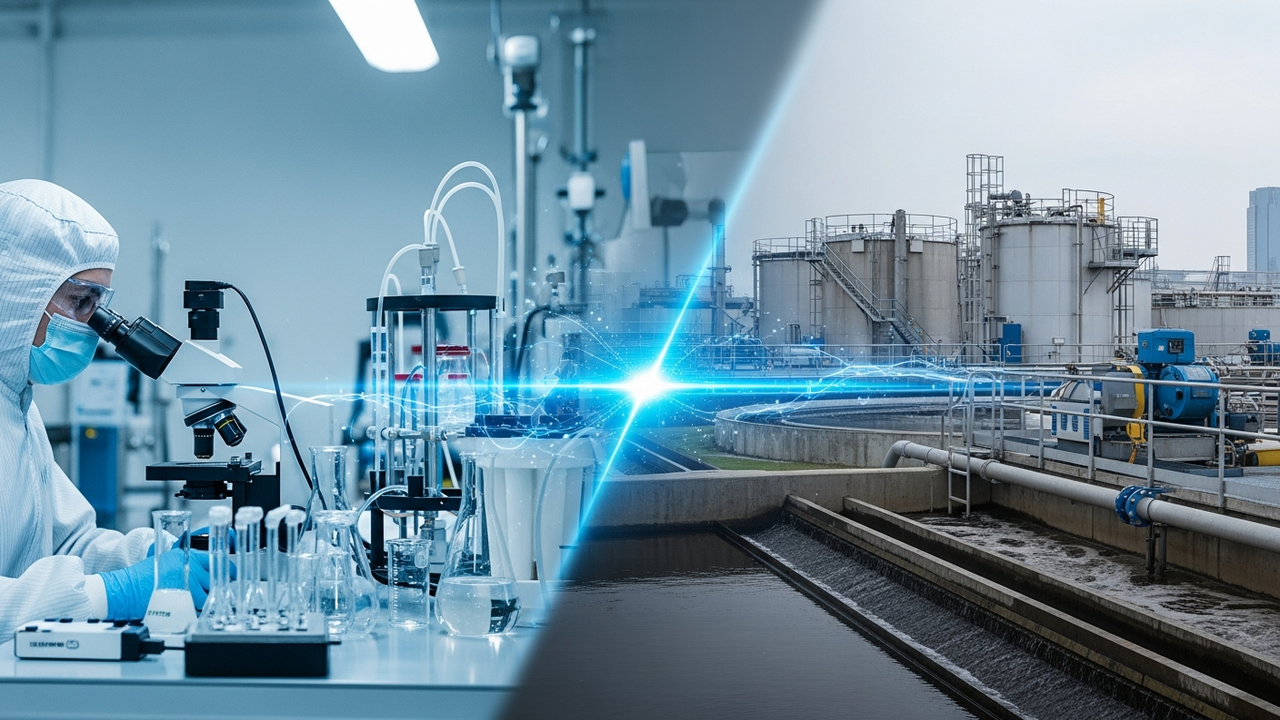
An article published in MDPI clearly identifies the significant challenge of the ‘lab–reality gap’ in the practical application of nanomaterial-based wastewater treatment technologies, where high performance observed in laboratory settings often fails to translate to real-world conditions. To overcome this, the article advocates for a fundamental integration of nanoscale phenomena with biological and physicochemical processes, rather than simply adding nanomaterials to existing systems, as an essential approach for developing sustainable and efficient wastewater treatment.
Technical / Clinical Details
At the laboratory scale, various nanomaterials—such as nano-adsorbents, photocatalytic nanoparticles, and nanofiltration membranes—have demonstrated high removal efficiencies for diverse wastewater contaminants including heavy metals, organic pollutants, and pathogens. However, actual wastewater possesses complex compositions, encompassing various dissolved substances, suspended particles, and microbial communities (matrix interferences). This complexity often leads to significant performance degradation and reduced longevity of nanomaterials due to surface fouling or aggregation. The article argues that preventing such real-world performance decline necessitates a comprehensive understanding of how nanomaterials function within the overall system, considering operational conditions like wastewater composition, flow rates, temperature, and pH from the design stage. Examples include hybrid systems combining biological treatment with nanofiltration membranes, or the development of bioreactors with immobilized nanomaterials.
Background & Context
Global water scarcity and escalating water pollution have dramatically increased the demand for effective and sustainable wastewater treatment technologies. Nanotechnology has garnered considerable attention as a next-generation solution due to the high surface area, unique reactivity, and selectivity of nanomaterials. However, past research and development have predominantly focused on improving the performance of individual nanomaterials, often neglecting system-level challenges critical for practical implementation. Industries and government bodies, driven by stricter environmental regulations and Sustainable Development Goals (SDGs), are urgently seeking cost-effective and robust wastewater treatment solutions, making the commercialization of nanomaterials a pressing concern.
Strategic Significance & Outlook
The article suggests that the future of nanomaterial-based wastewater treatment technologies requires a paradigm shift from individual material development to the design of multifunctional integrated systems. Interdisciplinary collaboration across materials science, chemical engineering, and biology will be crucial. Deepening the understanding of nanomaterials’ environmental behavior (safety, long-term stability) is also vital. Through such system-integrated research and development, nanotechnology holds the potential to offer truly innovative solutions for treating various types of wastewater, including municipal, industrial, and agricultural effluents, thereby making a substantial contribution to resolving global water challenges.
Source: https://www.mdpi.com/2073-4441/18/13/1551
Get our weekly technology intelligence — free
Receive an infographic that lets you judge at a glance whether each field’s analysis report is worth reading.
Subscribe Free — Weekly Tech Intelligence
By subscribing, you’ll receive Troy-Technical’s weekly technology intelligence newsletter.
- Your email and selected fields are used only to deliver the newsletter.
- We never share your information with third parties.
- You can unsubscribe anytime via the link in each email.
See our Privacy Policy for details.
Takes about a minute · Unsubscribe anytime