Background
Traditional robots are composed of rigid components, making flexible manipulation in complex environments and safe interaction with humans challenging. In contrast, “soft robots,” which deform flexibly like natural organisms such as octopuses or elephant trunks, are expected to open new possibilities in various fields including medicine, exploration, and manufacturing. To realize soft robots, “soft actuators” that change shape in response to external stimuli like temperature, light, or electricity are indispensable. While 3D printing technology is a powerful tool for precisely fabricating complex soft actuators, a key challenge has been the development of materials and manufacturing methods that can precisely control complex 3D shape changes with a single stimulus.
Key Findings / Results
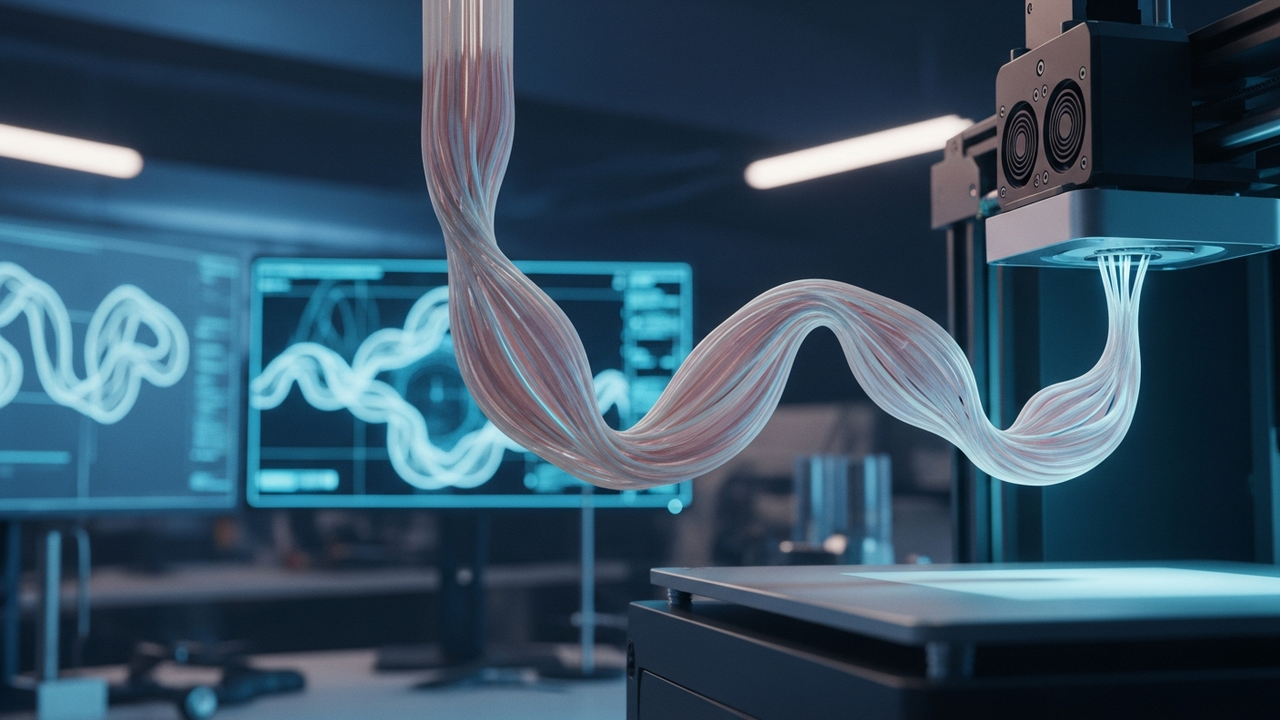
Addressing this challenge, a research team at Harvard University, led by Professor Jennifer Lewis, successfully fabricated artificial muscle-like filaments by applying their groundbreaking “Rotational Multimaterial 3D Printing (RM-3DP)” technology. The core of this innovative approach lies in:
- Integration of Liquid Crystal Elastomers (LCEs) and Passive Elastomers: This technology combines two materials with different properties: liquid crystal elastomers (LCEs), which contract in response to temperature changes, and passive elastomers, which maintain their shape and provide mechanical guidance.
- Precise Molecular Alignment Control via RM-3DP: The RM-3DP technique enables the precise programming of LCE molecular alignment within the filament during 3D printing by rotating the nozzle as material is extruded. This allows the filament to execute complex, pre-designed 3D shape changes, such as bending, twisting, and stretching, in response to thermal stimuli. This molecular-level alignment control is key to complex macroscopic movements.
- Exceptional Durability and Stability: The developed filaments demonstrated high durability, showing no degradation or interfacial delamination after 100 thermal cycles within a broad temperature range of 25°C to 175°C. This robustness is critically important for practical applications.
This technology significantly enhances the complexity and reliability of soft actuators produced in laboratories.
Technical Significance & Outlook
Harvard’s research findings hold the potential to revolutionize the field of soft robotics. These artificial muscle-like filaments are expected to have a wide range of applications, including:
- Soft Robotics: Enabling flexible and safe robot hands, compliant grippers, or robots that can adapt and move in diverse environments. This facilitates human-robot collaboration, handling of delicate objects, and exploration in confined spaces.
- Biomedical Devices: Bio-compatible and tissue-friendly shape-changing devices such as catheters for minimally invasive surgery, prosthetics, drug delivery systems, and wearable rehabilitation devices.
- Active Filters and Valves: Autonomous fluid control systems like smart filters and valves that open and close in response to temperature changes.
This technology accelerates the transition of artificial muscle-like materials from laboratory concepts to functional real-world technologies. Future challenges include establishing large-scale, cost-effective manufacturing processes for these filaments, evaluating long-term performance in more complex environments (e.g., underwater or under high loads), and integrating other smart materials for multi-functional capabilities that respond to multiple stimuli. This research, merging functional materials and 3D printing, opens new frontiers in future engineering.