Background
With the rapid development of information and communication technologies, particularly the proliferation of 5G/6G communication systems and high-frequency electronic devices, electromagnetic interference (EMI) in the terahertz (THz) frequency range is becoming a serious concern. Electromagnetic shielding is indispensable for preventing electronic device malfunction and ensuring data security. However, conventional electromagnetic shielding materials often suffer from challenges such as high density, heavy weight, and poor processability. There is a strong demand for next-generation EMI shielding materials that are lightweight, offer high shielding performance, and can be fabricated into complex shapes. Bio-inspired design, drawing cues from nature’s efficient structures, holds the potential to address these challenges.
Key Findings / Results
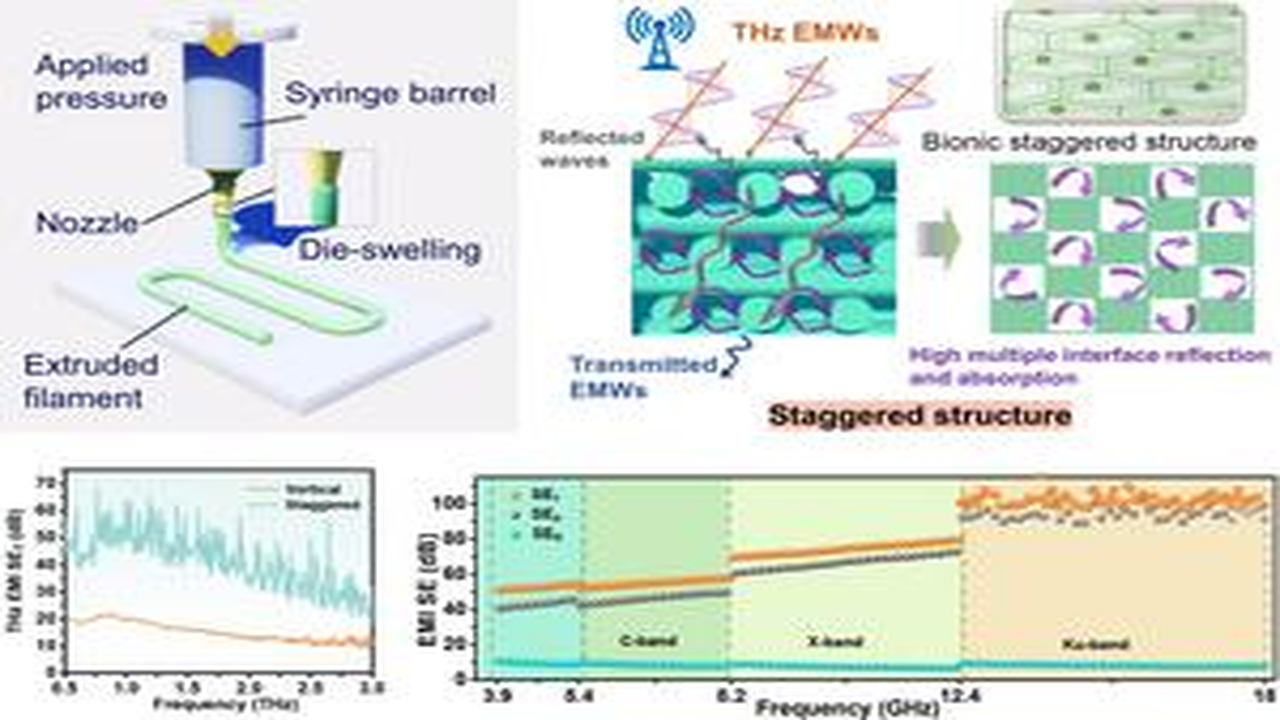
A research team from Beijing Forestry University has successfully developed 3D-printed aerogel frameworks with bio-inspired staggered cellular structures, achieving significant enhancement in terahertz electromagnetic shielding performance. The core of this innovative material and manufacturing technology is as follows:
- MXene/Cellulose Nanofibril (CNF) Composite Material: As the skeletal material for the aerogel, a composite of highly electrically conductive 2D MXene and lightweight yet mechanically strong cellulose nanofibrils (CNF) was utilized. MXene provides excellent electromagnetic wave absorption and reflection properties, while CNF enhances the structural stability of the aerogel.
- Direct Ink Writing (DIW) 3D Printing: Direct Ink Writing (DIW) 3D printing technology was employed to precisely fabricate complex bio-inspired structures. This method allows for the accurate formation of multilayer staggered cellular aerogel structures. By optimizing the rheological properties of the ink, high-resolution and stable printing is achieved.
- Bio-Inspired Staggered Cellular Structure: The structure is inspired by efficient multilayer staggered patterns found in nature. This unique architecture induces multiple reflections and scattering as electromagnetic waves pass through the material, maximizing both electromagnetic wave absorption and reflection.
- Exceptional Electromagnetic Shielding Performance: The developed 3D-printed aerogel framework demonstrated high reflection loss, absorption, and outstanding Shielding Effectiveness (SE) in the terahertz frequency band. The SE values meet the requirements for applications demanding high EMI shielding. The key to this performance enhancement lies in the multi-level structural design, where nanoscale MXene sheets form a mesh structure, and micro-scale staggered cellular structures optimize macroscopic electromagnetic interactions.
This research has been published in the prestigious academic journal “Nano Research,” receiving international recognition for its scientific value.
Technical Significance & Outlook
This 3D-printed bio-inspired aerogel framework holds the potential to revolutionize various fields as an advanced electromagnetic shielding material in the terahertz frequency range. Specific application areas include:
- 5G/6G Communication Equipment: Contributing to the suppression of electromagnetic interference in high-frequency communication devices and enabling miniaturization and weight reduction.
- High-Speed Electronic Devices: Protection of next-generation electronic devices requiring precise electromagnetic wave control, such as quantum computing devices, high-frequency radar, and terahertz imaging systems.
- Aerospace Sector: Lightweight and high-performance shielding materials are indispensable for EMI countermeasures in electronic equipment for satellites, aircraft, and spacecraft.
This technology aligns with three major trends in electromagnetic shielding: “lightweighting,” “thinning,” and “high-performance,” offering a new paradigm for the design of sustainable, high-functional materials. Future challenges include scaling up the manufacturing process and optimizing cost-effectiveness, evaluating long-term stability under various environmental conditions (e.g., high temperature, high humidity), and further multi-functionalization (e.g., integration with thermal management capabilities). This research, through the fusion of functional materials, 3D printing, and bio-inspired design, will serve as a foundational technology for the future information society and environmental technologies.