Key Findings
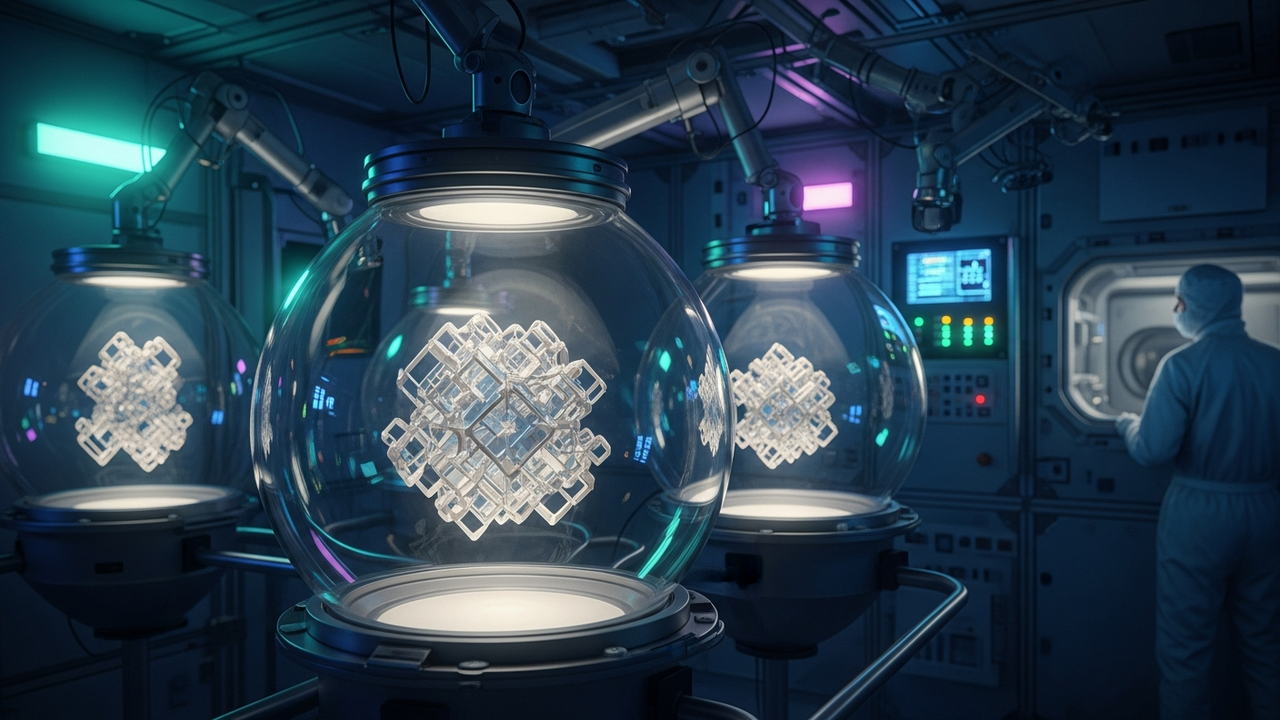
Protein crystallization under microgravity conditions is emerging as a significant breakthrough in pharmaceutical development, holding immense promise particularly for enhancing therapeutic proteins such as insulin. Experiments conducted on the International Space Station (ISS) have repeatedly shown that protein crystals grown in microgravity are larger, more perfect, and possess a more ordered structure compared to those grown on Earth.
Technical and Research Details
Protein crystallization is a critical process for determining the three-dimensional structure of proteins through X-ray crystallography. This structural information is paramount for designing new drugs and elucidating the mechanisms of action for existing medications.
- Microgravity Effects: On Earth, gravity and convection can introduce impurities and lead to the formation of imperfect or uneven crystals in protein solutions. In a microgravity environment, these factors are largely eliminated, allowing crystals to grow more slowly, under more controlled conditions, resulting in larger, higher-quality, and more defect-free structures.
- Quality Improvement: ISS experiments have demonstrated that a wide variety of proteins, including insulin, yield crystals with an average volume more than double that of Earth-grown crystals and significantly improved internal structural order. Such high-quality crystals provide higher-resolution X-ray diffraction data, enabling more precise elucidation of protein structures at the atomic level.
- Application Areas:
- Diabetes Therapeutics: More accurate structural information for insulin can optimize its stability, solubility, and pharmacokinetics within the body, leading to the development of more effective diabetes treatments with fewer side effects.
- Therapeutic Proteins and Enzymes: Applicable to structural analysis of other therapeutic proteins and enzymes, such as those used in cancer treatments and autoimmune diseases, accelerating the development of novel biopharmaceuticals.
- Vaccine Research: By applying this to the structural analysis of viral and bacterial proteins, it could contribute to the development of more effective vaccines and antiviral drugs.
Background and Industry Context
In the early stages of drug discovery, a precise understanding of target protein structures is often a bottleneck. Generating high-quality protein crystals is key to overcoming this. For decades, space-based protein crystallization research has been actively pursued by space agencies such as NASA, JAXA (Japan), and ESA (Europe). In recent years, private companies like Varda Space Industries and Redwire have accelerated investments in commercializing space-based pharmaceutical manufacturing, heightening expectations for industrial applications in this field.
Strategic Significance and Outlook
Advances in microgravity protein crystallization technology are poised to not only improve the efficiency and success rates of drug development but also potentially lead to entirely new therapeutic approaches. As the UK has established a regulatory pathway for space-manufactured medicines, regulatory bodies worldwide are beginning to adapt to this developing field. In the future, in-orbit pharmaceutical manufacturing could complement terrestrial production processes, establishing a competitive advantage in specific niche markets. This is expected to accelerate drug discovery, foster the development of treatments for rare diseases, and ultimately provide better patient care. This technology will be a major driver of growth in the biotechnology sector of the space economy.
Get our weekly technology intelligence — free
Receive an infographic that lets you judge at a glance whether each field’s analysis report is worth reading.
Subscribe Free — Weekly Tech Intelligence
By subscribing, you’ll receive Troy-Technical’s weekly technology intelligence newsletter.
- Your email and selected fields are used only to deliver the newsletter.
- We never share your information with third parties.
- You can unsubscribe anytime via the link in each email.
See our Privacy Policy for details.
Takes about a minute · Unsubscribe anytime